
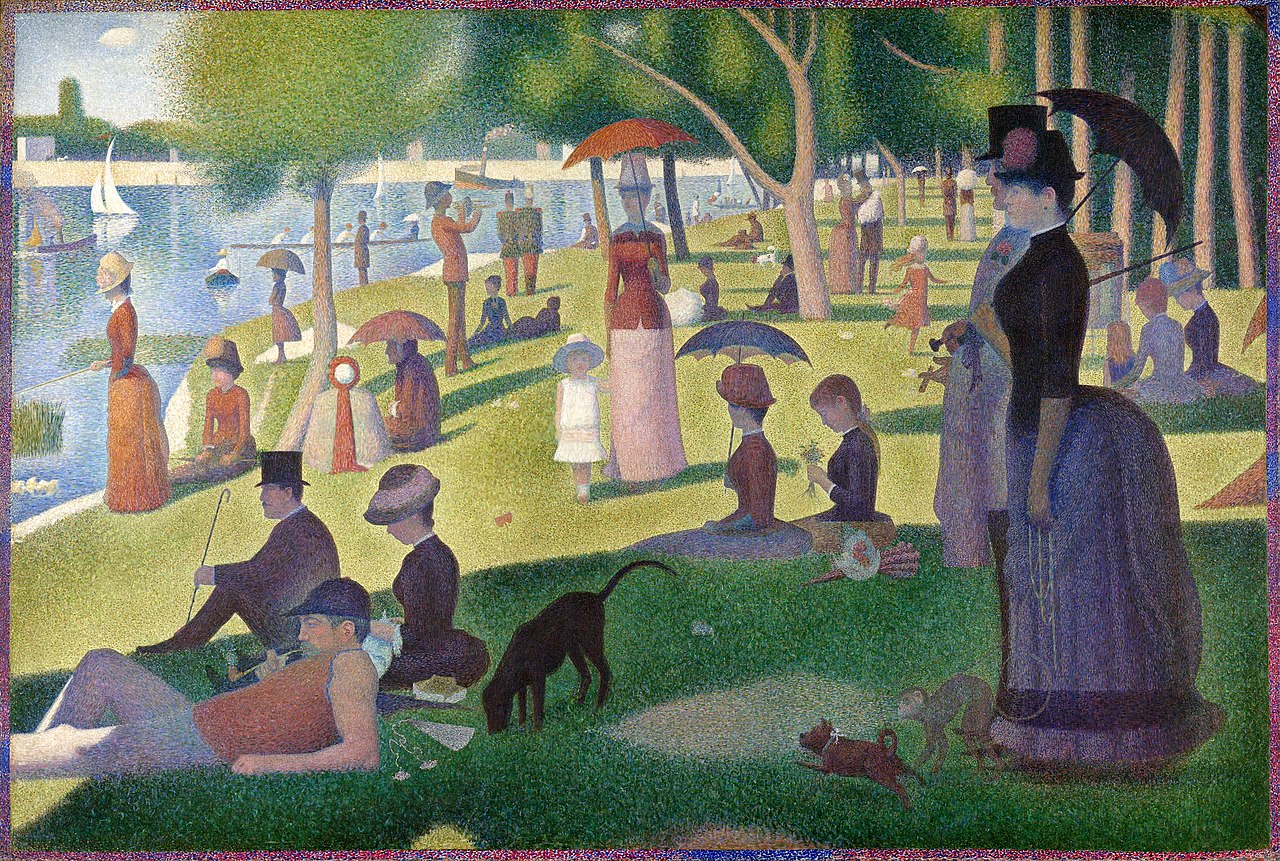
A Sunday Afternoon on the Island of La Grande Jatte by Georges Seurat has secured its place as one of the most recognized and beloved works of art in history.
Created over two years from 1884 to 1886, the painting is an arresting spectacle, with its intricate, colorful, and meticulous detail, a testament to Seurat's incredible dedication and skill. This masterpiece is not just another landscape painting; it represents a revolutionary moment in the history of art, which sparked an entirely new style: pointillism.
The Birth of a Masterpiece
Born in Paris in 1859, Georges Seurat demonstrated an artistic talent from a young age. His professional debut came in 1883 at the Salon des Artistes Français. However, it was in the following years, as he worked on La Grande Jatte, that he would take his place as a revolutionary artist.
La Grande Jatte was a fashionable retreat for Parisians seeking respite from city life, an island in the Seine near Neuilly. To capture its bustling energy, Seurat executed numerous preparatory drawings and oil sketches. The final composition, a massive canvas measuring 81.7 x 121.25 inches, came to life in his studio. The painting depicts a variety of characters: from elegantly dressed bourgeoisie to laborers, each engaged in their leisure activities in a bright, sunlit park.
Pointillism: A New Style
La Grande Jatte was pivotal as it marked the birth of pointillism, a technique Seurat derived from the scientific theories of color perception of his time. Instead of mixing pigments on the palette, Seurat placed tiny, precise dots of pure color side by side on the canvas. When viewed from a distance, these dots optically blend in the viewer's eye, producing luminous and complex color effects.
The impact of this method was revolutionary, leading to the development of Neo-Impressionism, a movement that emphasized the scientific application of color theory. Seurat's pointillist method was not just innovative but deeply analytical, aiming to bring a sense of order and structure to the spontaneous brushwork of the Impressionists.
The Painting's Journey and Significance
After its completion, A Sunday Afternoon on the Island of La Grande Jatte was exhibited at the last Impressionist exhibition in May 1886, causing a sensation. Today, the painting calls the Art Institute of Chicago its home, where it has resided since 1926. There, it continues to mesmerize millions of visitors every year, with its play of light and color and the quiet stillness of its scene, despite its bustling subject matter.
The painting's popularity transcends the traditional art world. It has been featured in various mediums of pop culture, including the musical "Sunday in the Park with George" by Stephen Sondheim, and even made a cameo in the film "Ferris Bueller's Day Off."
Conclusion
In essence, A Sunday Afternoon on the Island of La Grande Jatte is not just a painting; it's a moment in time, a vision of a world that's both distant yet familiar, beautiful, and serene. It represents a technical feat that transformed the art landscape. As Seurat's dots coalesce into a unified image, we are reminded of our own interconnectedness, the blending of individuals into a society, a fitting metaphor that underlines the painting's lasting relevance.
