
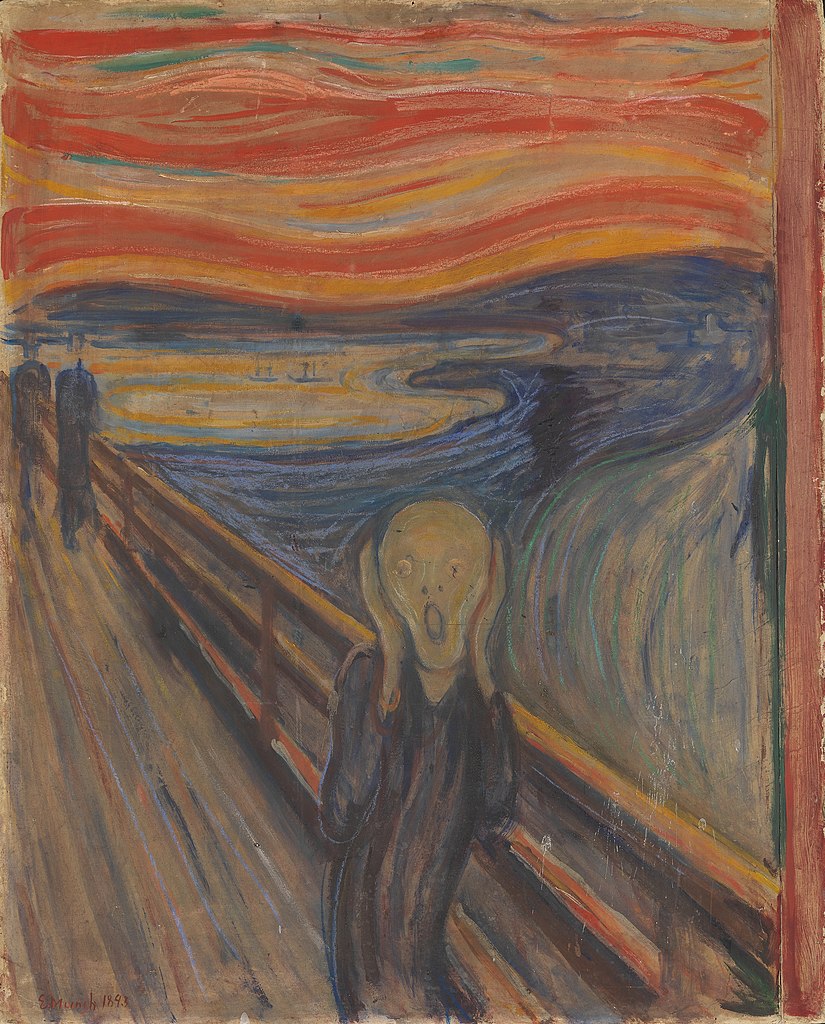
Edvard Munch's "The Scream" is often considered one of the most iconic images in the history of art, a visual manifestation of existential dread and despair that resonates across time.
It is a masterpiece that encapsulates and transcends its era, evoking emotions that resonate with audiences even in the contemporary world.
A Brief History
"The Scream" was created in 1893 as part of Munch's "The Frieze of Life" series, a thematic grouping of works centred on life, love, fear, death, and melancholy. The series was the artist's ambitious attempt to explore the human condition and emotional life. The inspiration for "The Scream" is traced back to Munch's personal experiences. As Munch once explained, he was out walking at sunset when he felt an immense sense of despair, a feeling that he aimed to reproduce in his painting.
The Cities where it is Presented
Multiple versions of "The Scream" were created by Munch, both in the form of paintings and pastels. The two most renowned painted versions are held in Norway. The National Gallery in Oslo houses the first painted version. The second, arguably more well-known due to its colorful past involving thefts and subsequent recoveries, is part of the collection at the Munch Museum, also in Oslo.
Why it is Famous
"The Scream" is a masterpiece that distills intense, raw emotion into a single, universally recognizable image. The expressive use of color and lines manifests a profound sense of anxiety and fear, making it resonate with audiences globally.
Its fame is not just due to its emotive power; "The Scream" has also been subjected to high-profile art thefts, further increasing its notoriety. The versions at the National Gallery and the Munch Museum were stolen in 1994 and 2004 respectively, with both subsequently recovered.
Artistic Style and Movement
Munch's style in "The Scream" is characteristic of the Symbolist movement, a genre that sought to express the emotional and symbolic aspects of human experience rather than the physical reality. It is also often associated with Expressionism due to its emphasis on individual perspective and emotion.
The painting is renowned for its innovative use of color and form to convey emotion. Munch uses a non-naturalistic palette to create an atmosphere of otherworldly despair, while his distorted, almost skeletal representation of the figure embodies psychological distress.
In conclusion, Edvard Munch's "The Scream" stands as an enduring symbol of human anxiety. Its unique combination of personal expression, innovative technique, and cultural resonance secure its position as one of the greatest paintings of all time. As we continue to explore and seek understanding in our human condition, "The Scream" will inevitably remain a vital touchstone, reverberating with our collective consciousness.
