
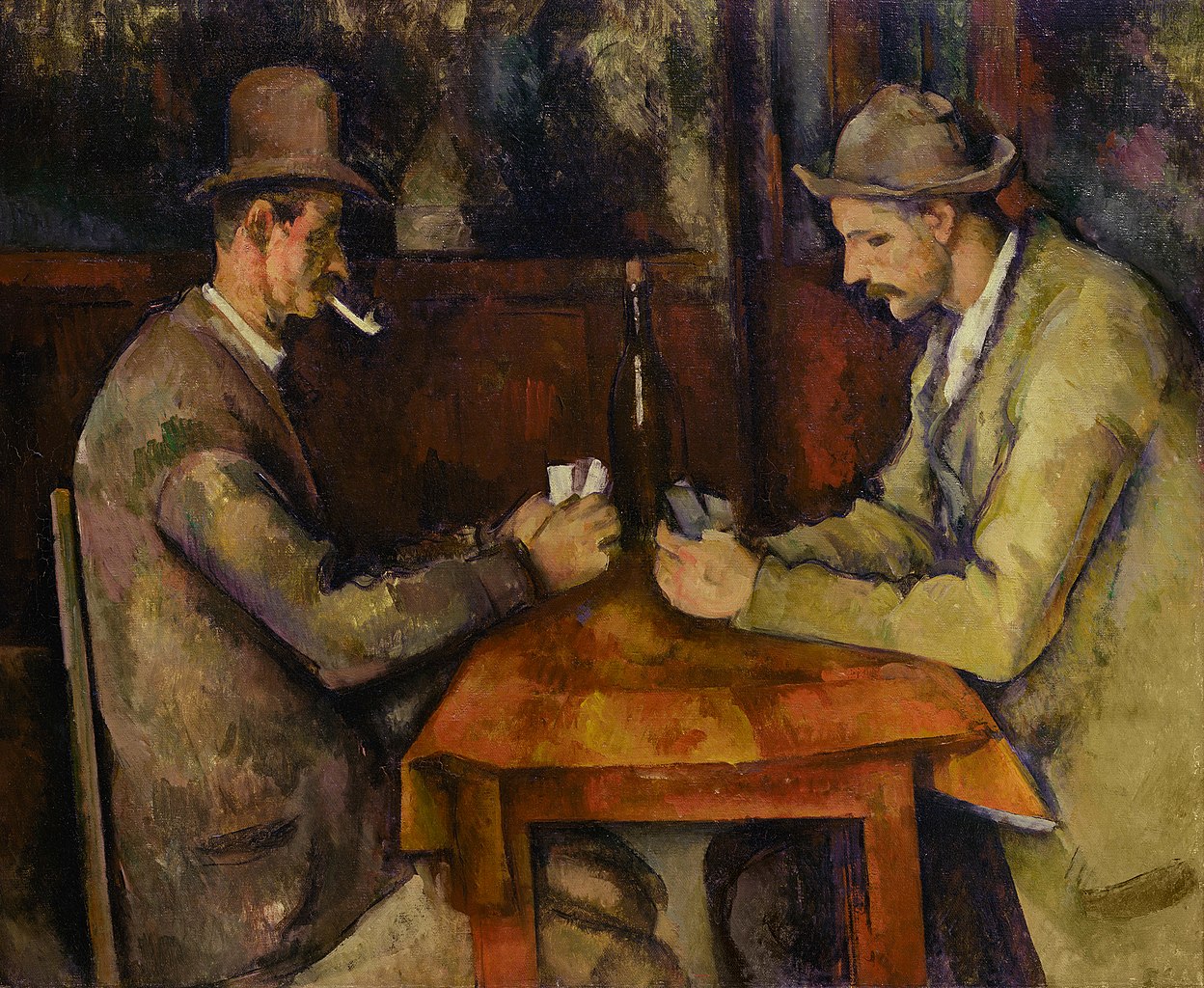
An integral part of the pantheon of renowned art masterpieces, Paul Cézanne's 'The Card Players Series' speaks volumes about the painter's ingenuity,
revolutionary approach to art, and the profound influence he had on the realm of modern painting.
A Glance into History:
The Card Players series, a collection of five oil paintings, was created by Cézanne in the early 1890s during his mature period. Each composition varies in size, the number of players, and the setting of the card game. While the largest composition consists of five figures – four players engaged in a game and a spectator – the smaller versions focus on two card players in opposition.
Interestingly, the subjects of these paintings were not aristocrats or distinguished guests, but rather local farmhands in his native Provence, France. Cézanne had a profound interest in depicting peasants in their everyday environment, adding a distinctly human and grounded touch to his work. This focus deviates from the typical historical, mythological, and religious subjects often portrayed during that period, marking a notable shift in the art world.
Where Are They Now?
The five paintings are currently held in various renowned art collections around the globe. The version with five figures is displayed in the Musée d'Orsay, Paris, France. The two smaller versions, both depicting two players, reside in the Courtauld Institute of Art in London, UK, and The Metropolitan Museum of Art in New York City, US. The remaining two paintings, each of three figures (two players and a spectator), belong to the collections of the Barnes Foundation in Philadelphia, US, and the private Royal Family Collection in Qatar.
Why Are They Famous?
The Card Players stand as emblematic pieces of Cézanne's innovative approach to art. Cézanne was known for his unique way of rendering the world in terms of geometric shapes, exploring form and color rather than attempting to mirror reality exactly. These paintings demonstrate his departure from the use of perspective and his emphasis on the exploration of volume and structure.
Additionally, these works were revolutionary in their portrayal of ordinary people engaged in a commonplace activity, contrasting the then-popular themes of grandiosity or drama. The series is celebrated for its somber ambiance, concentration, and monumentality, proving Cézanne's knack for capturing the profundity in everyday life.
Artistic Movement:
Cézanne is often referred to as the 'father of modern art,' with his work straddling the line between the late 19th-century Impressionist movement and the early 20th-century Cubist movement. His style in The Card Players series reflects this – while the vibrant, yet muted color palette and visible brushwork are reminiscent of Impressionism, the emphasis on geometric forms foreshadows the rise of Cubism.
Cézanne's style was a departure from the conventional painting norms of his time, making him a key player in paving the path for future avant-garde art movements. His profound influence is evident in the work of subsequent artists, including Picasso and Matisse, who referred to Cézanne as "the father of us all."
In conclusion, Paul Cézanne's 'The Card Players Series' serves as an icon of a seismic shift in art, marking the transition from the 19th to the 20th century. This series is not just a collection of paintings but a testament to Cézanne's revolutionary approach to art, embodying the mundane yet monumental essence of human life.
