
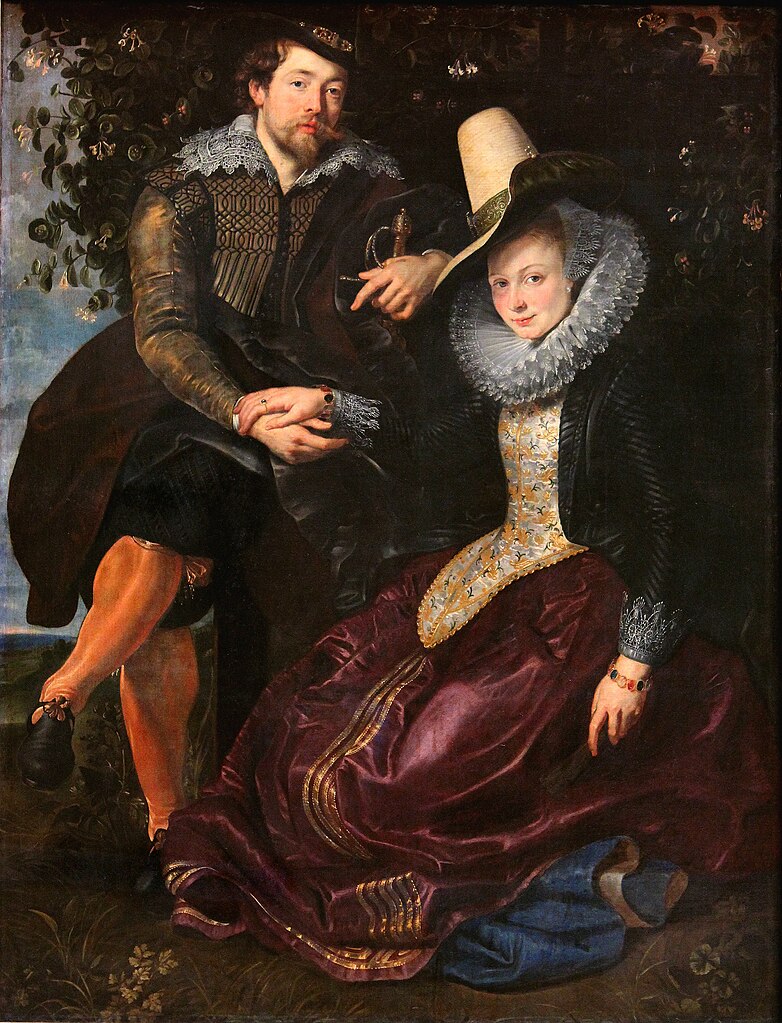
Peter Paul Rubens, a prominent figure in the Baroque art movement, is known for his bold, opulent, and dynamic style.
His canvas often bustles with vivid colors and dramatic, almost theatrical, narratives. One of his best-known works, "The Honeysuckle Bower," is a testament to his prodigious talent and an embodiment of the Baroque style.
A Glimpse into the Canvas
"The Honeysuckle Bower" is an intimately serene portrait featuring Rubens and his first wife, Isabella Brant, ensconced in a honeysuckle bower, symbolizing marital fidelity and eternal love. Painted in 1609-1610, the artwork blends formal portraitures with elements of landscape painting, which was relatively novel during that time.
At the heart of this painting is the palpable affection between Rubens and Brant. Their hands gently clasped, their eyes locked, the couple epitomizes youthful love and tranquility. Rubens, in his fashion-forward slashed doublet and elaborate feathered hat, oozes a calm yet self-assured masculinity. In contrast, Brant, adorned in a stylish millstone ruff and jewel-encrusted dress, embodies feminine grace and elegance.
The Journey of the Painting
Originally kept in Rubens's personal collection, "The Honeysuckle Bower" had an intriguing journey before it found its permanent home. Post the artist's death in 1640, the painting remained in his family's possession until 1794, when French revolutionaries seized it. It then ended up in Paris and was displayed in the Musée Napoléon for a decade.
After the fall of Napoleon, the painting was returned to Rubens's descendants in Antwerp. It was then sold to the royal collection of King William II of the Netherlands. It was purchased by the city of Antwerp in 1816 and is currently displayed in the Rubenshuis museum, located in the former home and studio of Rubens himself.
The Artistic Allure
"The Honeysuckle Bower," despite its personal nature, embodies many of the elements that made Rubens's works popular. It blends the vivid and flamboyant color palette of the Baroque style with a captivating storytelling, adding an emotional depth that resonates with the viewers.
Unlike his usual dramatic religious and mythological themes, this painting offers a more intimate and serene narrative. The dynamism typical of Baroque art is replaced with a peaceful setting, which allows the love between Rubens and Brant to take center stage.
The Baroque Movement
The Baroque art movement, spanning from the late 16th century to the mid-18th century, was characterized by its grandiosity, vivid realism, and dramatic use of light and shadow (chiaroscuro). It sought to captivate the viewer and stir deep emotional responses, often with theatrical intensity.
"The Honeysuckle Bower," while somewhat atypical of the Baroque style's grand narratives and religious themes, showcases Rubens's mastery of the genre. The intricate details, the play of light and shadow, and the emotional depth in the painting are all hallmarks of the Baroque style.
In conclusion, "The Honeysuckle Bower" is not just a visual treat but a testament to Rubens's artistic prowess and personal life. It is a unique piece that intertwines the artist's passion for painting with his affection for his wife, etching an indelible mark on the canvas of Baroque art history.
