
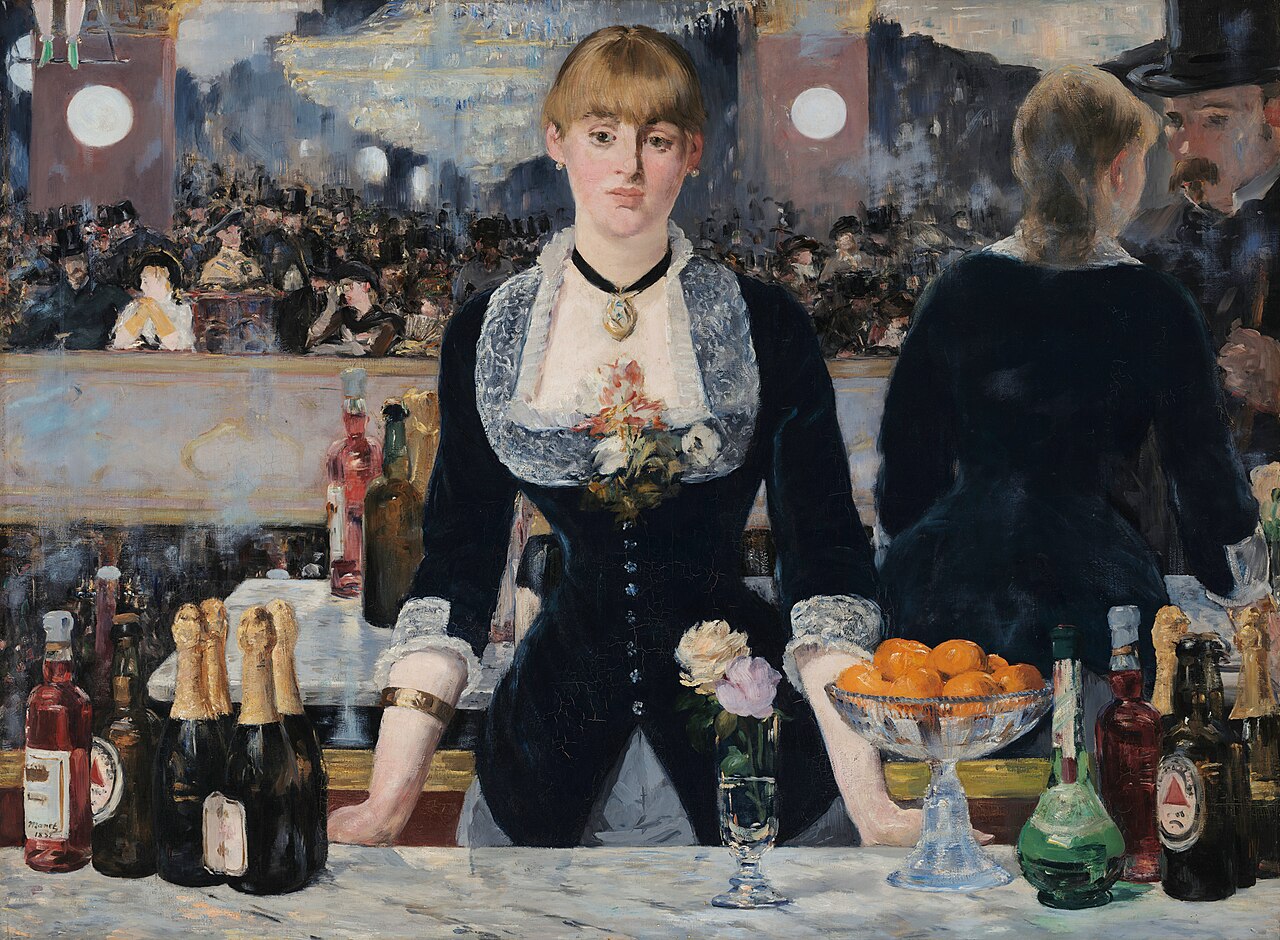
An emblem of fin-de-siècle Paris, Édouard Manet's A Bar at the Folies-Bergère continues to bewitch art enthusiasts with its enigmatic charm and intricate play of perspectives.
Steeped in an alluring blend of reality and illusion, this painting, crafted in 1882, is a striking symbol of the artistic innovation that defined the 19th century.
The Origins of the Painting
In the heart of Paris, in a bustling entertainment venue known as the Folies-Bergère, the seeds for one of Manet's most famed works were sown. An establishment known for its vivid mix of concerts, ballets, and circus acts, the Folies-Bergère was a haunt for both the city's bourgeoisie and its working class. Manet's depiction of a solitary barmaid amid the effervescent clamor of the locale provides a tantalizing glimpse into Parisian nightlife of the era.
The barmaid in question, Suzon, was a real employee at the Folies-Bergère. Manet often visited the venue and sketched her in his studio, instead of the noisy bar, cultivating a sense of detachment that pervades the painting.
The Journey Around the World
Following its unveiling at the Paris Salon in 1882, the painting incited a storm of controversy, with critics deeming it crude and provocative. Despite these early contentions, A Bar at the Folies-Bergère has since been celebrated for its avant-garde approach and has traveled far from its Parisian roots.
After Manet's death, the painting was bought by composer Emmanuel Chabrier, a friend of the artist, who hung it over his piano. It then traversed the Atlantic, landing in the United States as part of Louisine Havemeyer's renowned collection. The painting returned to Europe in 1923 and was finally sold to Samuel Courtauld. Today, it is displayed proudly in London's Courtauld Gallery.
The Notoriety of the Painting
This painting is renowned for its innovative use of perspective, flaunting conventions of the time. The composition captures a mirror behind the barmaid reflecting the vibrant activity of the venue, an intriguing mise en abyme that deepens the complexity of the scene.
However, it's the mirror's reflection that has sparked endless debates among art scholars. It seems to disregard the laws of physics, presenting an alternative viewpoint of the barmaid and her customer. This paradoxical perspective adds an element of tension and mystery, serving as a poignant commentary on the duality of existence in an increasingly modern world.
Style and Influence
A Bar at the Folies-Bergère is the final major work of Manet and is considered an important bridge between Realism and Impressionism, two major movements in 19th-century art. Manet rejected the Romanticism of his predecessors and instead embraced contemporary subject matter and a more direct, loose brushwork that challenged conventional artistic norms.
The painting's style exhibits the spontaneity and the emphasis on light and color, hallmark traits of Impressionism. Yet, Manet's continued exploration of contemporary societal themes retains a realism often associated with his earlier works.
This painting is an outstanding example of Manet's revolutionary oeuvre, pushing boundaries and questioning the nature of art and reality. Its thought-provoking composition and challenging narrative make it one of the greatest paintings of all time. It is not just a mirror held up to society, but also a looking glass into the soul of a city in flux and a world on the brink of a new era.
