
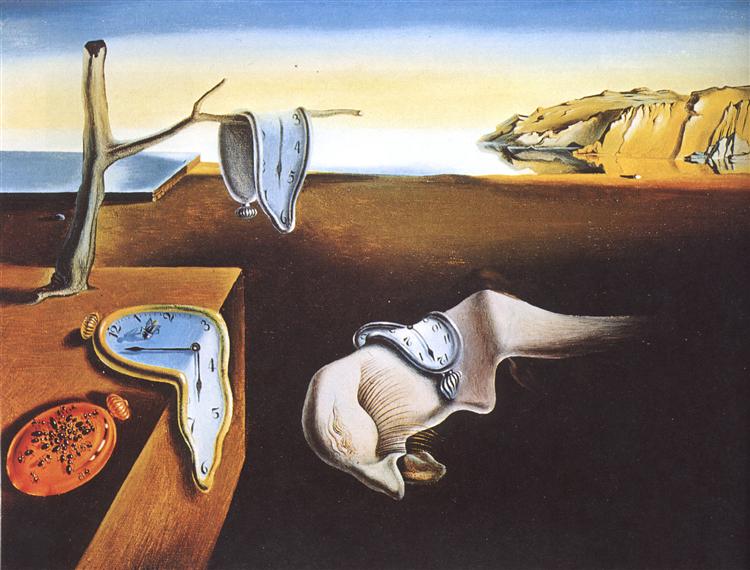
Salvador Dalí, the legendary Spanish surrealist, took the world of art by storm with his inventive and unorthodox exploration of the subconscious mind.
Dalí's works delved into the intricate labyrinths of dreams and perception, pushing the boundaries of what is considered art and redefining the framework of aesthetic expression. Among his myriad of iconic creations, the "The Persistence of Memory" remains one of the most famous and intensely scrutinized masterpieces of all time.
History and Presentation:
"The Persistence of Memory" was painted in 1931, during what is often considered the peak of Dalí's surrealist period. According to Dalí himself, the idea for the painting was conceived one evening when he observed melting camembert cheese during dinner and made an association with the surrealist perception of a soft, easily transformable universe.
Originally a part of the Julien Levy collection, the painting was acquired by the Museum of Modern Art (MoMA) in New York in 1934, where it has been prominently featured since. Aside from occasional loans to other museums, it has remained in MoMA, fascinating millions of visitors each year with its intriguing combination of the bizarre and the ordinary.
Why It's Famous:
"The Persistence of Memory" stands out due to its distinctly unique, dream-like imagery and its exploration of complex themes like time, decay, and memory. The painting is famous for its depiction of 'soft' or 'melting' watches, an unprecedented and striking visual metaphor. These drooping timepieces, perched on an organic object, draped over a branch, and one partially covered by a grotesque, eerily face-like creature, evoke a sense of disorientation and mystery, as if the viewer has stepped into an alternate universe where the conventional laws of physics do not apply.
Dalí's representation of a dreamscape, an ethereal, alien world where time itself appears distorted, has captivated audiences and scholars for decades. It raises profound questions about the nature of time, the unreliability of memory, and the omnipresence of decay, lending the painting its fame and enduring intrigue.
Movement or Style:
"The Persistence of Memory" is a definitive example of Surrealism, an artistic and literary movement that flourished in Europe between the World Wars. The surrealists, inspired by the psychoanalytic work of Sigmund Freud, sought to explore the subconscious mind and the realm of dreams, often utilizing illogical and irrational images in their works.
Dalí was a prominent figure in this movement, and his unique interpretive method, known as the "paranoiac-critical method," involved inducing a state of self-induced paranoia to access the subconscious. This method is vividly apparent in "The Persistence of Memory," with its otherworldly landscape and disquieting sense of unreality that engages and challenges the viewer's perception.
In essence, "The Persistence of Memory" is a testament to Dalí's genius and the power of Surrealism. The painting remains a cornerstone of 20th-century art, offering an enduring vision of a world beyond the boundaries of our reality, stretching the viewer's imagination to its limits, and continuing to captivate, provoke, and inspire.
