
There are works of art that stir the soul, that take us on a journey through time and space.
Such is the timeless genius encapsulated in The School of Athens, a mesmerizing masterpiece by Raffaello Sanzio da Urbino, known widely as Raphael.
The History of The School of Athens
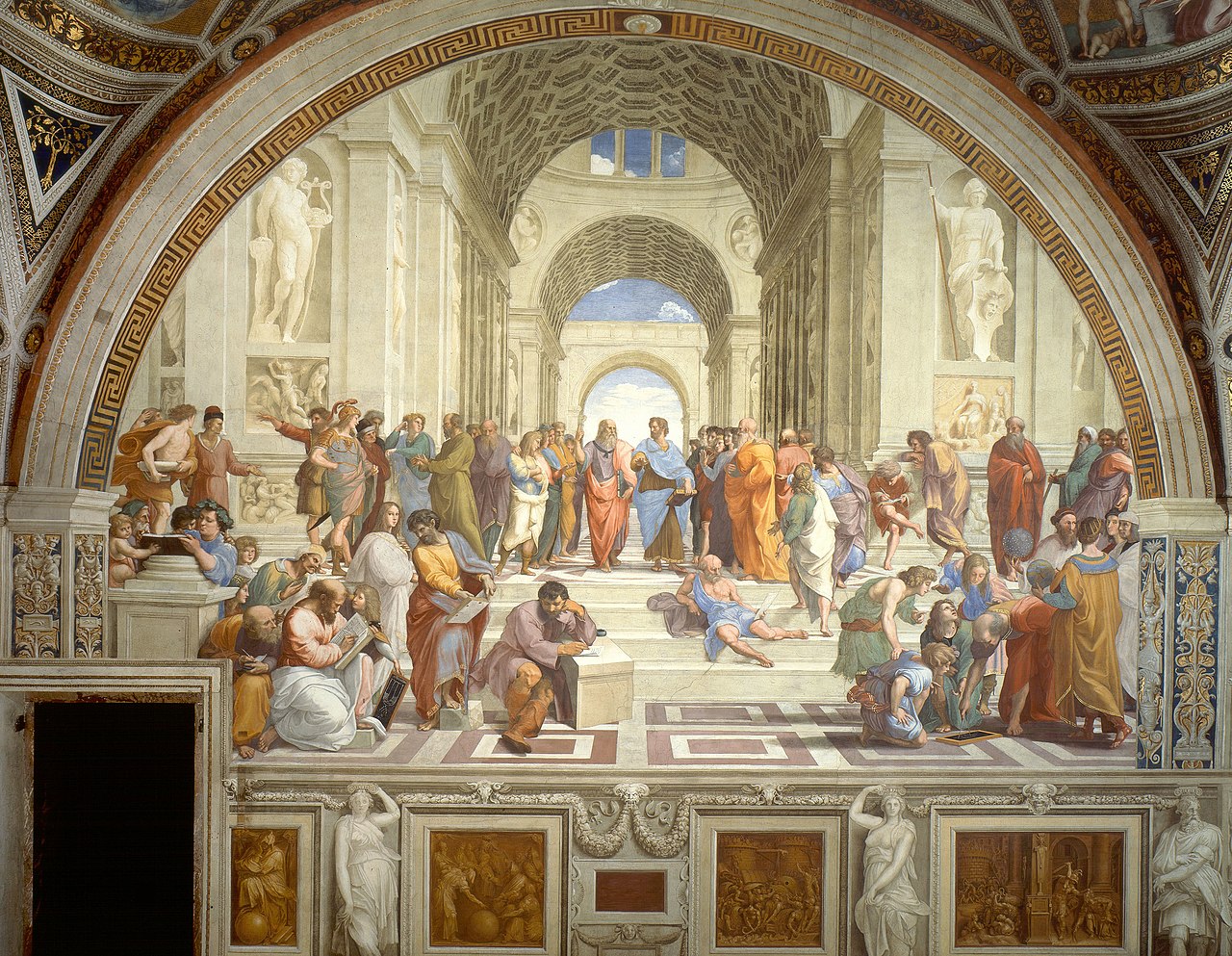
Commissioned by Pope Julius II, The School of Athens was painted between 1509 and 1511 as a part of Raphael's commission to decorate with frescoes the rooms that are now known as the Stanze di Raffaello, in the Apostolic Palace in the Vatican. The School of Athens is one of four frescoes in the Stanza della Segnatura, representing branches of knowledge. This particular painting is a sublime embodiment of philosophy.
The School of Athens depicts an open architectural space where the greatest philosophers and scholars of antiquity gather, engaged in various activities such as dialogue, work, or simply walking. Raphael's brilliance is evident in his careful use of perspective, guiding the viewer's attention towards the central figures - Plato and Aristotle.
Cities Where It Has Been Presented
Since its creation, The School of Athens has graced only one location, the room for which it was intended - the Stanza della Segnatura in the Vatican. Unlike many other masterpieces of art that have traveled the globe for exhibitions, this fresco remains a stable anchor, adding to the rich tapestry of art housed in Vatican City.
Why The School of Athens is Famous
The School of Athens is renowned not only for its aesthetic beauty but also for its intellectual symbolism. Raphael carefully positioned and modeled each figure to represent a particular philosopher or scientist from classical antiquity.
The two central figures, Plato and Aristotle, represent two differing schools of philosophical thought. Plato, pointing upwards, symbolizes his Theory of Forms, that the truest reality lies beyond the physical world. On the other hand, Aristotle, with his hand stretched forward, symbolizes his belief in empiricism, where knowledge comes primarily from sensory experience.
Beyond the philosophical nuances, Raphael's technical prowess, particularly his ability to depict perspective and his exquisite detail in human forms, has contributed to the fame of this piece. Furthermore, the painting is famed for including a self-portrait of Raphael and possibly a portrait of his master, Leonardo da Vinci, portrayed as Plato.
Artistic Style and Movement
The School of Athens is a quintessential example of the High Renaissance—a period roughly from the late 15th to the early 16th century, known for harmony, balance, and a sense of realistic depth. This painting in particular embodies the values of this period, with its perfect use of perspective, proportion, and human emotion.
Moreover, it reflects the Renaissance humanist ideals. Humanism was not just about revisiting Greek and Roman texts, but also about an anthropocentric worldview. The lively and diverse activities of the figures in the painting are a celebration of human potential, a key idea of humanism.
In conclusion, The School of Athens is a testament to the intellectual ambition and extraordinary skill of Raphael, encapsulating the spirit and aesthetics of the High Renaissance. This masterpiece continues to inspire and enthral, its grandeur and philosophical depth standing the test of time.
