
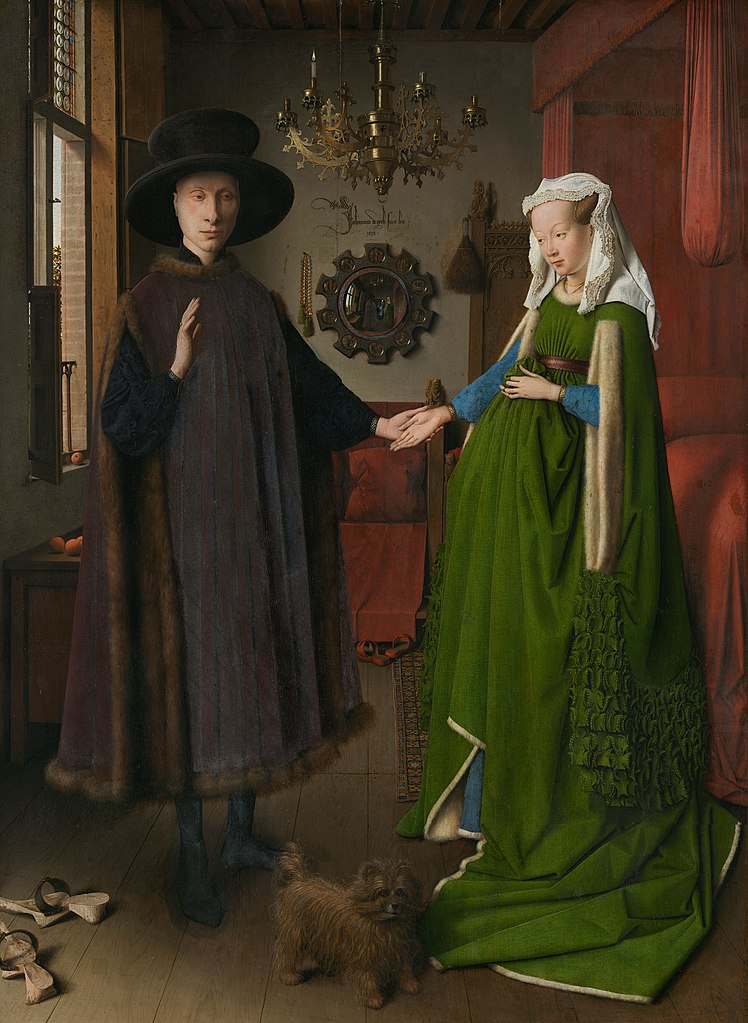
In the pantheon of Western art, few paintings hold as much historical significance and enigmatic charm as "The Arnolfini Portrait,"
painted by the Early Netherlandish master Jan van Eyck in 1434. This oil-on-oak panel painting, currently housed in the National Gallery in London, is a paragon of Northern Renaissance art, lauded for its exquisite detail, unparalleled realism, and the mysteries it envelops.
The Story Behind the Painting
"The Arnolfini Portrait," sometimes referred to as "The Arnolfini Wedding," depicts a man and a woman standing in the center of a richly furnished room. The exact identity of the figures has been a matter of intense scholarly debate over the years. The leading theory, as the title suggests, is that the painting portrays the merchant Giovanni di Nicolao Arnolfini and his wife. However, recent scholarship casts doubt on this assumption, introducing an element of mystery to the painting's history.
One of the greatest charms of the "Arnolfini Portrait" lies in its immeasurable depth of detail. From the elaborate chandelier hanging from the ceiling to the faithful representation of textures - from the couple's elaborate clothes to the oriental carpet - van Eyck demonstrated an astonishing ability to capture the minutiae of the world around him.
Exhibition History
Ever since it emerged from van Eyck's studio in Bruges, the "Arnolfini Portrait" has journeyed across cities and through centuries. It was most likely in the possession of King Philip II of Spain in the 16th century. By the 19th century, it found its way to England, where it was acquired by the National Gallery in London in 1842, where it remains on public display to this day, enchanting and perplexing viewers in equal measure.
The Painting’s Fame and Importance
There are myriad reasons why the "Arnolfini Portrait" holds an esteemed position in the history of art. Its mesmerizing realism, characteristic of Northern Renaissance art, was achieved through the application of oil paint in layers - a technique known as 'glazing.' This painting demonstrates the artist's virtuosic ability to render various textures, light, and space, making it a key example of the technical innovation of its time.
The painting is also famed for its enigmatic symbolism. Notable elements such as the single candle in the chandelier, the mirror reflecting the back of the room, and even the small dog at the couple's feet have all been scrutinized for their symbolic meanings, creating an almost infinite interpretation space.
Movement and Style
"The Arnolfini Portrait" is a prime example of Northern Renaissance art, specifically the Early Netherlandish painting school. These artists, among whom van Eyck was a pioneering figure, were known for their innovative use of oil paint and detailed, complex iconography. Their paintings often contain rich symbolism and intricate detail, demonstrating a keen interest in the observation of nature and the material world.
The Northern Renaissance, parallel to the Italian Renaissance, represented a period of rebirth and renewed interest in ancient cultures. However, artists like van Eyck demonstrated a greater focus on empirical observation and naturalism. "The Arnolfini Portrait," with its realistic depiction of light and texture and its profound symbolic depth, is an exquisite example of the unique blend of artistic innovation and detailed observation that marks this period.
In conclusion, Jan van Eyck's "The Arnolfini Portrait" is a masterpiece of the Northern Renaissance, showcasing the era's technical innovations and distinctive artistic style. It encapsulates a moment of time with mesmerizing detail, drawing the viewer into its well-preserved 15th-century world, making it one of the most revered paintings in Western art. Its allure lies not just in its aesthetics, but also in the intrigue and mystery surrounding it - a testament to the timeless fascination of this extraordinary painting.
