
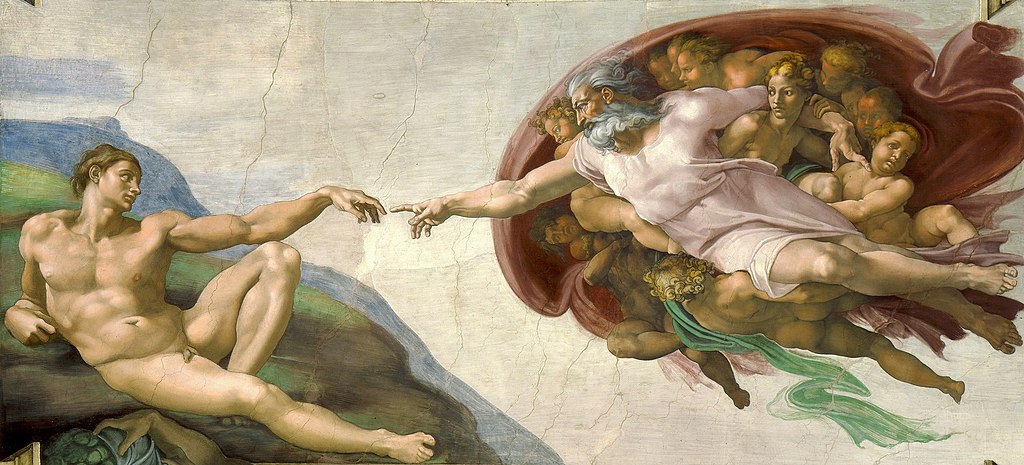
Few artworks rival the transcendental beauty and historical significance of Michelangelo di Lodovico's "The Creation of Adam".
Painted on the ceiling of the Sistine Chapel in Vatican City, the mural depicts a seminal moment that has reverberated through centuries, captivating observers with its profound sense of spirituality, composition, and the sheer power of human creation.
Historical Context:
Michelangelo was commissioned by Pope Julius II to adorn the ceiling of the Sistine Chapel in 1508. The completion of the entire chapel took about four years (1508–1512), but "The Creation of Adam" is believed to have been painted around 1511. The Vatican City remains the artwork's sole home since its creation, captivating countless audiences who visit the Sistine Chapel from all corners of the world.
Artistic Style and Movement:
Belonging to the High Renaissance, a cultural movement that was epitomized by grandeur and harmony, "The Creation of Adam" captures the essence of this period. Michelangelo's work, alongside the contributions of Leonardo da Vinci and Raphael, is considered a pinnacle of this movement. His painting portrays an innovative use of anatomy, perspective, and composition that showcased humanism – a central theme of the Renaissance era.
The Painting Itself:
"The Creation of Adam" captures the moment of God giving life to Adam, the first man, as narrated in the Book of Genesis. The figures of God and Adam are positioned within two distinct zones but reach out to each other, their fingers nearly touching in a divine spark. God is portrayed as an elderly yet muscular figure, encapsulated by a billowing red cloak with cherubs, suggestive of heavenly spheres, while Adam is depicted in a relaxed pose, signifying his state of being before receiving life.
Why It Is Famous:
The fame of "The Creation of Adam" is linked to its remarkable execution and profound philosophical interpretation of the biblical creation narrative. The nearly touching fingers of God and Adam have become one of the most replicated religious images, symbolizing humanity's relationship with divinity. Additionally, the impressive depiction of anatomy showcased Michelangelo's deep understanding of the human body, obtained through arduous study and dissection, a practice that was controversial during his time.
Moreover, some suggest that the shape around God represents an anatomically accurate image of the human brain. While this interpretation is not universally accepted, it adds a fascinating layer to the painting's allure, merging religion, art, and science.
In Conclusion:
"The Creation of Adam" is much more than a beautiful painting—it's an enduring symbol of the connection between humankind and the divine, an epitome of the High Renaissance's grandeur and harmony. It showcases Michelangelo's incredible artistic prowess and the era's humanistic values, making it one of the most influential and admired works in the history of art.
