
Dhaka
One of the world's great megacities, Dhaka is the pulsating capital of Bangladesh — a city of extraordinary density, colour, and energy set on the flat deltaic plains of the Ganges-Brahmaputra basin. Ancient Mughal monuments rise beside glass towers, chaotic rickshaw-choked streets give way to tranquil mosque courtyards, and one of Asia's most vibrant street food cultures unfolds at every corner. Dhaka is one of the fastest-growing and most fascinatingly complex cities on the planet.
City at a Glance
About Dhaka
Dhaka is the capital and largest city of Bangladesh — one of the most densely populated nations on Earth, a delta country of 170 million people crisscrossed by hundreds of rivers and waterways on the vast floodplains of the Ganges, Brahmaputra, and Meghna. With a metropolitan population exceeding 21 million, Dhaka ranks among the ten largest cities in the world and is one of the fastest-growing megacities in Asia. It sits on the eastern bank of the Buriganga River in the centre of the country, and its origins stretch back over a thousand years — though its great period of prominence came under the Mughal Empire, when Dhaka served as the capital of Bengal Province and a major centre of the global muslin trade from the 17th century onwards. The extraordinary Lalbagh Fort, the Ahsan Manzil Pink Palace, and the atmospheric old Mughal quarter of Puran Dhaka (Old Dhaka) all survive from this period.
Modern Dhaka is a city of dramatic contrasts — ancient mosques and crumbling Mughal havelis stand alongside gleaming glass towers and garment factories that make Bangladesh the world's second-largest apparel exporter. The streets are a magnificent, chaotic spectacle: millions of hand-painted cycle rickshaws (Dhaka has more rickshaws than any other city on Earth), CNG auto-rickshaws, buses, and pedestrians fill every lane in a kaleidoscopic flow. The city's food scene is one of South Asia's most vibrant — Biryani culture here is legendary, the Mughal-influenced cooking of Old Dhaka is extraordinary, and the street food is among the best on the continent. For the adventurous traveller, Dhaka is an endlessly rewarding, overwhelming, and unforgettable city.
Best Time to Visit & Weather
Winter Best Time
November – February. The ideal time to visit Dhaka. Temperatures are pleasantly warm (15–25 °C / 59–77 °F), humidity is at its lowest, and rainfall is minimal. The air is clearer, the streets are at their most walkable, and the city's monuments and markets are at their most enjoyable. December and January are the coolest and most comfortable months. Book accommodation in advance for the peak winter travel season.
Pre-Monsoon Spring Warm & Lively
March – May. Temperatures climb sharply (30–38 °C) and humidity rises, making the city intensely hot and hazy. However, this is also the season of Bangladeshi New Year (Pohela Boishakh — April 14th), one of the most spectacular and colourful festivals in South Asia, celebrated with enormous street processions, music, and festivities throughout Dhaka. Worth visiting for the cultural experience despite the heat.
Monsoon Season
June – October. Dhaka's monsoon season brings heavy daily rainfall, widespread flooding in low-lying areas, intense humidity (90%+), and temperatures of 28–33 °C. The city's drainage infrastructure struggles with the deluge — flooding in Old Dhaka and outer neighbourhoods is common. Travel within the city is significantly disrupted. Not recommended for first-time visitors. Comprehensive travel insurance is essential.
Autumn Shoulder
October – November. As the monsoon recedes, Dhaka becomes gradually more pleasant. The rice fields around the city turn brilliant green, the rivers are full and majestic, and the countryside is at its most photogenic. Temperatures drop to 25–30 °C and humidity eases significantly by November. An excellent time to combine Dhaka with a visit to the Sundarbans mangrove forest to the south.
- Dhaka's traffic is legendary in its intensity — a journey of 5 km can take 45–90 minutes in peak hours. Plan all sightseeing with generous travel time, start early in the morning before traffic builds, and use rickshaws for short distances in Old Dhaka rather than cars.
- The cycle rickshaw is the best way to explore Old Dhaka — negotiate the fare before getting in, expect to pay 30–80 BDT for short trips, and enjoy one of the great urban travel experiences of Asia. Dhaka's rickshaws are elaborately painted works of folk art.
- Friday mornings are the best time to visit Old Dhaka — traffic is significantly lighter than on weekdays, the Baitul Mukarram mosque area is fascinating after Friday prayers, and the old streets are more navigable and atmospheric.
- Dhaka tap water is not safe to drink — always use sealed bottled water. Heat and humidity make staying hydrated essential — carry water at all times, especially when sightseeing.
- The Bangladeshi taka is not freely exchangeable outside Bangladesh — exchange currency on arrival at the airport or at banks in central Dhaka. Major hotels and larger restaurants accept credit cards; street food and rickshaws are strictly cash only.
Top Attractions
Lalbagh Fort
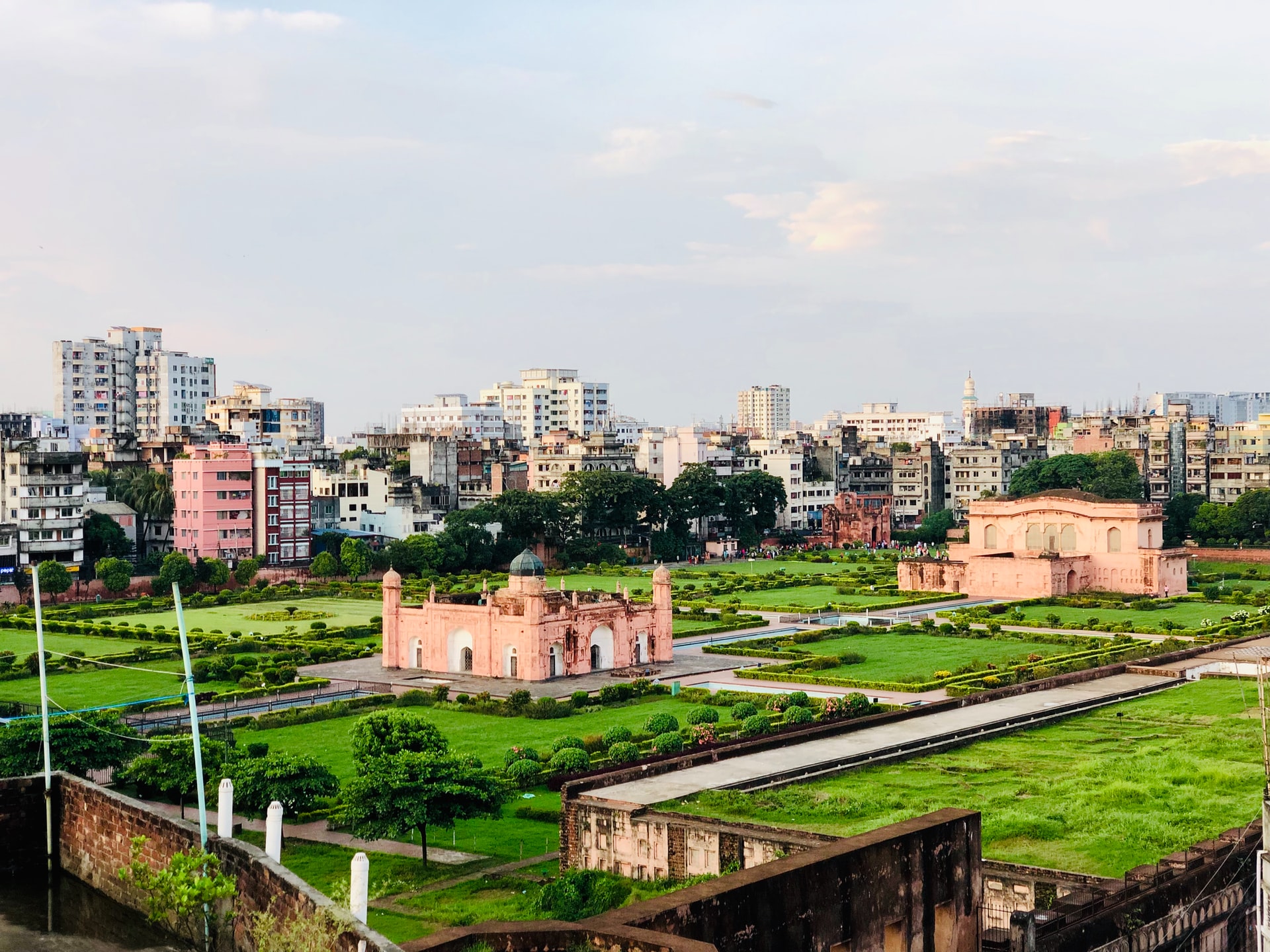
Dhaka's most important Mughal monument — the Lalbagh Fort (Fort Aurangabad) was begun in 1678 by Prince Muhammad Azam, son of Emperor Aurangzeb, and never completed. Its three surviving structures — the Mosque, the Tomb of Bibi Pari (encrusted with marble and inlaid tiles), and the Diwan-i-Aam audience hall — are among the finest examples of Mughal architecture in Bengal. Set in spacious gardens beside the Buriganga, the fort is Old Dhaka's crown jewel and a UNESCO tentative list site.
Ahsan Manzil — The Pink Palace
The magnificent Ahsan Manzil — the Pink Palace — was the official residential palace of the Nawabs of Dhaka, built in 1872 on the northern bank of the Buriganga River. Its distinctive pink Indo-Saracenic facade, grand durbar hall, and extraordinary collection of period furnishings, portraits, and Nawabi artefacts make it the finest 19th-century palace museum in Bangladesh. The riverside setting and the ornate interior are both spectacular.
Star Mosque (Tara Masjid)
One of the most beautiful mosques in Bangladesh — the Tara Masjid (Star Mosque) in the Armanitola area of Old Dhaka is covered entirely in exquisite blue and white Chinese porcelain mosaic stars and floral patterns, creating one of the most visually stunning interiors of any mosque in South Asia. Originally built in the early 18th century and extensively embellished in the 19th and 20th centuries, it remains an active place of worship of extraordinary beauty.
Sadarghat River Port
The Sadarghat River Terminal on the Buriganga River is one of the busiest inland river ports in the world — a perpetual spectacle of enormous double-decker rocket steamers, wooden country boats, ferries, and thousands of daily passengers embarking and disembarking in organised chaos. Watching the vessels come and go from the ghats at dusk is one of the great urban spectacles of South Asia. A short boat ride on the river offers a completely different perspective of Old Dhaka.
National Museum & Liberation War Museum
The Bangladesh National Museum in Shahbagh holds the country's most comprehensive collection of archaeological finds, Mughal art, decorative arts, and natural history exhibits. Nearby, the deeply moving Liberation War Museum documents the 1971 Bangladesh Liberation War and genocide — an essential and profoundly important visit for understanding modern Bangladesh and the birth of the nation. Both museums are accessible and well-presented.
Old Dhaka (Puran Dhaka)
The historic heart of Dhaka — Old Dhaka (Puran Dhaka) is a dense, labyrinthine quarter of Mughal-era mosques, crumbling merchant havelis, narrow lanes, wholesale spice markets, metalworkers' streets, and Hindu temples. The Shakhari Bazar (conch-shell workers' street), Islampur fabric market, and the riverside area around Sadarghat are all essential Old Dhaka experiences. Best explored on foot or by rickshaw with a local guide.
National Assembly Building (Jatiyo Sangsad Bhaban)
One of the great works of 20th-century architecture — the Jatiyo Sangsad Bhaban (National Parliament House) was designed by American architect Louis Kahn and completed in 1982 after 20 years of construction. The vast geometric complex of concrete, marble, and reflecting pools is considered one of Kahn's masterpieces and one of the finest buildings in Asia. The exterior can be viewed and photographed from the surrounding grounds.
Suhrawardy Udyan & Ramna Park
Suhrawardy Udyan is one of Dhaka's most historically significant open spaces — it was here that the Pakistani army surrendered on 16 December 1971, ending the Liberation War. The park contains the Independence Square monument and eternal flame. Adjacent Ramna Park is the city's most popular green lung — where Dhakaites jog, practise yoga, and gather at dawn, and where the spectacular Pohela Boishakh New Year celebrations centre each April.
Day Trip Itineraries
Day 1 — Old Dhaka: Mughals, Markets & the River
- 7:30 AM – Sadarghat at dawn — Start at the river terminal at first light — the early morning activity at Sadarghat, with steamers arriving and departing in the mist, is one of the great spectacles of South Asian city life. Take a short river boat ride for views of Old Dhaka from the water. Allow 1 hour.
- 9:00 AM – Lalbagh Fort — Visit Dhaka's finest Mughal monument before the heat and crowds build. The Tomb of Bibi Pari and the fort's gardens are particularly beautiful in the morning light. A good local guide makes a significant difference here. Allow 1.5 hours.
- 11:00 AM – Ahsan Manzil (Pink Palace) — Walk or take a rickshaw to the magnificent Pink Palace for a thorough visit to its Nawabi interiors and extraordinary period collection. The riverside gardens and the pink exterior are spectacular. Allow 1.5 hours.
- 1:00 PM – Old Dhaka street food lunch — Lunch at one of the legendary biryani houses of Old Dhaka — Haji Biriyani or Nanna Biriyani on Nazimuddin Road are the most famous. A plate of Kacchi Biryani here is one of the great food experiences of South Asia. Allow 1 hour.
- 2:30 PM – Star Mosque & Shakhari Bazar — Visit the extraordinary Star Mosque, then explore the narrow lane of Shakhari Bazar — Dhaka's ancient conch-shell workers' street, unchanged for centuries. Allow 1.5 hours.
- 5:00 PM – Rickshaw ride at dusk — End the day with a rickshaw ride through the backstreets of Old Dhaka as the day cools — the painted rickshaws, the calls to prayer from a dozen mosques, and the evening street food stalls are the perfect Dhaka sunset experience.
Day 2 — Modern Dhaka: Culture, Architecture & Markets
- 9:00 AM – Bangladesh National Museum — Spend a morning at the National Museum in Shahbagh for a comprehensive overview of Bangladesh's history, Mughal art, and cultural heritage. Allow 2 hours. The museum café is a good breakfast stop.
- 11:00 AM – Liberation War Museum — A deeply important and moving visit — the Liberation War Museum documents the 1971 genocide and independence struggle in detail. Essential for understanding Bangladesh. Allow 1.5 hours.
- 1:00 PM – Lunch at Dhanmondi — Head to the Dhanmondi or Gulshan area for lunch at one of Dhaka's many excellent modern Bangladeshi restaurants — try kacchi biryani, hilsa fish curry (ilish), or shorshe ilish at a proper sit-down restaurant. Allow 1 hour.
- 2:30 PM – Jatiyo Sangsad Bhaban — Visit the exterior of Louis Kahn's extraordinary National Parliament Building — the reflecting pools, geometric concrete forms, and vast scale make it one of the most impressive architectural experiences in Asia. Allow 1 hour.
- 4:00 PM – Ramna Park & Suhrawardy Udyan — Walk through Ramna Park and visit the Independence Square monument at Suhrawardy Udyan — a peaceful end to a full day. The park is lovely in the late afternoon.
- 7:00 PM – Dinner & Gulshan evening — Dine at one of the Gulshan or Banani neighbourhood restaurants — Dhaka's most cosmopolitan dining district with excellent Bangladeshi, Indian, Lebanese, and international options. The evening street food scene in Gulshan is also worth exploring.
Local Food & Dining
Dhaka's food culture is one of the great undiscovered cuisines of Asia — rooted in the extraordinarily rich Mughal culinary tradition of Bengal, shaped by the rivers and the delta (fish is the heart of Bangladeshi cooking), and expressed in a street food scene of breathtaking variety and quality. Biryani culture in Old Dhaka is legendary across South Asia; the hilsa (ilish) fish is the national obsession; and the city's tea stalls, sweet shops, and street snack vendors operate around the clock in a city that never truly sleeps.
Must-Try Bangladeshi Foods
- Kacchi Biryani — The crown jewel of Dhaka's food culture — raw marinated mutton layered with fragrant basmati rice, saffron, and whole spices, then slow-cooked in a sealed pot (dum) until the meat falls off the bone and the rice absorbs every flavour. The Kacchi Biryani of Old Dhaka's legendary restaurants (Haji Biriyani, Nanna Biriyani) is considered by many food lovers to be the finest biryani in the world. Non-negotiable.
- Ilish (Hilsa) Fish Curry — The national fish of Bangladesh and a Bengali cultural obsession — the oily, richly flavoured hilsa is cooked in dozens of ways: with mustard (shorshe ilish), in banana leaf (paturi), steamed, fried, or curried. Found in every Bangladeshi restaurant and home kitchen. The best hilsa comes from the Padma River during the monsoon migration season.
- Haleem — A slow-cooked stew of wheat, barley, lentils, and shredded beef or mutton, simmered for hours until it reaches a thick, porridge-like consistency and an extraordinary depth of spiced flavour. A Mughal-era dish that is now a Dhaka institution — particularly popular during Ramadan and as a street food in Old Dhaka.
- Pitha (Rice Cakes) — Traditional Bengali rice flour cakes made in dozens of varieties — steamed, fried, or filled with coconut, date palm jaggery, or sesame. Pitha is especially prominent in winter and during the Pohela Boishakh (Bengali New Year) festival. Street vendors selling warm pitha from clay pots are one of the great sensory pleasures of a Dhaka winter morning.
- Fuchka (Pani Puri) — Dhaka's most beloved street snack — hollow crispy semolina shells filled with spiced mashed chickpeas, potato, tamarind water, and fiery green chilli water. The fuchka of Dhaka is considered distinct from and superior to the pani puri of India by devoted Dhaka locals — the tamarind water recipe is a closely guarded secret at the city's best stalls.
- Mishti Doi & Roshogolla — The great Bengali sweet tradition — mishti doi is a thick, caramelised set yogurt of extraordinary richness, and roshogolla are soft white cheese dumplings soaked in light sugar syrup. Both are essential parts of any Dhaka meal. The sweet shops (mishti shops) of Old Dhaka are among the finest in Bengal.
Haji Biriyani
The most famous biryani restaurant in Bangladesh — Haji Biriyani on Nazimuddin Road in Old Dhaka has been serving its legendary Kacchi Biryani since 1939. The queue of customers stretching out the door at lunchtime is one of Old Dhaka's defining daily scenes. Arrive early — the biryani sells out every day. A single visit here is sufficient to understand why Dhaka biryani has the reputation it does across South Asia.
Nanna Biriyani
The great rival to Haji — Nanna Biriyani, also on Nazimuddin Road in Old Dhaka, serves an equally renowned Kacchi Biryani that draws devoted regulars who consider it superior to its more famous neighbour. The debate between Haji and Nanna partisans is one of Dhaka's great ongoing culinary arguments. Visiting both on consecutive days and forming your own opinion is warmly recommended.
Star Hotel & Kabab Houses
Old Dhaka's network of traditional kabab and kebab houses — serving seekh kabab, shami kabab, boti kabab, and roast beef — represents the direct continuation of the Mughal court kitchen tradition in Dhaka. The best are clustered around Chawkbazar and the Nazimuddin Road area of Old Dhaka. Eaten with naan bread straight from the tandoor and a cup of thick, sweet Bangladeshi tea (cha).
Gulshan & Banani Restaurants
Dhaka's modern, cosmopolitan dining hub — the Gulshan and Banani neighbourhoods in northern Dhaka are home to the city's best contemporary restaurants, rooftop bars, and international cuisine. Star Kabab and Restaurant, Khazana, Fakruddin, and a growing number of modern Bangladeshi fine dining restaurants offer sophisticated versions of the national cuisine in comfortable, air-conditioned settings — the best choice for evening dining.
- Old Dhaka's legendary biryani restaurants sell out early — arrive at Haji Biriyani or Nanna Biriyani by 12:30 PM at the latest for lunch. Coming after 1:30 PM means risking disappointment.
- Bangladeshi food is generally less fiery than Indian food from the subcontinent's west — the heat comes from mustard, green chilli, and the generous use of aromatic spices rather than dried red chilli powder. The flavour profile is distinctive and extraordinary.
- Street food in Dhaka is generally safe when freshly cooked and piping hot — fuchka, haleem, kababs, and pitha from busy street stalls with high turnover are fine for most travellers. Avoid pre-cut fruit and raw salads from street vendors.
- Dhaka has a strong sweet tea (cha) culture — tea stalls operate on every corner from dawn to midnight. A glass of thick, sweet, condensed-milk tea (doodh cha) costs 10–15 BDT and is one of the best 20 cents you will spend in any city in Asia.
- Bangladesh is a majority Muslim country — alcohol is not available at most restaurants and is absent from Old Dhaka entirely. Higher-end hotels and a small number of licensed restaurants in Gulshan serve alcohol to guests.
Entry Requirements
Bangui is in Bangladesh. Most nationalities require a visa to enter Bangladesh. Bangladesh operates an e-visa and visa-on-arrival system for many nationalities at Hazrat Shahjalal International Airport. Check eligibility and apply in advance via the Bangladesh e-visa portal. A valid passport with at least 6 months validity is required. Apply for Bangladesh e-Visa List of e-Visa Countries
Important Emergency Numbers
Find Flights to Dhaka
Dhaka Airport Code: DAC — Hazrat Shahjalal International Airport
Cities with IATA Airport CodesCurrency: Bangladeshi Taka (BDT)
Currencies of the WorldDhaka Streets Map
Book the Best Tours

Dhaka is the capital city of Bangladesh, South Asia.
Bangladesh Country Profile


