Kigali Weather
KIGALI WEATHERAbout Kigali
Kigali is the capital and largest city of Rwanda — a metropolis of extraordinary resilience, rapid transformation, and increasingly vibrant urban sophistication that has become one of the most compelling and most admired cities in Africa. Positioned almost exactly at the geographic centre of Rwanda, straddling a series of steep verdant ridges and lush valleys at an elevation of approximately 1,567 metres above sea level, Kigali is embedded within the landscape that gave Rwanda its most enduring epithet: the Land of a Thousand Hills. From almost any rooftop or hilltop restaurant terrace in the city, the view outward into Rwanda's corrugated countryside — row upon row of green ridges fading into the equatorial haze — is one of the most distinctive and most beautiful urban vistas in East Africa. Founded in 1907 as a modest German colonial administrative outpost by Dr. Richard Kandt, Kigali was designated the capital of independent Rwanda in 1962, selected primarily for its central location in a country whose transport and communications then depended on road connections to all four provinces. The catastrophe of the 1994 Genocide against the Tutsi — in which an estimated one million people, predominantly Tutsi and moderate Hutu, were murdered in approximately one hundred days in an act of organised mass murder of staggering speed and scale — profoundly shaped the Kigali that visitors encounter today: a city that has rebuilt itself with exceptional deliberateness and with a clarity of national purpose that is, by any measure, one of the remarkable stories of modern African governance. Today, Kigali is widely acclaimed as the cleanest, safest, and most efficiently managed capital city in Africa — a distinction maintained by a genuine civic culture of collective responsibility, strict environmental regulation (including a celebrated ban on non-biodegradable plastic bags that has been in force since 2008), and the determination of a society that has decided, consciously and collectively, to become something different from what its recent history threatened.
Best Time to Visit Kigali & Weather Guide
Kigali enjoys a mild tropical highland climate tempered by its high elevation — temperatures are remarkably consistent year-round (20–27°C by day, 14–18°C at night), without the extreme heat of lower-altitude East African cities, and divided into two dry seasons and two rainy seasons that shape the character of each period of the year.
☀️ Long Dry Season (June–September)
The finest and most popular season for visiting Kigali and Rwanda — the long dry season brings reliably clear skies, cool to warm days of 23–27°C, low humidity, and the luminous quality of light that makes Kigali's hillside panoramas most spectacular. July and August are the peak months for gorilla trekking in Volcanoes National Park (the primary reason most international visitors come to Rwanda) — the dry trails make the forest approaches more manageable, and the vegetation is less dense, slightly improving sightlines. June–September is also the best period for game viewing in Akagera National Park (Rwanda's Big Five savannah reserve in the east), when animals concentrate around water sources. Hotel rates and flight prices peak in July–August — book accommodation at least 3 months in advance if visiting during this period. The outdoor café and rooftop restaurant culture of Kigali is at its most pleasant in the dry season, with mild evenings perfect for dinner on a hillside terrace.
Best Time to Visit🌤️ Short Dry Season (December–February)
The second dry season — shorter and somewhat warmer than the June–September period, with temperatures reaching 26–28°C and very pleasant conditions for city exploration and wildlife activities. December and January are excellent months to visit Kigali outside the peak July–August crowds, with hotel rates slightly lower and the city's cultural events calendar active. The Rwandan Christmas and New Year period (late December) brings a particular festive energy to Kigali's restaurants, bars, and outdoor event spaces. The dry-season clarity makes this an excellent time for photography — the hillside city views and the deep green of Rwanda's post-rainy season vegetation photographed against blue equatorial skies are at their most striking. February marks the transition back toward the long rains, with occasional late-afternoon showers beginning to appear by month's end.
Good Dry Season🌧️ Long Rains (March–May)
Rwanda's wettest season — the long rains of March through May bring heavy afternoon and evening showers that can be intense but rarely last more than an hour or two, followed by clearing skies of extraordinary freshness. The landscape is at its most extravagantly green — the thousand hills of Rwanda are draped in a lush, vivid emerald vegetation that is genuinely spectacular for photography and for appreciating the country's beauty. Gorilla trekking is still possible (the mountain gorillas of Volcanoes National Park are present year-round) but the steep, muddy forest trails make the approach more challenging. Hotel prices drop significantly in the long rains — March through May offer the best value accommodation rates of the year, and Kigali's indoor cultural attractions (Genocide Memorial, Inema Arts Centre, Rwanda Art Museum) are best experienced without the pressure of peak-season visitor volumes. April 7 is Kwibuka (Remembrance Day) — a national day of solemn commemoration marking the beginning of the 1994 genocide; an experience of considerable emotional power for visitors present in Kigali on this date.
Green Season🌦️ Short Rains (October–November)
The shorter and generally lighter rainy season — October and November bring intermittent showers, typically in the afternoons, that are less intense than the long rains and leave the mornings reliably clear and pleasant. This shoulder season is an excellent time to visit Kigali for travellers seeking a balance between the lower prices of the rainy season and the more comfortable conditions of the dry season: morning game drives, city sightseeing, and gorilla treks are all perfectly feasible with appropriate rain gear. The Kigali International Film Festival (CINEMAX) typically takes place in October, bringing African and international cinema to venues across the city. October–November is also the finest period for birdwatching in Rwanda's national parks, as migratory species from the northern hemisphere arrive in the country's forests and wetlands, complementing the already extraordinary resident bird diversity.
Shoulder SeasonDry Season (Jun–Sep & Dec–Feb): Light layers for the mild days and cool evenings — Kigali's elevation means evenings are noticeably cooler than coastal East Africa. A light fleece or jacket is useful for cool mornings and air-conditioned venues. Comfortable walking shoes for Kigali's hilly terrain. High-factor sunscreen — the equatorial sun at 1,567m is stronger than its mild temperature suggests.
Rainy Season (Mar–May & Oct–Nov): A compact umbrella or lightweight waterproof jacket for the afternoon showers — rains are usually brief and intense. Waterproof footwear for the slippery hillside paths. Light layers as temperatures remain comfortable even in the rain.
Gorilla Trekking (year-round): Long-sleeved shirt and trousers for vegetation and insects; waterproof jacket; sturdy walking boots or hiking shoes with ankle support; garden gloves for grip on the steep slopes; a lightweight day pack. Gorilla trekking permits cost USD 1,500 per person per day and must be booked well in advance through the Rwanda Development Board.
Year-round: Rwanda operates on the Type C/J European two-pin plug (230V/50Hz) — UK and US visitors will require a plug adaptor. Plastic bags are illegal in Rwanda — do not bring plastic shopping bags; they will be confiscated at Kigali airport. Carry reusable bags. The Rwandan franc (RWF) is the currency — USD is widely accepted in tourist areas but it is worth carrying local currency for markets and smaller restaurants. English is widely spoken in Kigali; French is less prevalent than it once was. Rwanda requires yellow fever vaccination proof for some travellers — verify requirements before travel. Anti-malarial medication is recommended; consult your doctor before travel.
Top Attractions in Kigali
Kigali rewards visitors with a compelling range of cultural, historical, and contemporary attractions — from the profound solemnity of its genocide memorials and the creative energy of its arts districts to the vibrant colour of its markets and the spectacular hillside panoramas that define the city's physical identity.
🕊️ Kigali Genocide Memorial
The most important and most emotionally powerful heritage site in Rwanda and one of the most significant memorial sites in the world — the Kigali Genocide Memorial in Gisozi is built on the site of a mass grave where more than 250,000 victims of the 1994 Genocide against the Tutsi are interred, and serves simultaneously as a burial ground, a museum, and a centre for education and reconciliation. The memorial's three permanent exhibition galleries trace the history of the genocide with an unflinching clarity that is devastating in its detail: the historical background rooted in Belgian colonial racial classification, the systematic planning and execution of the mass murders, and the stories of individual victims and survivors told through photographs, clothing, and personal effects recovered from church massacres and killing sites across the country. The serene gardens, which cover the mass graves in a landscape of contemplative beauty, provide a space for reflection after the emotional intensity of the interior exhibitions. An essential and deeply moving experience that contextualises everything else about contemporary Rwanda; allow at least two hours. Entry is free; guided tours (highly recommended) are available at no additional charge from the memorial's trained guides, many of whom are genocide survivors.
Essential Memorial🎨 Inema Arts Centre
The most vibrant and internationally recognised contemporary arts institution in Rwanda and the best introduction to the extraordinary creative energy that has emerged in Kigali's post-genocide cultural renaissance — Inema Arts Centre, founded in 2012 by brothers Emmanuel Nkuranga and Innocent Nkurunziza in the Kimironko district, is a working studio, gallery, and performance space that has grown into the beating heart of Kigali's arts scene and a symbol of the country's creative ambition. The gallery's permanent collection of large-format paintings — vibrant, colourful, expressionist canvases that draw on Rwandan daily life, landscape, and history in a palette of extraordinary richness — represents some of the finest contemporary African painting produced anywhere on the continent. The centre hosts regular dance performances of traditional Rwandan intore dance (a spectacular court dance tradition of leaping, drumming, and elaborate regalia), open studio events, artist residencies, and workshops. A visit to Inema — to watch the artists at work in the shared studio space, to browse the gallery walls hung with works available for purchase, and to attend an evening performance if one is scheduled — is the most joyful and most distinctively Kigali cultural experience available in the city.
Creative Hub🏛️ Rwanda Art Museum (Former Presidential Palace)
One of the most fascinating and most unusual museums in East Africa — the Rwanda Art Museum (formerly the Presidential Palace Museum) at Kanombe, 4km from Kigali International Airport, occupies the former residence of President Juvénal Habyarimana, whose assassination on 6 April 1994 — when his plane was shot down over the compound on its final approach to Kigali Airport — triggered the genocide that began the following morning. The presidential residence and grounds have been preserved largely as they were in 1994, providing a haunting and historically resonant setting for the contemporary artworks of Rwandan and international artists that now fill the galleries. The museum's collection of over 100 works chronicles Rwanda's history and present-day development through painting, sculpture, photography, and mixed media. The crashed Falcon 50 aircraft wreckage on the grounds — exactly where it fell on the night of 6 April 1994 — is among the most powerfully charged historical artefacts in Rwanda and provides a visceral connection to the events that shaped the country's recent history.
Historic & Art Museum🛍️ Kimironko Market
The largest, liveliest, and most characteristically Rwandan market in Kigali and one of the great East African urban markets — Kimironko Market, a sprawling, densely packed commercial space in the Gasabo district east of the city centre, is where Kigali's residents do their serious shopping and where the goods of Uganda, Kenya, the Democratic Republic of Congo, and the whole East African Community converge in a sensory environment of compelling vitality. The market sells everything: fresh produce from Rwanda's highland farms (the tomatoes, avocados, sweet peppers, passion fruit, and pineapples of the Rwandan market are of exceptional quality and freshness), bolts of bright kitenge fabric in the full range of East African prints, secondhand clothing, shoes, household goods, fresh fish from Lake Kivu, and a section of craft and souvenir stalls carrying traditional Rwandan woven baskets (agaseke) — the most distinctive and most beautiful craft product of Rwanda, woven in the Imigongo geometric pattern in natural grasses and plant dyes. A morning in Kimironko Market is the most authentic and most energetic cultural immersion available in Kigali — go with cash, comfortable shoes, and an appetite for sensory engagement.
Vibrant Local Market🏙️ Kigali Convention Centre & CBD
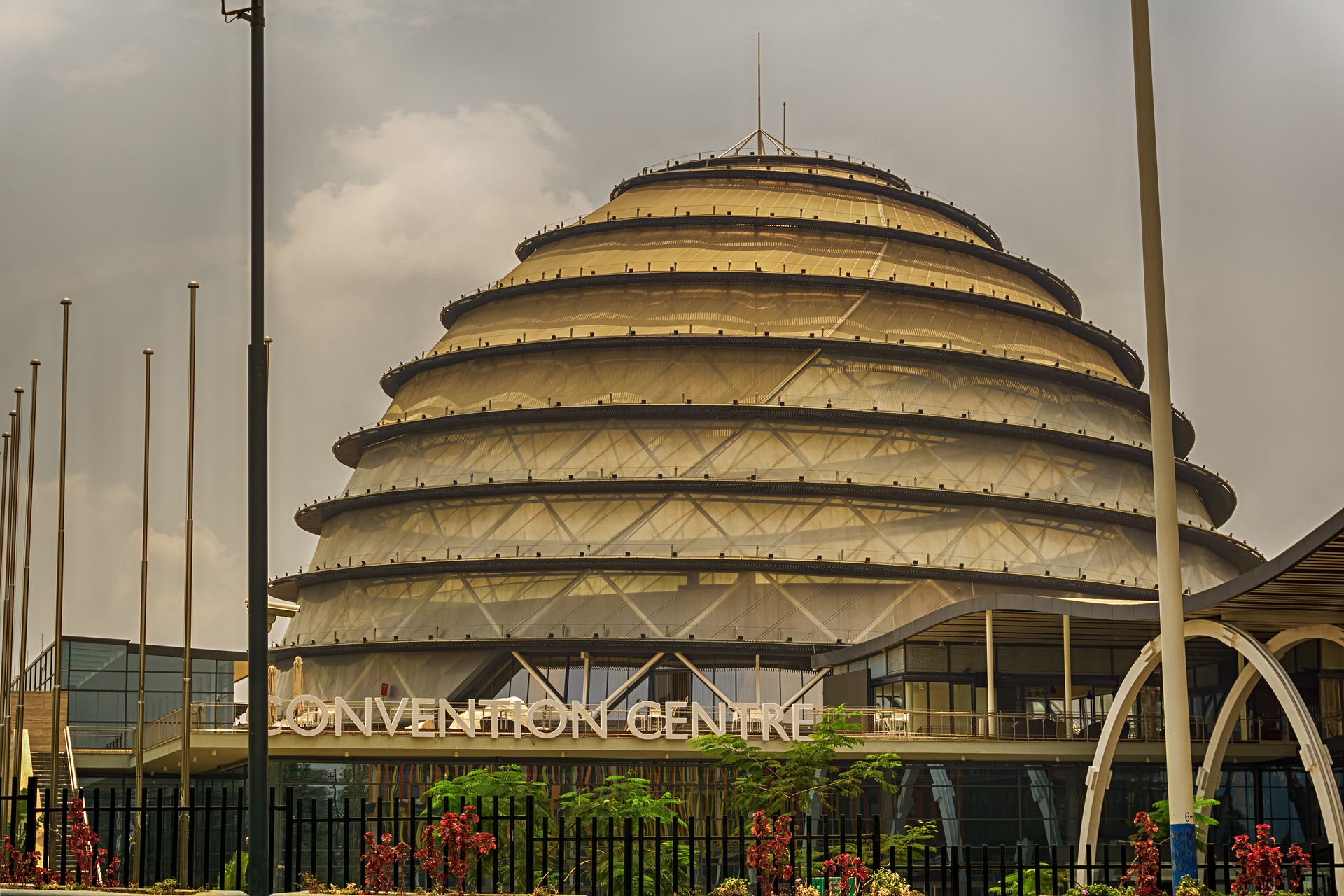
The most architecturally dramatic building in Kigali and the most visible symbol of Rwanda's extraordinary ambition as a modern African state — the Kigali Convention Centre, its gleaming dome dominating the Kimihurura skyline, opened in 2016 and immediately became the most important conference and events venue in East Africa, hosting the African Union Summit, international business conferences, and major cultural events in a complex of bold architectural confidence. The Convention Centre's dome — illuminated in the Rwandan national colours at night — and the surrounding Kigali City Tower, new diplomatic missions, and rapidly rising glass commercial towers constitute the most compelling evidence of Rwanda's transformation from post-genocide recovery to continental economic leadership. The broader CBD and Kimihurura district — with the Radisson Blu, Marriott, and Kigali Serena hotels, the upmarket restaurant strips, and the rooftop bars with their extraordinary hillside views — is the most dynamic and most international-facing district of the city.
Modern Kigali🌿 Nyamirambo & the Muslim Quarter
The most culturally distinctive and most traditionally vibrant neighbourhood of Kigali — Nyamirambo, the dense, hilly district south of the city centre, is the oldest established urban neighbourhood in Kigali and the historic heart of the city's Muslim community, dominated by the Kigali Central Mosque (known locally as the Gaddafi Mosque, built with Libyan funding) and characterised by the narrow lanes, street food vendors, small mosques, and the warm social energy of a neighbourhood that has maintained its communal character through all of Kigali's upheavals. The Nyamirambo Women's Centre — a cooperative that runs walking tours of the neighbourhood led by local women guides, combining visits to the mosque, the milk bars (inyambo), the street food stalls, and the homes of local craftswomen — is the finest community-based tourism experience in Kigali and one of the most praised and most authentic guided experiences in Rwanda. Walking the lanes of Nyamirambo in the late afternoon, eating street brochettes from a charcoal grill, and watching the neighbourhood come to life in the cool of the evening is the most genuinely local experience Kigali offers.
Authentic Neighbourhood🦅 Mount Kigali & Viewpoints
The finest panoramic viewpoints over the Rwandan capital and the surrounding thousand hills — Mount Kigali (1,850m), the forested ridge rising above the city to the north, offers a manageable hiking trail to a summit with sweeping 360-degree views across the city's corrugated hillscape to the Virunga volcanoes on the northern horizon. The pine forests on the approach provide cool shade and the occasional sighting of colobus monkeys and the rich highland birdlife that makes Rwanda one of the finest birdwatching destinations in Africa. For visitors preferring a more accessible panoramic experience, the terrace of the Repub Lounge in Kimihurura, the rooftop of Inzora Café, and the garden of Heaven Restaurant in Kiyovu offer the finest elevated views over Kigali's rolling urban hills. The golden hour before sunset — when the equatorial light turns the thousand hills amber and the city lights begin to emerge against the darkening valleys — is the most photographically rewarding time of day in Kigali.
Panoramic Views🌊 Umusambi Village & Nature
The most unexpected and most charming natural attraction in central Kigali — Umusambi Village, a beautifully restored wetland sanctuary within the city limits, provides a permanent refuge for over 50 endangered Grey Crowned Cranes rescued from the illegal pet trade across East Africa. These extraordinary birds — Rwanda's national bird, depicted on the Rwandan coat of arms — have been rehabilitated but are unable to be released to the wild; at Umusambi they inhabit a thoughtfully landscaped wetland environment of considerable tranquillity, accessible on guided walks of approximately one hour. The Grey Crowned Crane (Balearica regulorum) is a bird of spectacular elegance and considerable size — the golden crown of filaments rising from its grey head is one of the most remarkable natural ornaments in the avian world — and encountering them at close range in a wetland setting is a genuinely moving wildlife experience within walking distance of the city centre. The broader wetland supports herons, ibis, kingfishers, and a significant diversity of East African waterbirds that will delight birdwatchers.
Nature & WildlifeLocal Food Recommendations
Kigali's food scene has undergone a transformation of remarkable speed and ambition — named by Condé Nast Traveler as Africa's most exciting food city in 2024, the Rwandan capital now offers a dining landscape that ranges from traditional Rwandan home cooking of considerable character to some of the finest contemporary African and international restaurant cuisine on the continent, all underpinned by the extraordinary quality of Rwanda's highland-grown produce.
🍽️ Must-Try Rwandan Dishes
- Brochettes — Rwanda's most beloved street food and the social food of every outdoor gathering, market, and roadside grill: skewered and charcoal-grilled meat (brochettes — the French term that has become universal in Rwandan food culture, reflecting the country's Francophone heritage) in beef, goat, chicken, pork, or sambaza (the tiny finger-length fish from Lake Kivu, best eaten deep-fried until crisp). The brochette grill is found at every street corner, at every outdoor bar, and at every Rwandan social gathering of any description; the smell of charcoal and caramelising meat on the evening air is as characteristically Kigali an experience as the hillside views. Served with ubunyobwa (roasted peanuts), fresh tomato and onion salad, or chips. A plate of four brochettes with salad and a cold Primus beer costs 3,000–6,000 RWF (USD 2–4) at any local restaurant or street grill — one of the greatest food value propositions in East Africa.
- Isombe — one of the most distinctively Rwandan and most complex dishes in the national culinary repertoire: a rich, deeply flavoured stew of pounded cassava leaves cooked slowly with groundnut paste (peanut butter), onions, garlic, and tomato to a thick, unctuous consistency of extraordinary depth. Isombe is a dish of considerable nutritional density and a flavour profile unlike anything in most visitors' experience — the bitterness of the cassava leaf transformed by long cooking into a savoury, earthy richness that pairs perfectly with ugali (stiff maize porridge) or rice. Available at traditional Rwandan restaurants throughout Kigali; the versions at Heaven Restaurant (Kiyovu) and Repub Lounge (Kimihurura) are particularly well-prepared for visitors encountering the dish for the first time.
- Agatogo — the most satisfying and most comforting of everyday Rwandan dishes: a hearty plantain-based stew of green bananas (amatoke) slow-cooked with chunks of beef or goat in a fragrant sauce of tomatoes, onions, and the aromatic spices of Rwanda's highland cooking tradition. Agatogo is the foundation of Rwandan domestic cooking — the dish cooked at home across all economic levels, in every household from the hillside smallholder to the Kigali apartment — and eating a well-made version (the banana melting to a silky richness, the meat falling off the bone into the fragrant sauce) is one of the most genuine introductions to Rwandan food culture available. Found at traditional restaurants and in the buffet-style lunch canteens of Nyamirambo and the older city districts.
- Ibihaza (Pumpkin stew) and Gishyimbo (Beans) — the great vegetarian dishes of Rwandan highland agriculture: ibihaza — pumpkin and pumpkin leaves slow-cooked to a sweet, silky stew seasoned with onion and salt — and gishyimbo — kidney beans or climbing beans in a deeply savoury broth, often enriched with groundnut paste — are the essential vegetable accompaniments to every Rwandan meal and in their finest versions are dishes of genuine culinary satisfaction, not merely side dishes. Rwanda's highland climate produces beans and pumpkins of exceptional quality; the variety and flavour of the bean dishes served at traditional Kigali restaurants is considerably superior to what most visitors will have encountered elsewhere. Both are also served as standalone dishes at the market canteens (inyombo) of Kimironko and Nyamirambo at prices of extraordinary value (800–1,500 RWF / USD 0.60–1.10 per plate).
- Sambaza and Tilapia — the freshwater fish traditions of Rwanda's lakes: sambaza (dagaa in Swahili — tiny silver fish from Lake Kivu, typically deep-fried in oil until golden and crisp, then eaten whole as a snack or with rice and beans) is the most widely consumed fish in Rwanda and a staple of Kigali street food culture; and tilapia — large, meaty Nile tilapia from Lake Kivu and Lake Muhazi, grilled or fried whole and served with chips, kachumbari (fresh tomato and onion salad), and akabanga chilli oil — is the premium fish dish of Kigali's better restaurants. The version at Heaven Restaurant — coconut curry tilapia with roasted vegetables — is one of the finest fish dishes in East Africa.
- Akabanga — Rwanda's most distinctive and most powerful condiment, and perhaps the most intensely hot chilli product in East Africa: a small bottle of akabanga — pure Rwandan chilli oil of extraordinary concentration, typically sold in tiny 15ml bottles with a drip-applicator that dispenses the oil one or two drops at a time — sits on every table at every restaurant and brochette grill in Kigali. One drop transforms a plate of brochettes or a bowl of agatogo into a searing, complex experience of considerable addictiveness. Two drops should be treated with caution. The bottles of akabanga sold at Kimironko Market and airport shops are the most instantly recognisable, most compact, and most appreciated souvenir available from Rwanda.
☕ Coffee, Drinks & Bar Culture
- Rwandan specialty coffee — one of the finest and most internationally celebrated coffees in the world, and Rwanda's most important agricultural export: the arabica coffee of Rwanda's highland terroir — grown at 1,500–2,000 metres in the red volcanic soil of the Western and Northern Provinces — produces beans of extraordinary quality, characterised by a bright, clean acidity, a full body, and a fruity complexity that regularly wins international competitions. The social enterprise coffee shops of Kigali — particularly Question Coffee (Gishushu, which trains and employs female coffee farmers), Rubia Coffee Roasters (Kimihurura, using exclusively Rwandan single-origin beans), and Shokola Café (on the rooftop of the Kigali Public Library) — serve some of the finest coffee in East Africa in settings of genuine charm. Taking a coffee tasting session at Question Coffee and buying a bag of freshly roasted Rwandan single-origin beans as a souvenir are among the most recommended experiences for coffee enthusiasts visiting Kigali.
- Primus, Mutzig, and Rwandan beer — the dominant beer culture of Kigali is anchored by Bralirwa (Brasseries et Limonaderies du Rwanda), which produces the flagship Primus lager (a clean, well-made pale lager of considerable refreshing quality) and Mutzig (a slightly stronger, Alsatian-influenced lager that has become the premium mainstream choice in Kigali's bars and restaurants). Both are available at every bar, restaurant, and shop in the city, cold and at prices of excellent value (1,500–3,000 RWF / USD 1.10–2.20 per bottle). The Kweza Craft Brewery — Rwanda's first craft brewery, founded and run entirely by women — produces seasonal ales, IPAs, and stouts of genuine quality that are beginning to appear on the menus of Kigali's more forward-thinking bars and restaurants, representing the leading edge of Kigali's evolving drinks culture.
- Urwagwa and traditional drinks — Rwanda's pre-colonial brewing tradition produced urwagwa (banana beer — a lightly fermented, slightly hazy, mildly alcoholic beverage brewed from ripe highland bananas that was the traditional social drink of the Rwandan courts and is still produced and consumed in rural areas), and ikigage (a fermented sorghum beer of more substantial character). Both are experiencing a modest craft revival in Kigali's artisan food movement; the most interesting versions are found at traditional restaurants in Nyamirambo and at the weekend Kimironko Market stalls. For non-alcoholic refreshment, the fresh fruit juices of Kigali — passion fruit, mango, avocado smoothies, and the extraordinary pineapples of Rwanda's Northern Province — available at every café and juice bar in the city, are among the finest in East Africa.
- Milk bars (Inyambo) — one of the most characteristically Rwandan social institutions and the most unexpected attraction in Nyamirambo: Rwanda's deep-rooted dairy culture (the long-horned Ankole cattle that appear on Rwandan postage stamps are one of the country's iconic images) has produced the neighbourhood milk bar — a simple stall or small room equipped with a stainless steel tank of fresh cow's milk, where morning customers gather to drink hot, steamed glasses of fresh milk plain, with cocoa powder, honey, or tea. More than fifty milk bars operate in Nyamirambo alone. The Rwandan government has actively promoted milk bars as a mechanism of nutritional improvement in lower-income urban communities; visiting one in the early morning — drinking a glass of fresh hot milk with the neighbourhood regulars — is the most genuinely local food experience available in Kigali.
🍽️ Where to Eat — Local Tips
- Heaven Restaurant & Boutique Hotel (Kiyovu) — the most celebrated and most recommended restaurant for Rwandan cuisine in an international-standard setting: perched on a Kiyovu hilltop with sweeping views over the city, Heaven serves an outstanding menu of modern Rwandan cuisine — isombe, grilled tilapia with coconut curry, ibihaza pumpkin stew, and passionfruit cheesecake — using exclusively fresh, local, and in-season ingredients sourced directly from Rwandan farmers. Heaven also operates as a social enterprise that trains aspiring Rwandan chefs from disadvantaged backgrounds. Budget 20,000–40,000 RWF (USD 15–30) for a full dinner with drinks — the finest and most mission-driven dining experience in the capital.
- Repub Lounge (Kimihurura) — the most popular and most convivial restaurant-bar in Kigali for both international visitors and Kigali's professional community: a sprawling multi-terrace establishment with outdoor decks offering city-light views, an open kitchen serving a menu of Rwandan classics and East African sharing plates (brochettes, isombe, sambaza, goat stew), and a weekend programme of live Afro-jazz, traditional Rwandan music, and DJ sets that makes it the finest live music venue in the city. Budget 10,000–25,000 RWF (USD 7.50–19) per person for food; cocktails and Primus beers throughout the evening. Arrive by 7pm on weekends to secure a terrace table.
- Nyamirambo Walking Tour with Nyamirambo Women's Centre — the best and most authentic food and cultural experience in Kigali: the women-led walking tours of the Nyamirambo neighbourhood combine visits to the neighbourhood mosque, milk bars, brochette grills, Rwandan home cooking demonstrations, and the craft workshops of the Women's Centre into a 3-hour experience of genuine warmth and cultural richness. The tour concludes with a traditional Rwandan lunch prepared by the women of the cooperative in a home kitchen setting — fresh isombe, agatogo, beans, rice, and fresh fruit — that is the most honest and most moving food experience available in the capital. Tours cost approximately 25,000 RWF (USD 19) per person including lunch and directly support the women of the cooperative.
- Brachetto Restaurant (Kacyiru) — the finest fine-dining restaurant in Kigali and the preferred table of the diplomatic community, politicians, and visiting dignitaries: situated in a beautiful tropical garden near the US Embassy, Brachetto serves Italian-inspired cuisine of considerable artistry — handmade pasta, creative seafood preparations, and an extensive wine cellar of over 100 labels from Italy, France, and South Africa — in a setting of intimate candlelit elegance. Budget 35,000–70,000 RWF (USD 26–52) per person with wine. Reservations essential for dinner.
- Question Coffee (Gishushu) — the finest specialty coffee experience in Kigali and the ideal morning stop before a day of sightseeing: a beautifully designed café and coffee training centre run as a social enterprise supporting female Rwandan coffee farmers, serving single-origin Rwandan filter coffees, espresso drinks, fresh pastries, and light lunches in a terrace setting of considerable charm. The coffee tasting flights — comparing beans from different Rwandan growing regions — provide the finest introduction to Rwandan coffee culture available, and the coffee beans and akabanga chilli oil on sale at the counter make outstanding gifts. Budget 3,000–8,000 RWF (USD 2.25–6) for coffee and a pastry.
🎨 Arts, Culture & Creative Scene
- Kigali's contemporary arts scene has emerged with remarkable speed and confidence as one of the most significant in East Africa — driven by a generation of Rwandan artists who have processed the country's traumatic recent history through visual art, performance, and music of genuine power and originality. The Inema Arts Centre (Kimironko) and the Ivuka Arts Kigali gallery (Kacyiru) are the most important commercial galleries; the Niyo Art Gallery (Kimihurura) specialises in the fine and applied arts of Rwanda and the wider African continent. The annual Kigali Art Week (typically October–November) brings galleries, artists, and collectors from across Africa to the city in a programme of exhibitions, studio visits, and art fair events that is the most significant visual arts event in the Great Lakes region.
- Rwanda's extraordinary musical heritage — the royal intore dance and drumming tradition of the Rwandan courts (a performance tradition of spectacular visual drama, featuring leaping warriors in elaborate regalia, the thundering of royal drums, and the complex vocal harmonies of the inanga zither tradition) — is accessible to visitors through regular performances at the Inema Arts Centre and the Rwanda Cultural Village at Kandt House. Contemporary Rwandan music has also developed a distinct and increasingly internationally visible profile: the rwandapop fusion genre — combining traditional Rwandan vocal styles with Afrobeats, R&B, and electronic production — is broadcast from radio stations throughout the city and performed live in the bars and concert venues of Kimihurura and Nyarutarama.
- The Kigali Public Library — a striking contemporary building in the city centre, with its rooftop Shokola Café and regular readings, talks, and literary events — has become the intellectual hub of Kigali's creative class. The Kigali International Film Festival (CINEMAX) (October–November), the Rwanda Arts Festival (August), and the Kigali Jazz Junction bring international and African performers to the city in a cultural calendar of increasing ambition and international standing. The Kigali Convention Centre's events programme includes regular classical concerts, theatrical performances, and the high-profile international conferences that have made Rwanda one of Africa's most important MICE (Meetings, Incentives, Conferences, Events) destinations.
- The Caplaki Crafts Village (near the Kigali Serena Hotel) is the finest and most organised artisan craft market in Kigali: a purpose-built cooperative of craft stalls carrying traditional Rwandan basketry (agaseke woven baskets in the Imigongo geometric pattern — the most beautiful and most distinctively Rwandan craft object, produced by weaving natural grasses and plant dyes in the fine geometric patterns that have been part of Rwandan court culture for centuries), painted Imigongo panels (the striking black-and-white geometric cow-dung-and-earth paintings of the Eastern Province), traditional jewellery, wooden carvings, and a full range of Rwandan textile and craft products at fair, fixed prices. The most trustworthy and most comprehensive craft shopping experience in the capital.
Day Trip Itineraries from Kigali
Kigali's position at the centre of Rwanda provides access to some of the most extraordinary wildlife, landscape, and cultural experiences in Africa within a comfortable day-trip or overnight-excursion distance:
🦍 Day Trip / Overnight: Volcanoes National Park (Gorilla Trekking)
Travel time: 2.5 hours northwest by car | Cost: Gorilla permit USD 1,500 per person; best as overnight stay
Volcanoes National Park — the mist-shrouded Virunga volcano chain in northwestern Rwanda, 2.5 hours from Kigali — is home to approximately one-third of the world's surviving mountain gorillas (Gorilla beringei beringei) and provides what is, for many visitors, the most profound and most transformative wildlife experience on earth: a permit-restricted guided trek through dense Afromontane forest to spend one permitted hour with a habituated mountain gorilla family group at close quarters. The experience of encountering these immense, gentle, deeply familiar animals — a silverback weighing 200kg resting 3 metres away, a mother cradling her infant, juveniles playing in the undergrowth — is an encounter that consistently moves visitors to tears of joy and wonder. Gorilla permits cost USD 1,500 per person per day and must be booked well in advance (minimum 3–6 months for peak season) through the Rwanda Development Board. Combine with golden monkey trekking in the same park for an outstanding two-day wildlife experience.
Once-in-a-Lifetime🦁 Day Trip: Akagera National Park
Travel time: 2.5 hours east by car | Cost: Entry USD 50 per person; full-day safari from USD 120
Akagera National Park — Rwanda's only Big Five savannah reserve, restored to exceptional quality through a partnership between the Rwanda Development Board and African Parks since 2010 — occupies the rolling papyrus swamp and acacia savannah landscape of the Akagera River valley in eastern Rwanda, 2.5 hours from Kigali. Lions, elephants, black rhino, buffalo, and hippo have all been successfully reintroduced and are now resident in a park that also harbours leopard, giraffe, zebra, topi, and over 500 bird species including the rare shoebill stork. Akagera is one of the great African conservation success stories of the past decade and offers genuine Big Five game viewing of excellent quality at significantly lower prices than equivalent East African parks. Best visited as an early-start day trip from Kigali or an overnight stay at the excellent Akagera Game Lodge.
Big Five Safari🌊 Day Trip: Lake Kivu
Travel time: 2.5 hours west to Gisenyi/Rubavu | Cost: Transport from Kigali RWF 3,000–5,000 by bus; hotels from USD 80/night
Lake Kivu — one of Africa's Great Rift Valley lakes, stretching 90km along the border between Rwanda and the Democratic Republic of Congo — is the most beautiful natural landscape within easy reach of Kigali: a vast, deep, extraordinarily blue lake set against the emerald green hills of western Rwanda and the distant volcanic peaks of the Virunga chain. The lakeside town of Gisenyi (Rubavu), 2.5 hours west of Kigali, is the most pleasant and most accessible Lake Kivu resort: its lakeshore promenade, boat trips to the lake's numerous forested islands, fresh sambaza fish at the lakeside restaurants, and the relaxed pace of a small Rwandan resort town provide a perfect counterpoint to the intensity of Kigali's cultural and genocide memorial experiences. An overnight stay at one of the excellent lake-view lodges is recommended; a day trip by bus or private vehicle is perfectly feasible.
Scenic Lake Escape🦧 Day Trip: Nyungwe Forest National Park
Travel time: 4–5 hours south by car | Cost: Park entry USD 40; chimpanzee trekking permit USD 100; best as 2-night stay
Nyungwe Forest National Park — one of the largest remaining montane rainforests in Central Africa, covering the mountains of southwest Rwanda — is Rwanda's premier destination for chimpanzee trekking, canopy walkway experiences (the 90-metre-high suspended walkway above the Igishigishigi forest canopy is one of the most thrilling nature walks in Africa), colobus monkey encounters, and exceptional birdwatching (over 300 species including 29 Albertine Rift endemics). The distance from Kigali makes Nyungwe best suited to a minimum 2-night excursion, but visitors who can allocate the time will find it one of the most rewarding and least-crowded major wildlife destinations in East Africa — a forest of extraordinary biodiversity in a landscape of haunting mist-shrouded beauty.
Rainforest AdventureTourist Tips for Kigali
🚖 Getting Around
- Kigali is a hilly, spread-out city where walking between attractions is often impractical — private transport is the most practical way to navigate. Yego Moto (the app-based moto-taxi service, using registered green-helmeted motorcycle taxis) is the fastest, most affordable, and increasingly popular option for short journeys within the city (1,500–3,000 RWF / USD 1.10–2.25 per trip) — safe, reliable, and now equipped with insurance and tracking through the app. Uber and Yandex Go also operate car-taxi services in Kigali at slightly higher prices; both are safe and recommended for longer journeys or airport transfers. Hotel concierge services and specialist tour operators can arrange full-day cars with driver for day trips.
- Kigali International Airport (KGL) — Rwanda's only international airport, 12km east of the city centre — is served by RwandAir (Rwanda's national carrier, with an expanding network including London Heathrow, Brussels, Dubai, Mumbai, and major African hubs), Ethiopian Airlines, Kenya Airways, Brussels Airlines, Qatar Airways, Turkish Airlines, and KLM. Airport to city centre by taxi costs approximately 15,000–25,000 RWF (USD 11–19), 15–25 minutes depending on traffic. The airport is compact, efficient, and one of the most well-managed in Africa.
- City buses operate on several main corridors throughout Kigali — modern, air-conditioned vehicles with a flat fare of approximately 350–500 RWF (USD 0.25–0.38) per journey, running from early morning until late evening. Practical for budget travellers on the main routes (Remera–CBD–Nyamirambo), but the hilly topography and dispersed attractions mean that taxis and motos remain more practical for most visitor itineraries.
- Rwanda has excellent roads throughout the country — among the best-maintained road networks in sub-Saharan Africa — making self-drive car hire a perfectly viable option for day trips to Akagera, Volcanoes, and Lake Kivu. All major car hire companies operate from Kigali Airport; international driving licences are accepted. Rwanda drives on the right.
- Plastic bags are prohibited — do not carry plastic shopping bags anywhere in Rwanda. Reusable bags are available at supermarkets and at the airport shop. Security checks at all shopping centres, hotels, and major venues involve bag searches; allow extra time.
💡 General Safety & Travel Tips
- Rwanda uses the Rwandan Franc (RWF). ATMs are widely available at all major shopping centres (Kigali Heights, UTC, Nakumatt), bank branches, and the airport — Visa and Mastercard both work reliably. US dollars are widely accepted in tourist-area restaurants, hotels, and at Caplaki Crafts Village; the euro is less common. Always carry some RWF cash for markets, street food, moto-taxis, and smaller establishments. Currency exchange is available at the airport and at licensed bureaux throughout the city; rates at the airport are reasonable. Do not exchange money on the street.
- Rwanda uses the Type C/J European two-pin plug (230V/50Hz) — UK visitors need a UK-to-European adaptor; US visitors need both adaptor and voltage converter for 110V devices. Power cuts are rare in central Kigali but a power bank is useful for day trips into the countryside.
- The Rwanda e-visa system allows citizens of most countries to obtain a tourist visa online in advance through the official migration.gov.rw portal — simple, straightforward, and typically processed within 72 hours. Many nationalities are also eligible for visa-on-arrival at Kigali International Airport. East African Community citizens (Kenya, Uganda, Tanzania, Burundi, South Sudan, Somalia) enjoy visa-free access. Always verify your country's current entry requirements before travel. All visitors must have proof of yellow fever vaccination if arriving from a yellow fever risk country.
- The last Saturday of every month is Umuganda — national community work day from 8am until noon, during which most shops, restaurants, and businesses are closed, traffic movement is restricted in residential areas, and the streets are quiet as citizens participate in communal cleaning and building activities. Plan travel and activities in Kigali around this schedule — most tourist attractions, hotels, and international restaurants reopen by noon.
- Kigali is one of Africa's finest bases for gorilla trekking — but permits are limited, expensive (USD 1,500 per person), and book up months in advance, particularly for July–August and December–January. Book through the Rwanda Development Board website (rdb.rw) or through accredited tour operators before departing for Rwanda — attempting to purchase permits on arrival is not recommended for peak-season travel.
Apply for Tourist Visa
Rwanda offers a streamlined and visitor-friendly visa system. Citizens of East African Community member states (Kenya, Uganda, Tanzania, Burundi, South Sudan, Somalia) enjoy visa-free access to Rwanda. Citizens of most other countries can apply for a Rwanda e-visa online through the official migration.gov.rw portal, with processing typically within 72 hours and a single-entry 30-day visa fee of USD 50. Visa-on-arrival is also available at Kigali International Airport for nationals of most countries at the same fee. All visitors must hold a passport valid for at least 6 months beyond their intended departure date. Yellow fever vaccination certificate is required for travellers arriving from yellow fever-endemic countries. Verify your country's current requirements with the Rwanda Directorate General of Immigration before travel. Rwanda Visa Information
Important Emergency Numbers
🇷🇼 Kigali Emergency Contacts
- 🚑 Ambulance: 912
- 🔥 Fire Brigade: 112
- 👮 Police: 113
- 🆘 General Emergency: 112
International Emergency Phone Numbers
Find Flights to Kigali
Airport Code: KGL — Kigali International Airport / Gregoire Kayibanda International Airport (12km east of city centre)
Airport Transfer: Taxi from Kigali International Airport (KGL) to city centre costs approximately 15,000–25,000 RWF (USD 11–19), 15–25 minutes. International airlines serving Kigali include RwandAir, Ethiopian Airlines, Kenya Airways, Brussels Airlines, Qatar Airways, Turkish Airlines, KLM, Egyptair, and Air France, with direct or one-stop connections from London, Brussels, Amsterdam, Paris, Dubai, Doha, Nairobi, Addis Ababa, and major African hubs. RwandAir operates direct flights to London Heathrow, Brussels, and Mumbai, making Kigali one of the most directly accessible Central African capitals from Europe.
International Airport FinderCurrency in Kigali
The currency of Rwanda is the Rwandan Franc (RWF). ATMs are widely available at all major shopping centres (Kigali Heights, Union Trade Centre) and bank branches throughout the city. Visa and Mastercard are accepted at international hotels, major restaurants, and supermarkets. US dollars are widely accepted in tourist-area establishments. Currency exchange is available at the airport and at licensed bureaux throughout the city. Do not exchange currency informally on the street.