San Marino Weather
SAN MARINO WEATHERAbout the City of San Marino
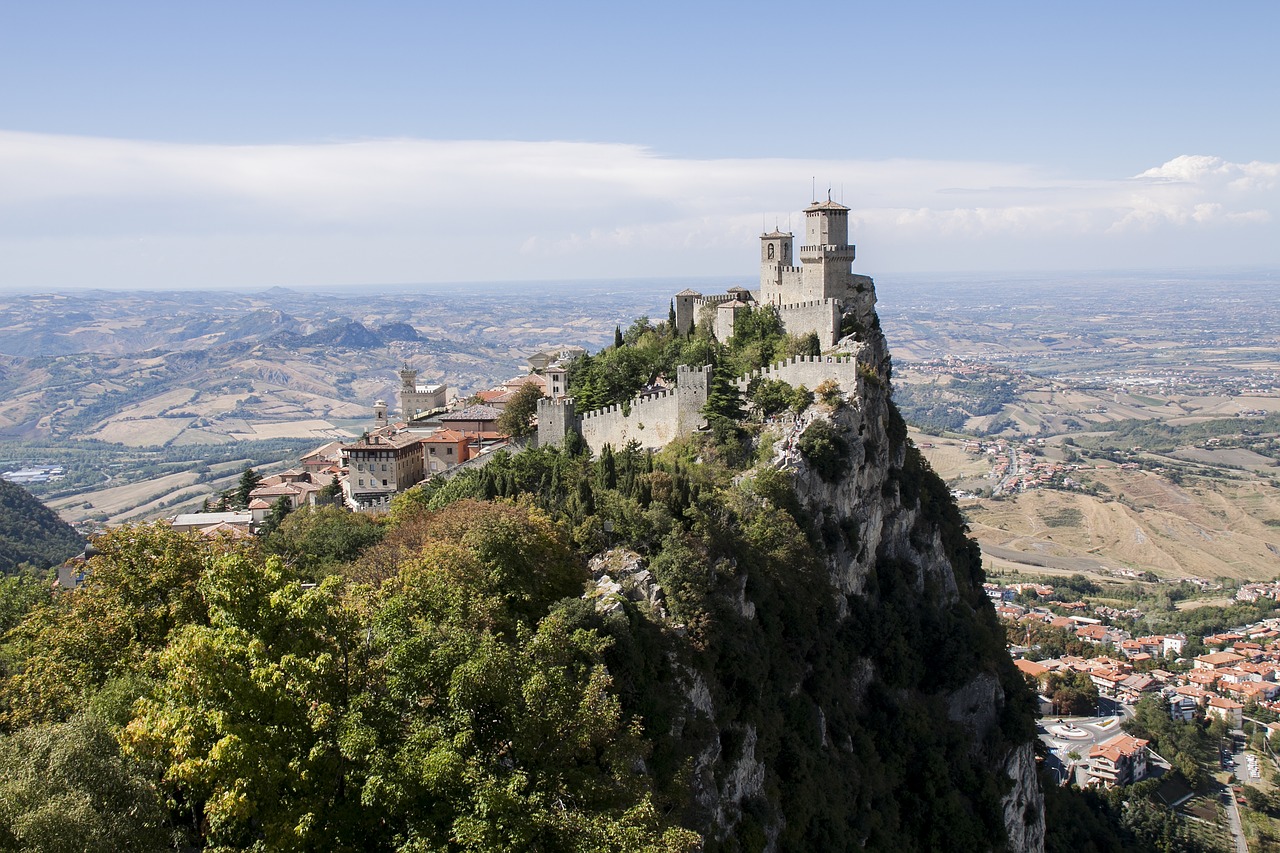
The City of San Marino — formally the Città di San Marino — is the capital of the Most Serene Republic of San Marino, the world's oldest surviving republic and one of the most remarkable political anomalies on Earth: a tiny, landlocked microstate of just 61 km² perched on the summit and slopes of Monte Titano, a rocky limestone outcrop rising 739 metres above the Adriatic coastal plain of northern Italy, entirely surrounded by the Emilia-Romagna and Marche regions of Italy and yet entirely independent of them for over 1,700 years. With a resident population of barely 4,000 people, the City of San Marino is one of the smallest capital cities in the world — a medieval hilltop fortress-city of extraordinary preservation, dominated by three ancient towers (Tre Torri) that crown the three peaks of Monte Titano and have defined the San Marinese skyline since the 11th century. The republic was founded, according to tradition, on 3 September 301 AD by a Christian stonemason named Marinus (later Saint Marinus) who fled the persecution of Emperor Diocletian and established a small community of Christian believers on the mountain — making San Marino's founding date the oldest of any surviving nation-state. The entire historic centre and Monte Titano were inscribed as a UNESCO World Heritage Site in 2008, recognised as an outstanding example of a medieval planned settlement that has preserved its historic urban fabric and traditional governance institutions intact.
Best Time to Visit San Marino & Weather Guide
San Marino's elevated position on Monte Titano gives it a slightly cooler and more dramatic climate than the Adriatic Riviera below — warm Mediterranean summers, mild springs and autumns, and genuine cold and sometimes snow in winter, creating a range of seasonal atmospheres each with its own character.
🌸 Spring (April–June)
The finest and most comfortable season to visit — temperatures of 15–24°C, the surrounding hillsides vivid with wildflowers, clear skies with dramatic views from the towers across the Adriatic plain (on exceptionally clear days, the sea is visible from the summit), and the tourist crowds of July–August still absent. April and May are particularly beautiful — the medieval streets are at their most atmospheric without the summer congestion, the light is soft and golden on the ancient stone, and the surrounding countryside is brilliantly green after the winter rains. Spring is the finest season for walking the battlements, photographing the towers, and exploring the historic centre in unhurried comfort. The Medieval Days festival (typically late July into spring preparation events) begins ramping up its schedule.
Best Time to Visit☀️ Summer (July–August)
Peak tourist season — temperatures of 26–32°C on the mountain (significantly cooler than the Adriatic coast below), brilliant sunshine, and the city at its most lively but also most crowded. July and August see the heaviest visitor traffic — the narrow medieval streets can become very congested midday, and accommodation must be booked months in advance. The summer season brings the finest events programme: the Medieval Days (Giornate Medievali) festival in late July transforms the historic centre into a living medieval pageant — tournaments, archery competitions, traditional costumes, and street performances of extraordinary colour and spectacle. The Crossbow Tournament between the ancient crossbow companies is one of the most atmospheric medieval re-enactments in Europe. Early morning visits (before 10am) and late evening strolls (after 7pm when day-trippers depart) offer the most tranquil summer experience.
Peak Season — Book Ahead🍂 Autumn (September–October)
An excellent and underrated time to visit — temperatures of 16–24°C, the crowds of August thinning rapidly, the hillsides turning gold and russet, and the light taking on the warm amber quality of the Italian autumn that makes every stone and tower glow magnificently. September is often considered the finest month: warm enough to be thoroughly comfortable, the summer bustle subsiding, and the historic centre returning to something approaching its everyday character. The San Marino Grand Prix — now held at the Misano World Circuit Marco Simoncelli near Rimini (40 minutes from the capital) — draws motorsport visitors to the region in September. October brings the first autumn chill to the mountain but the views, colours, and atmosphere are superb.
Excellent Alternative❄️ Winter (November–March)
San Marino's quietest and most atmospheric season — the tourist crowds virtually absent, the medieval streets returning to their everyday Sammarinese character, and the mountain occasionally dusted with snow that transforms the towers and battlements into a scene of extraordinary fairy-tale beauty. Temperatures range from 2–10°C, with cold winds on the exposed summit. December is particularly magical — the Christmas market in the Piazza della Libertà, the illuminated towers against the winter night sky, and the festive atmosphere of a small Italian-culture mountain city preparing for the holidays creates one of the most charming winter city-break experiences in Europe. The Epiphany celebrations (6 January) are observed with traditional Sammarinese ceremony. Fog is common in the Adriatic plain below — rising above it to sunshine on Monte Titano is one of winter's most rewarding surprises.
Quiet & AtmosphericSpring/Autumn (Apr–Jun, Sep–Oct): Layered clothing for temperatures that can range from 12°C in the morning to 24°C by midday. A light jacket or cardigan for the summit winds — Monte Titano's elevated position means it is always several degrees cooler and windier than the Adriatic coast below. Comfortable walking shoes with good grip are essential — the cobbled medieval streets and the path around the battlements are uneven and can be slippery when wet. San Marino's dress codes for churches and official buildings require covered shoulders and knees.
Summer (Jul–Aug): Light summer clothing but always carry a layer — the mountain breeze can be cool even on hot days. Sun protection (SPF 50+, hat, sunglasses) is essential on the exposed battlements and tower summits. Arrive early or late to avoid midday crowds and heat.
Winter (Nov–Mar): Warm winter clothing — coat, hat, gloves. The summit can be genuinely cold and windy. Waterproof shoes for potentially wet cobblestones. Snow is possible December–February — an extraordinary and memorable sight but can make the steep approach roads temporarily difficult.
Year-round: Cash (Euro) for small purchases, market stalls, and coin/stamp shops. San Marino issues its own Euro coins which are legal tender throughout the Eurozone but highly collectible — purchasing a set from the State Philatelic and Numismatic Office is the finest and most compact souvenir of the visit.
Top Attractions in the City of San Marino
The City of San Marino is compact enough to be thoroughly explored on foot in a single day — but the extraordinary density of medieval heritage, dramatic viewpoints, and unique cultural experiences rewards a longer stay.
🏰 The Three Towers (Tre Torri di San Marino)
The defining symbols of San Marino and the most iconic image in all of the republic — the Tre Torri (Three Towers), perched on the three rocky peaks of Monte Titano's ridge, are the medieval fortress system that has protected San Marino's independence for over a millennium. Guaita (the First Tower, 11th century) is the oldest and most photographed, its crenellated walls clinging to a sheer rock face with dizzying exposure. Cesta (the Second Tower, 13th century) houses a remarkable museum of medieval weapons — crossbows, swords, armour, and siege equipment — and offers the finest panoramic views from any point on Monte Titano: on clear days the Adriatic Sea, the entire Adriatic coastal plain, and the distant peaks of the Apennines are simultaneously visible. Montale (the Third Tower, 14th century) is a private tower not open to the public but visible from the battlements path. A combined ticket for Guaita and Cesta is the essential San Marino visit.
UNESCO — Must See🚶 La Passo delle Streghe & the Battlements Walk
The most atmospheric and rewarding walk in San Marino — the Passo delle Streghe (Witches' Pass), a narrow stone path cut into the sheer face of Monte Titano connecting the First and Second Towers along the exposed eastern ridge of the mountain, offers some of the most dramatic and vertiginous walking in any European capital: a medieval footpath barely a metre wide with the rock face rising on one side and an almost vertical drop to the valley floor far below on the other. The walk takes approximately 20–30 minutes between the towers and provides constantly changing views of the fortifications, the medieval city below, and the vast Adriatic plain stretching to the horizon. The experience of walking these ancient battlements — used by San Marinese defenders for over 800 years — is the single most memorable physical experience the republic offers.
Unmissable Walk🏛️ Palazzo Pubblico & Piazza della Libertà
The civic and ceremonial heart of the world's oldest republic — the Palazzo Pubblico (Public Palace), a neo-Gothic building completed in 1894 on the Piazza della Libertà, serves as the seat of San Marino's unique dual government: the republic is governed by two Capitani Reggenti (Captains Regent) — co-heads of state elected every six months from the Grand and General Council, a tradition unbroken since 1243. The changing of the guard ceremony at the Palazzo Pubblico — performed by the Guardia del Rocca in their historic Renaissance uniforms — takes place on the hour during opening times and is one of the most picturesque and genuinely historically rooted ceremonial displays in Europe. The palace's interior, open to visitors, contains the Council Chamber, state apartments, and historical artefacts of great significance to the republic's long history.
Heart of the Republic⛪ Basilica di San Marino & Saint's Relics
The spiritual centre of the republic and the most important church in San Marino — the Basilica di San Marino, a neo-classical building completed in 1838 on the site of earlier churches dedicated to the republic's founder, houses the relics of Saint Marinus — the stonemason-saint who founded the community on Monte Titano in 301 AD and whose memory and spiritual presence have defined Sammarinese identity for 17 centuries. The basilica's interior, with its marble columns, ornate side chapels, and the urn containing the saint's remains beneath the high altar, is a place of genuine devotion for many Sammarinese and a site of considerable historical gravity for the visitor. The adjacent Church of San Pietro contains the ancient niches in the rock face that, according to tradition, served as the beds of Saint Marinus and his companion Saint Leo — among the most ancient sacred sites in the republic.
Sacred Heritage🏺 Museo di Stato (State Museum)
The finest museum in San Marino and an essential complement to the outdoor medieval experience — the Museo di Stato (State Museum), housed in a series of elegant rooms in the historic centre, presents an outstanding collection spanning the full chronological range of San Marino's history and the wider archaeological heritage of Monte Titano: prehistoric and Roman artefacts from excavations on and around the mountain; early medieval objects from the period of the republic's foundation; Renaissance paintings, sculptures, and decorative arts; and a superb numismatic collection including San Marino's renowned coin issues from the 19th century to the present. The museum's coverage of the Roman-era heritage of the region — predating the republic's foundation by centuries — places San Marino's extraordinary longevity in its proper deep-historical context.
History & Artefacts🧀 Via Basilicius & the Historic Centre Shopping
San Marino's compact medieval street network — the Via Basilicius, Contrada del Collegio, and Contrada Omagnano — is lined with an extraordinary concentration of specialist shops selling the republic's most famous products: duty-free perfume, cosmetics, tobacco, and alcohol (San Marino's status outside the Italian VAT system makes it a traditional shopping destination for Italian day-trippers); collectors' postage stamps and commemorative coins from the State Philatelic and Numismatic Office (the republic's stamps are internationally renowned for their artistic quality and collectible value); locally produced ceramics, crossbow equipment, medieval replica weapons, and Sammarinese craft objects. The density of interesting specialist shops in a small medieval street network creates a pleasantly quirky shopping experience quite unlike any other European capital.
Unique Shopping🎯 Crossbow Tournament & Medieval Days
San Marino's most spectacular annual event and the finest expression of its living medieval heritage — the Crossbow Tournament (Palio Balestrieri) is held twice yearly (late May and early September) in the Piazza della Libertà, contested between San Marino's two ancient crossbow companies (the Balestrieri del Castello and the Balestrieri di Borgo) in their historic Renaissance-era costumes with traditional crossbows of 15th-century design. The tournament — a tradition maintained continuously since the medieval period — is preceded by a flag-throwing procession, drum corps, and the full ceremonial display of the republic's historic institutions. The Medieval Days festival in late July extends this medieval pageantry across an entire week: street performances, archery contests, falconry, craft markets, and the spectacular torchlit evening ceremonies that transform the ancient city into a living historical experience of quite extraordinary atmosphere.
Living Medieval Heritage🌅 Monte Titano Viewpoints & Panoramas
Monte Titano's exceptional elevation above the Adriatic plain — rising 739 metres from a coastline barely 25km away — provides panoramic views of a scale and drama quite disproportionate to San Marino's tiny size: from the tower summits and the battlements path, the entire northern Adriatic coastal plain from Rimini to Pesaro is spread below in a vast patchwork of cities, farmland, and the glittering sea beyond. On exceptionally clear days (most common in autumn and early spring after rain has washed the atmosphere), the Dalmatian coast of Croatia is visible across the water, and the full arc of the Apennine mountains provides a magnificent western backdrop. Sunrise from the Cesta Tower — when the mountain emerges from the pre-dawn sea of cloud and the first light strikes the ancient stone — is one of the most beautiful and unexpected views available from any European capital.
Panoramic ViewsLocal Food Recommendations
San Marino's cuisine is deeply rooted in the culinary traditions of the surrounding Emilia-Romagna and Marche regions of Italy — widely considered the richest and most celebrated culinary zone in Italy — with distinctive Sammarinese specialities that reflect the republic's mountain heritage, its unique political independence, and the agricultural traditions of Monte Titano's slopes.
🍽️ Must-Try Sammarinese Dishes
- Torta Tre Monti — San Marino's most celebrated and distinctive confection, and the republic's most recognisable culinary export: a layered wafer cake filled with chocolate and hazelnut cream and decorated with a chocolate exterior embossed with the image of San Marino's three towers — the Tre Torri that dominate the capital's skyline. The Torta Tre Monti is the definitive Sammarinese souvenir food and the cake most associated with the republic's national identity. Made by the Papini bakery — the traditional producer — it is available throughout the historic centre and in gift shops across the republic. The flavour is rich, sweet, and unambiguously indulgent — a concentrated expression of Italian pasticceria at its most characteristic.
- Fagioli con le cotiche (bean and pork rind soup) — one of the most deeply traditional and comforting dishes of the San Marinese mountain kitchen: slow-cooked borlotti beans with pork rind (cotiche), pancetta, and aromatic vegetables in a thick, richly flavoured broth that reflects the republic's peasant agricultural heritage and the mountain winters that shaped its cooking. Served with a generous pouring of the local extra-virgin olive oil and thick slices of piadina bread, it is one of the most satisfying and authentic traditional meals available in San Marino's restaurants and farmhouse trattorie.
- Nidi di rondine (Swallow's Nests pasta) — San Marino's most famous and visually distinctive pasta dish, and one of the most characterful preparations in the entire central Italian culinary tradition: rolled pasta sheets layered with roasted meat, cured ham, and cheese, rolled into cylinders and baked in béchamel sauce — the cross-section of each serving resembling a swallow's nest. Available at traditional restaurants throughout the historic centre and the surrounding Sammarinese villages, it is the dish most distinctly associated with Sammarinese identity and the one most frequently recommended by local residents as the essential taste of their republic.
- Piadina romagnola — the great flatbread of the Romagna tradition, and one of the finest and most versatile street foods in Italy: a thin, unleavened flatbread cooked on a terracotta griddle (testo), folded around fillings of prosciutto crudo, squacquerone cheese (a fresh, soft, slightly tangy Romagnola cheese of exceptional quality), rocket, and local cured meats, or simply dressed with olive oil and rosemary. Available at piadina stands and small cafés throughout San Marino and the surrounding region, it is the essential affordable lunch of the Adriatic coast and hills — simple, fresh, and deeply satisfying.
- Formaggio di fossa (pit cheese) — one of the most distinctive and unusual cheeses of the Emilia-Romagna and Marche tradition, produced in the area surrounding San Marino: sheep's milk cheese aged in tufa-rock pits (fosse) dug into the ground, where the anaerobic fermentation over 90 days produces a cheese of extraordinary intensity — pungent, crumbly, slightly sharp, with a complexity of flavour that rewards patient tasting. Available at specialist cheese shops and traditional restaurants throughout the republic. Best paired with local honey and a glass of Sangiovese di Romagna wine.
- Strozzapreti al ragù — the great pasta of the Romagnola tradition in its most classically Sammarinese form: hand-rolled strozzapreti ("priest-chokers" — a short, twisted pasta shape made by rolling the dough between the palms) served with a rich, slowly cooked meat ragù of pork and beef or wild boar, finished with local Sangiovese wine and aged Parmigiano-Reggiano. Available at every traditional trattoria in San Marino — the quality of the hand-rolled pasta distinguishes the finest establishments from the tourist-oriented restaurants on the main shopping streets.
🍷 Drinks & Wine Culture
- Sangiovese di San Marino / Brugneto — San Marino produces a small but characterful range of wines from vineyards on the slopes of Monte Titano and the surrounding hillsides, all made from the Sangiovese grape that dominates the Emilia-Romagna wine tradition. The republic's flagship red wine — Brugneto (DOC San Marino) — is a robust, cherry-fruited Sangiovese of genuine quality, aged in oak and produced in limited quantities that make it a prized discovery for visitors. The Tessano (a lighter, fresher Sangiovese) and the white Biancale are also worth seeking out at local restaurants and the republic's wine shops. San Marino wine is rarely found outside the republic — tasting locally is the only reliable opportunity.
- Grappa and amaro — San Marino's mountain heritage and Italian culinary tradition are both expressed in its excellent grappa (grape marc spirit) and locally produced amaro (bitter herbal digestif). The republic's grappa is produced from Sangiovese grape pressings — powerful, aromatic, and of high quality. An after-dinner ammazzacaffè (a shot of grappa or amaro after coffee) is as much a Sammarinese dining ritual as anywhere in northern Italy and is the correct conclusion to any traditional Sammarinese meal.
- Caffè culture — San Marino shares fully in the Italian espresso tradition: short, intensely concentrated, consumed standing at the bar in 60 seconds as a ritual punctuation of the day. The coffee at San Marino's historic-centre bars is of consistently high quality — a legacy of the Italian-culture tradition that defines the republic's social life. A morning cappuccino and cornetto (croissant) at a historic-centre café before the day-trippers arrive is one of the most pleasurable and authentically local ways to begin a day in the republic.
- Duty-free alcohol — San Marino's status outside the Italian VAT system has historically made it a destination for the purchase of duty-free spirits, wine, and tobacco at prices significantly below Italian retail. The republic's shops stock an extensive range of imported spirits, Italian and international wines, and local Sammarinese products. Visitors entering Italy from San Marino are subject to Italian customs allowances — check current limits before purchasing.
🍽️ Where to Eat — Local Tips
- Ristorante La Terrazza — the most panoramically situated restaurant in San Marino, with a terrace overlooking the Adriatic plain from the edge of the historic centre: classic Sammarinese and Romagnola dishes (nidi di rondine, strozzapreti, grilled meats) with what may be the finest view from any restaurant table in the republic. Prices are moderate for the location and quality — $18–30 per main course. Reserve for terrace tables in summer.
- Trattoria Buca San Francesco — one of the most traditional and reliably authentic restaurants in the historic centre: hand-rolled pasta, fagioli con le cotiche, local Brugneto wine, and the full range of Sammarinese home cooking in a stone-vaulted room of considerable atmosphere. Popular with Sammarinese residents — always a good sign. Budget $15–25 per main course.
- Piadina stands on Contrada del Collegio — the finest and most affordable eating in San Marino: the several piadina kiosks and small cafés along the main shopping street serve fresh, hot piadina with squacquerone, prosciutto, and rocket for $4–7 each. The essential quick lunch of the historic centre — eat standing at the counter like a local and watch the medieval city flow past.
- Ristorante Righi — San Marino's most acclaimed fine dining restaurant, occupying a prime position on the Piazza della Libertà with views of the Palazzo Pubblico: creative Sammarinese and modern Italian cuisine of considerable sophistication, an outstanding local and regional wine list, and service that matches any equivalent restaurant in Italy. The tasting menu (approximately €60–80 per person) is the finest single culinary statement available in the republic. Reserve well in advance.
- Gelaterias on Via Basilicius — San Marino's gelato is of the consistently high quality expected anywhere in northern Italy: genuine artisan production, seasonal flavours, and the proper dense, creamy texture of Italian gelato rather than the aerated imitation found in tourist destinations elsewhere in Europe. The gelaterias of the main shopping street are the finest quick and affordable pleasure the historic centre offers — a cone of stracciatella or pistachio consumed while walking the battlements is the most perfectly calibrated San Marino experience.
🏅 San Marino Stamps, Coins & Collectibles
- San Marino's most internationally celebrated cultural products are its postage stamps — issued since 1877, the republic's stamps are internationally renowned for their exceptional artistic quality, the originality of their subject matter (San Marino's designers have historically avoided political or royal portraiture in favour of art historical themes, landmarks, and international cultural subjects), and their collectible value among philatelists worldwide. The State Philatelic and Numismatic Office (Ufficio Filatelico e Numismatico) in the historic centre sells current and recent stamp issues, collector sets, and first-day covers at official face value — far below the prices at which they trade in the international philatelic market.
- San Marino's Euro coins — minted with the republic's own designs on the national side — are legal tender throughout the Eurozone but rarely enter general circulation outside the republic, making them highly sought after by numismatists. The State Numismatic Office sells annual collector coin sets and commemorative issues: a set of San Marino's current year Euro coins is simultaneously a practical souvenir, a piece of European monetary history, and a modest but genuine investment for the serious collector.
- Crossbow equipment and medieval reproductions — the republic's thriving crossbow tournament tradition has generated a specialist craft industry: authentic-quality reproduction crossbows, bolts, and medieval archery equipment of genuine craftsmanship are sold at specialist shops throughout the historic centre, alongside armour, swords, and heraldic items of varying quality. The finest reproductions are those sold by shops affiliated with the official crossbow companies rather than the more generic tourist-trade items.
- Ceramics from Monte Titano — the surrounding Emilia-Romagna and Marche regions are renowned for their majolica ceramic tradition, and several excellent ceramic studios in the San Marino historic centre and the surrounding republic's territory produce hand-painted plates, bowls, and decorative tiles with San Marinese heraldic and landscape motifs of genuine craft quality. The finest examples are signed by the individual ceramicist and represent the most durably beautiful souvenir of the visit.
Day Trip Itineraries from San Marino
San Marino's position in the heart of northern Italy's most culturally rich region — the Adriatic Riviera and the Emilia-Romagna — provides exceptional day-trip possibilities in every direction:
🏖️ Day Trip: Rimini — Adriatic Riviera & Roman Heritage
Travel time: 30 minutes by road or bus | Cost: €2–5 by public bus; taxi ~€25
San Marino's natural twin destination — Rimini, 25km east on the Adriatic coast, is simultaneously one of Italy's most celebrated seaside resorts (15km of sandy beach, the nonstop summer nightlife of the Riviera Romagnola) and one of the most historically significant Roman cities in northern Italy: the Arch of Augustus (27 BC — the oldest surviving Roman triumphal arch in Italy), the Tiberius Bridge (21 AD, still carrying traffic), and the extraordinary Tempio Malatestiano (the civic temple of the Malatesta lords, with a Renaissance exterior by Leon Battista Alberti encasing a medieval church) make Rimini's historic centre one of the finest concentrations of Roman and Renaissance heritage on the Adriatic. The seaside and the history make Rimini an ideal and effortless companion to a San Marino visit.
Essential Companion🎨 Day Trip: Urbino — Renaissance Masterpiece
Travel time: 1 hour by road | Cost: Car hire recommended; public bus available
One of the finest and least-visited Renaissance cities in Italy — Urbino, 60km south of San Marino in the Marche hills, is a UNESCO World Heritage City whose Palazzo Ducale (Ducal Palace of Federico da Montefeltro) is one of the supreme achievements of Italian Renaissance architecture and the home of the Galleria Nazionale delle Marche — an outstanding collection including Piero della Francesca's masterwork The Flagellation of Christ and Raphael's La Muta. Urbino was the birthplace of Raphael (his modest birth house is preserved as a museum) and one of the great centres of Renaissance intellectual life. The combination of UNESCO hill-town, world-class art gallery, and extraordinarily preserved medieval street plan makes Urbino one of the finest day trips in central Italy.
Renaissance Masterpiece🍝 Day Trip: Bologna — Italy's Food Capital
Travel time: 1.5 hours by road | Cost: Car hire; or train from Rimini to Bologna (~1hr, €10–15)
The gastronomic capital of Italy and one of Europe's great medieval university cities — Bologna, 100km northwest of San Marino, combines a magnificent historic centre of arcaded medieval streets (the longest arcade network in the world — 40km of covered porticoes) with the finest food culture in Italy: the birthplace of ragù alla bolognese, mortadella, tortellini, and tagliatelle al ragù. The Quadrilatero market district — a medieval street grid of specialist food shops, delicatessens, and produce markets — is the finest concentrated food shopping experience in Italy. The Due Torri (Two Towers), the Piazza Maggiore, and the Basilica di San Petronio are among the finest civic spaces in northern Italy. Bologna rewards a full day's exploration — arrive early and eat well.
Foodie Heaven🏛️ Day Trip: Ravenna — Byzantine Mosaic Capital
Travel time: 1 hour by road or train from Rimini | Cost: €5–8 combined museum ticket
One of the most extraordinary and undervisited art destinations in Europe — Ravenna, 70km north of San Marino on the Adriatic plain, was the capital of the Western Roman Empire, the Ostrogothic Kingdom, and the Byzantine Exarchate between the 5th and 8th centuries AD, and preserves eight UNESCO World Heritage monuments containing the finest surviving early Christian and Byzantine mosaics in the world: the Mausoleum of Galla Placidia (5th century), the Basilica di San Vitale, the Basilica di Sant'Apollinare Nuovo, and the Baptisteries of the Orthodox and Arian communities. The mosaics' gold-ground figures, luminous colour, and extraordinary state of preservation — largely untouched for 1,500 years — make Ravenna one of the great art-historical experiences in Italy and a perfect complement to San Marino's medieval heritage.
UNESCO MosaicsTourist Tips for San Marino
🚌 Getting Around
- The City of San Marino's historic centre is entirely pedestrianised — no private vehicles are permitted within the walls. The entire UNESCO historic centre can be walked thoroughly in 3–4 hours; a full exploration including all towers, museums, and the battlements walk requires a comfortable full day.
- By car from Rimini — the most practical approach: the SP68 road from Rimini (25km) winds up through the Sammarinese hillside to the city's main car parks at Piazzale L and Piazzale M — large covered and open parking areas at the base of the historic centre, connected to the pedestrian zone by lifts and escalators. Journey time from Rimini approximately 30 minutes. Pay parking at approximately €1.50/hour.
- Bus from Rimini — Bonelli Bus operates regular services between Rimini railway station and the San Marino Bus Terminal at Piazzale L: approximately 50 minutes, running multiple times daily, cost approximately €5 return. The bus service is reliable and provides the easiest access for visitors without a car. Timetables at the Rimini tourist office or online.
- Cable car (Funivia) — a historic cable car (funivia) connects the lower town of Borgo Maggiore (directly below the capital on the mountain road) with the historic centre: a 75-second ascent offering dramatic views of the fortifications and the surrounding landscape. Operating hours vary seasonally — check locally. The cable car is the most atmospheric and memorable way to arrive in the city from the valley below.
- San Marino issues its own tourist passport stamps — a souvenir entry and exit stamp in your passport, available from the tourist office for a small fee. Though not an official immigration document, the stamps are a popular and uniquely Sammarinese souvenir and a genuine novelty for passport collectors.
💡 General Safety & Travel Tips
- San Marino is exceptionally safe — one of the safest destinations in Europe with an extremely low crime rate. The primary visitor concern is the aggressive tourism infrastructure on the main shopping streets (souvenir shops targeting day-trippers) — which can obscure the genuine medieval character of the historic centre visible just a street or two away. Walk off the main tourist axis to find the authentic city.
- The Euro (EUR) is the currency. San Marino, though outside the EU, uses the Euro under a monetary agreement and issues its own Euro coins. ATMs are available in the historic centre. Credit cards are widely accepted. San Marino's duty-free status on tobacco and alcohol makes it notably cheaper for these products than Italy — a legacy of its traditional role as a shopping destination for Italian residents of the surrounding region.
- San Marino receives over 3 million visitors per year compared to a resident population of 34,000 — the ratio of tourists to residents is one of the highest in the world. In July and August the historic centre can feel overwhelmingly crowded between 10am and 5pm. Arrive before 9am or after 5pm (when day-trippers depart) for the most atmospheric and uncrowded experience. Staying overnight — when the city empties completely of visitors — transforms the experience entirely.
- San Marino has its own police force (the Corpo della Gendarmeria), military corps (the Corpo dei Gendarmi, the Guardia del Rocca, the Guardia di Rocca, and the Milizia), and border posts on the roads entering from Italy — though the borders are completely open and no passport control is exercised. The military and ceremonial corps are a genuine living institution rather than a tourist performance — they perform real security functions for the republic's government.
- Italy's 230V/50Hz electrical standard applies (Type F/L plugs). The Italian mobile phone networks (TIM, Vodafone, WindTre) provide coverage throughout San Marino — the republic does not have its own mobile network. EU roaming rules apply for European visitors.
Apply for Tourist Visa
San Marino has no border controls with Italy — access is entirely free for anyone entitled to enter Italy/the Schengen Area. Citizens of EU/EEA member states, the UK, USA, Canada, Australia, New Zealand, Japan, and most other developed nations with Schengen access can visit San Marino freely without any advance visa application. Visitors who require an Italian/Schengen visa must obtain one through the normal Italian embassy or consulate process before travel — San Marino does not issue its own visas. San Marino is not a Schengen member but observes an open border policy with Italy. A stay in San Marino does not count against your Schengen 90-day allowance by formal treaty, though this should be verified for your specific nationality. San Marino Visa Information
Important Emergency Numbers
🇸🇲 San Marino Emergency Contacts
- 🚑 Ambulance: 113
- 🔥 Fire Brigade: 118
- 👮 Police (Gendarmeria): 115
International Emergency Phone Numbers
Find Flights to San Marino
Nearest Airport: RMI — Federico Fellini International Airport, Rimini (25km / 30 minutes from San Marino city centre). San Marino has no airport of its own — all air access is via Rimini.
Airport Transfer: Taxi from Rimini Airport to San Marino approximately €30–40 (30 minutes). The Bonelli Bus service from Rimini railway station (connected to the airport by shuttle) to San Marino costs approximately €5 return and takes 50 minutes. Rimini Airport operates seasonal flights to destinations throughout Europe — year-round connections are more limited. Bologna Guglielmo Marconi Airport (BLQ), 100km northwest, is the major regional hub with year-round connections to most European capitals and intercontinental connections via Rome and Milan.
International Airport FinderCurrency in San Marino
The currency of San Marino is the Euro (EUR) — used under a monetary agreement with the European Union. San Marino is not an EU member but is permitted to mint its own Euro coins (distinguishable by the Sammarinese national design on the reverse) which are legal tender throughout the Eurozone. San Marino's duty-free status makes tobacco, alcohol, and perfume notably cheaper than in Italy. ATMs are available in the historic centre. Credit cards (Visa, Mastercard) are widely accepted. No currency exchange is needed for visitors arriving from the Eurozone.