Country's codes
International phone code for Sudan: +249
3 letters: SDN
2 letters (internet domain): .SD
Digital country code: 729
Standard EAN-13 (country barcode): Unassigned
 Olympic country code: SUD
Sudan
Sudan is a large and culturally diverse country in northeastern Africa. It has a Red Sea coastline and shares borders with Egypt, Libya, Chad, the Central African Republic, South Sudan, Ethiopia and Eritrea.
Current situation: Sudan has experienced a major armed conflict since April 2023. Security conditions, transport services, healthcare access and entry arrangements may change with little notice. Travellers should check current government travel advice before making any travel plans.
Useful Country Information
Area
Approximately 718,723 square miles. Sudan is one of Africa’s largest countries by area.
Population
This is based on the latest available World Bank population figure for 2024. Population estimates may vary because of displacement caused by the continuing conflict.
Capital
Khartoum is the official capital. During the conflict, many national government operations were temporarily conducted from Port Sudan.
Major Cities
Khartoum, Omdurman, Khartoum North, Port Sudan, Nyala, Kassala, El Obeid and Wad Madani.
Current city population figures are difficult to estimate because millions of people have been displaced within Sudan and across its borders.
Languages
Sudanese Arabic is widely spoken. English is also used, together with numerous indigenous languages including Nubian, Beja, Fur, Masalit and Nuba languages.
People and Culture
Sudan is home to many ethnic and cultural communities, including Arab, Nubian, Beja, Fur, Nuba, Masalit and other African groups.
Religion
Most Sudanese people are Sunni Muslims. The country also has Christian communities and followers of traditional African beliefs.
National Day
Sudan became formally independent from Anglo-Egyptian administration on 1 January 1956.
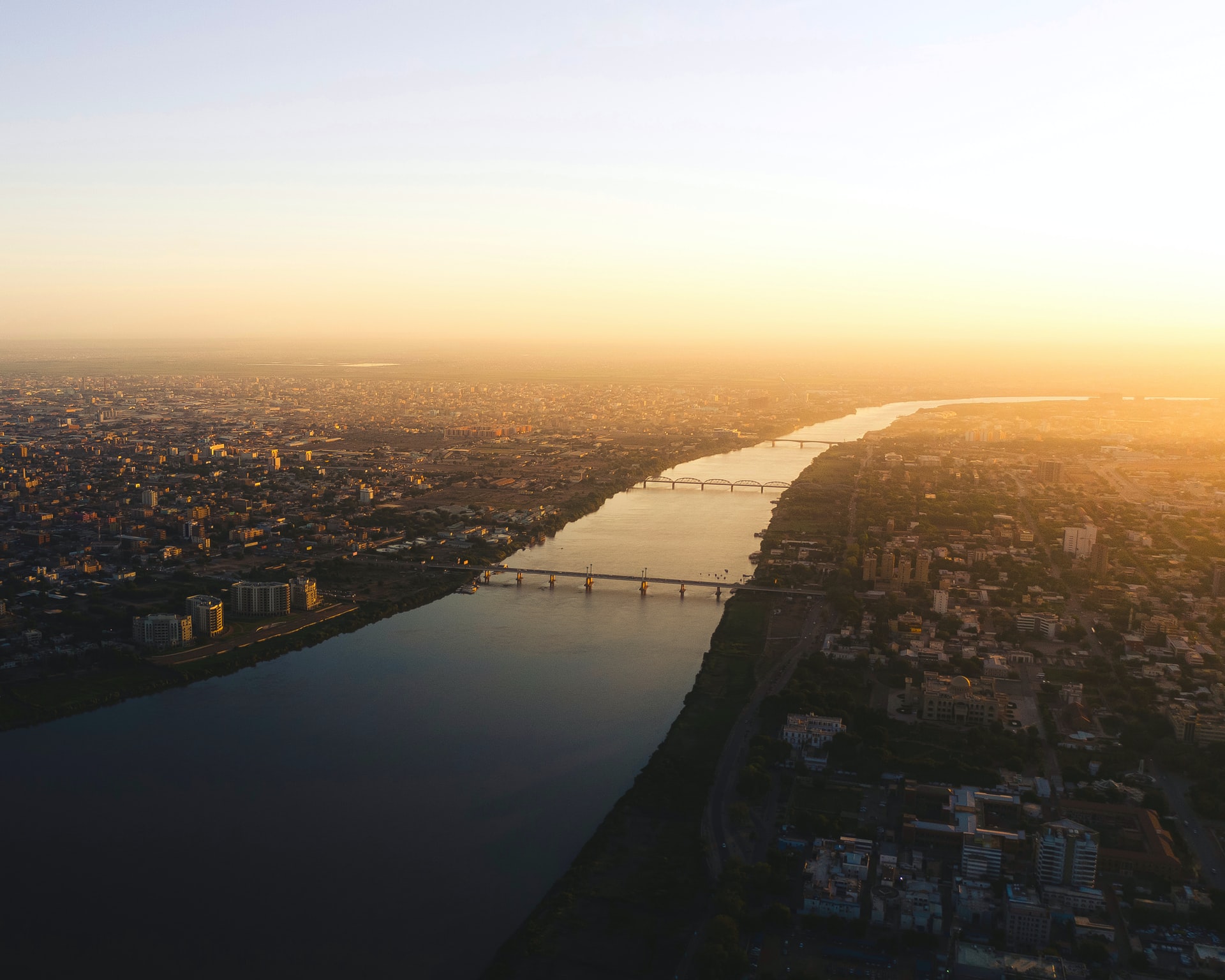
Khartoum

Geography
The Nile
The Blue Nile and White Nile meet at Khartoum and continue northward through Sudan toward Egypt. The river has played a central role in Sudanese settlement, agriculture, transport and history.
Landscape
Sudan’s landscape includes desert in the north, the Nile Valley, semi-arid plains, mountains, savannah and a coastline on the Red Sea. The climate is generally hot and dry, with seasonal rainfall that is greater in the south than in the north.
Red Sea Coast
Port Sudan is the country’s principal seaport and an important centre for trade. The Red Sea coast is also known for coral reefs and marine biodiversity, although travel conditions should always be checked before visiting.
Historical Background
Sudan has a long history that includes the ancient Kingdom of Kush, the Nubian kingdoms and later Islamic sultanates. During the nineteenth century, much of the region came under Turco-Egyptian control before the establishment of the Mahdist state in 1885.
Following the defeat of the Mahdist state, Sudan was administered under the Anglo-Egyptian Condominium from 1899. Sudan declared independence in December 1955 and formally became an independent country on 1 January 1956.
Political instability followed independence, with periods of civilian government, military rule and conflict between the central government and forces in southern Sudan. General Ibrahim Abboud seized power in 1958, and Colonel Jaafar Nimeiri took control following another coup in 1969.
The 1972 Addis Ababa Agreement temporarily ended the first civil war and granted autonomy to southern Sudan. Fighting resumed in 1983 after the southern autonomous region was dissolved and political and legal changes were introduced by the central government.
Omar al-Bashir came to power in a military coup in 1989. His government remained in control for almost 30 years. During this period, Sudan experienced continued conflict in the south and, from 2003, a major conflict in Darfur.
The Comprehensive Peace Agreement was signed in 2005 between the Sudanese government and the Sudan People’s Liberation Movement. It ended the second north–south civil war and provided for a referendum on southern independence.
Following the referendum, South Sudan became an independent country on 9 July 2011. Sudan and South Sudan nevertheless continued to face disagreements involving borders, oil resources and disputed areas.
Omar al-Bashir was removed from office in April 2019 after widespread protests. A military-civilian transitional arrangement was subsequently established, but the transition was disrupted by a military takeover in October 2021.
On 15 April 2023, fighting began between the Sudanese Armed Forces and the paramilitary Rapid Support Forces. The conflict spread across Khartoum, Darfur and other parts of the country, causing extensive destruction, severe food insecurity and one of the world’s largest displacement crises.
Advice for travellers: This country profile provides general geographical and historical information. It should not be used as confirmation that travel to Sudan is currently safe. Check the latest advice from your government, airline and travel insurance provider before arranging a journey.
Monetary unit: Dinar