Astana Weather
ASTANA WEATHERAbout Astana
Astana — previously known as NurSultan (2019–2022) and Akmola before that — is one of the most extraordinary capital cities on Earth: a gleaming, hypermodern metropolis of titanium domes, glass towers, and sweeping boulevards that has risen from the flat Kazakh steppe since 1997, when Kazakhstan's founding president Nursultan Nazarbayev made the audacious decision to move the national capital from Almaty to this remote, wind-battered city in the centre of the country. The result is one of the world's most remarkable planned capitals — a showcase of 21st-century architecture by some of the world's greatest designers, including Norman Foster (the iconic Khan Shatyr entertainment centre and the Palace of Peace and Reconciliation pyramid), and a city that feels simultaneously futuristic and deeply embedded in the nomadic Kazakh cultural tradition it was built to celebrate. Set on the banks of the Ishim River in the vast Eurasian steppe — one of the most extreme continental climates on Earth, with temperatures ranging from -40°C in winter to +40°C in summer — Astana is a city of breathtaking ambition and genuinely astonishing architectural spectacle. Kazakhstan is the world's largest landlocked country, and Astana's position at its geographical heart makes it the symbolic and practical centre of a nation that spans the breadth of a continent.
Best Time to Visit Astana & Weather Guide
Astana has one of the most extreme continental climates of any capital city in the world — blistering hot summers, savage winters, and two brief but beautiful shoulder seasons that represent the best windows for visiting.
🌸 Spring (May–June)
One of the two best seasons — the steppe awakens from winter with surprising speed and beauty: wildflowers carpet the grasslands around the city, the Ishim River runs high with snowmelt, and temperatures climb from around 12°C in May to a pleasant 22–26°C by June. The city's parks and boulevards turn green almost overnight. June is particularly fine — long days (almost 17 hours of daylight), warm temperatures ideal for exploring the outdoor architectural spectacles of the new city, and a festive energy as the city shakes off winter. The combination of still-snowy steppe on the horizon and summer warmth in the city creates extraordinary photographic opportunities.
Best Time to Visit☀️ Summer (July–August)
Astana's summer is hot, dry, and sunny — temperatures regularly reach 30–38°C in July and August, with low humidity making the heat more bearable than in humid cities. The steppe landscape turns golden and expansive in the summer heat, and the city's outdoor spaces — the waterfront, the new city boulevard, and the central park — are busy with local life. July hosts Astana's most important national celebration — Astana Day (July 6), the city's birthday, celebrated with spectacular concerts, fireworks, and cultural events. Summer is peak tourist season and the time when Astana's grand architectural ambitions are most fully on display under clear blue steppe skies.
Peak Season🍂 Autumn (September–October)
The second best season — September brings golden light, crisp air, and the steppe landscape at its most dramatically atmospheric. Temperatures are ideal for sightseeing (18–22°C in September, cooling to 5–10°C in October). The city's trees turn amber and gold, and the architectural landmarks glow in the low autumnal light. September is arguably the finest single month to visit Astana — warm days, cool evenings, no summer crowds, and the full cultural season (theatre, concerts, and exhibitions) in swing. By late October, the first frosts arrive and winter begins to close in rapidly.
Excellent❄️ Winter (November–March)
Astana's winter is one of the most extreme urban environments on Earth — temperatures regularly fall to -25°C to -35°C, with wind chill pushing the effective temperature far lower. The city is, however, superbly equipped for winter life: the underground shopping centres, the Khan Shatyr indoor resort, and the city's excellent heated public transport make it entirely possible to live and visit in extreme comfort. The architectural landmarks — particularly the Bayterek Tower and the Palace of Peace — are dramatically beautiful in heavy snow. Winter is low season with the lowest prices, but requires serious cold-weather preparation. A winter visit to Astana is a genuinely unforgettable and unique experience.
Extreme ColdSpring/Autumn: Layers are absolutely essential — Astana's spring and autumn weather can change dramatically within a single day. A warm jacket, thermal underlayer for evenings, comfortable walking shoes, and sun protection (SPF 50+) for the intense steppe sun.
Summer: Lightweight clothing for daytime, but always pack a light jacket — summer evenings can cool rapidly. Sun protection and a hat are essential; the steppe sun at 51°N latitude is intense and the city offers limited shade on its wide open boulevards.
Winter: This is one of the most demanding cold-weather environments you will encounter in any city. Pack a heavy-duty Arctic-grade coat (rated to at least -30°C), thermal base layers (wool or synthetic), a warm hat covering the ears, heavy gloves or mittens, a face covering/balaclava for wind chill, and fully waterproof insulated boots. Do not underestimate Astana's winter — it is not merely "cold", it is genuinely Arctic in character.
Year-round: A universal power adapter (220V, European sockets). A local SIM card for Yandex navigation. Small-denomination tenge banknotes for markets and taxis.
Top Attractions in Astana
Astana's attractions are unlike those of any other capital city — a collection of 21st-century architectural masterpieces set against the vast Eurasian steppe, punctuated by extraordinary museums of Kazakh nomadic culture and history.
🗼 Bayterek Tower
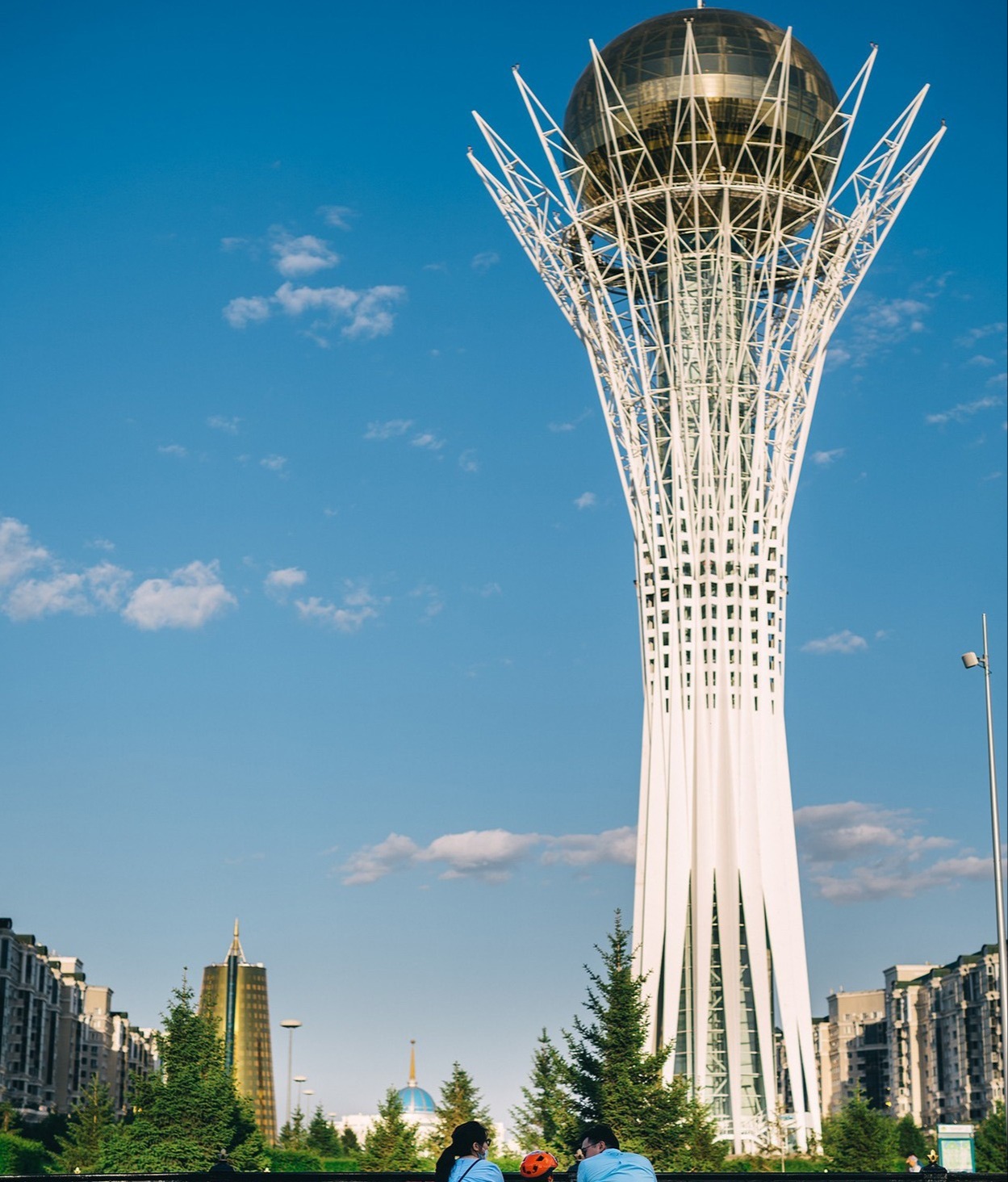
The most iconic landmark in Astana and the symbol of Kazakhstan's independence — Bayterek Tower is a 105-metre observation tower conceived by President Nazarbayev himself, based on the Kazakh myth of the sacred tree Bayterek (meaning "tall poplar"), in whose branches the legendary bird Samruk lays its golden egg of happiness. The structure — a slender white column topped by a gleaming golden sphere — contains a viewing platform at 97 metres offering extraordinary panoramic views over the new city's futuristic skyline and the flat steppe stretching to the horizon in every direction. Inside the golden orb, visitors can press their hand into a gilded imprint of Nazarbayev's palm — a uniquely Kazakhstani experience. One of the most photographed structures in Central Asia.
Iconic Symbol⛺ Khan Shatyr Entertainment Centre
One of the most extraordinary buildings in the world — Khan Shatyr (meaning "Khan's Tent"), designed by Norman Foster and Partners and completed in 2010, is the world's largest tent structure: a translucent ETFE-skinned tent 150 metres tall, 200 metres wide, and covering 140,000 square metres — larger than 10 football stadiums. Inside this climate-controlled marvel, regardless of the -30°C winter outside, visitors find a full-scale indoor city: a tropical beach resort with real sand and 35°C air temperature, a monorail, a waterpark, restaurants, shops, a park, and entertainment venues. The building's ETFE cushion skin allows sunlight to enter while retaining heat — a building that redefines what architecture can do in response to extreme climate.
Architectural Wonder🔷 Palace of Peace and Reconciliation
One of Norman Foster's most extraordinary and symbolically powerful buildings — the Palace of Peace and Reconciliation (also called the Pyramid of Peace) is a 62-metre glass and steel pyramid rising from the new city's central boulevard, its apex a stained-glass sun of multicoloured doves. The pyramid was built to host the Congress of Leaders of World and Traditional Religions — a triennial gathering of religious leaders from across the world that Astana hosts as part of Kazakhstan's role as a bridge between civilisations. The interior is a sequence of dramatic spaces: a 1,500-seat opera house at the base, a circular conference room in the apex, and a sun-filled atrium of extraordinary spatial power. Open to visitors outside congress sessions.
Must See🏛️ National Museum of Kazakhstan
Central Asia's largest and most ambitious national museum — the National Museum of Kazakhstan, opened in 2014 in a vast building adjacent to Independence Square, houses an outstanding collection tracing the full arc of Kazakhstani history and culture from prehistoric times to the present. The museum's greatest treasures are its extraordinary Golden Man reconstructions — based on the famous Scythian warrior burial discovered in 1969 near Almaty, whose gold-encrusted ceremonial armour is one of the most spectacular archaeological finds of the 20th century. The nomadic culture galleries — displaying yurt interiors, traditional Kazakh dress, ceremonial objects, and the entire material culture of the steppe nomads — are among the finest ethnographic displays in Central Asia.
Essential🕌 Hazrat Sultan Mosque
The largest mosque in Central Asia and one of the most architecturally magnificent in the Islamic world — Hazrat Sultan Mosque, completed in 2012, dominates the new city's southern skyline with its four 130-metre minarets and a central dome 51 metres in diameter. The mosque accommodates 10,000 worshippers inside and a further 30,000 in the surrounding courtyard. The interior is of extraordinary craftsmanship — hand-painted decorations, elaborate tile work, and an enormous chandelier of Swarovski crystal. Open to non-Muslim visitors outside prayer times. The combination of the mosque's pristine white marble against the blue steppe sky — particularly in winter under snow — is one of the most memorable architectural images in Kazakhstan.
Architectural Highlight🏙️ Nurzhol Boulevard & New City Architecture Walk
The spine of Astana's futuristic new city — Nurzhol Boulevard (formerly known as the left bank boulevard) is a 2km grand axis connecting the Bayterek Tower to the Presidential Palace (Ak Orda), flanked by the most concentrated collection of spectacular contemporary architecture in Central Asia. Walking the boulevard is an exercise in architectural astonishment: Norman Foster's Khan Shatyr and Pyramid at one end, Kisho Kurokawa's Ministry buildings in their bold metallic forms, the twin towers of the Transport Tower, the extraordinary House of Ministries, and the gleaming gold dome of the Presidential Palace (the largest in the world at 80 metres diameter). At sunset, the entire boulevard turns gold — one of the most photogenic urban spectacles in Asia.
Unmissable Walk🎡 EXPO 2017 Site — Future Energy Museum
Astana hosted the 2017 World Exposition on the theme of "Future Energy" — the EXPO site, now repurposed as a permanent visitor attraction, contains the spectacular spherical Nur Alem pavilion (the world's largest spherical building at 100 metres diameter), now operating as a museum of future energy and sustainable technology. The surrounding EXPO park contains numerous national pavilions transformed into permanent cultural attractions, restaurants, and event spaces. The site is a remarkable example of post-EXPO urban regeneration and remains one of Astana's most distinctive and photographically rewarding attractions, particularly at night when the Nur Alem sphere is dramatically illuminated.
Unique Attraction🌿 Central Park & Ishim Riverfront
Astana's most beloved outdoor space — the Central Park along the Ishim River waterfront provides the city's most pleasant and human-scaled environment: tree-lined promenades, fountains, cycling paths, and beautiful views of the new city's skyline reflected in the river. In summer, the riverfront comes alive with outdoor cafés, boat rentals, and the cheerful energy of Astana's young population enjoying its city. The Atameken ethnographic park — a remarkable open-air map of Kazakhstan with scale models of every significant historical, cultural, and architectural monument in the country — is one of the most entertaining and educational attractions in Astana, particularly for visitors planning to explore Kazakhstan more widely.
Local FavouriteLocal Food Recommendations
Astana's cuisine reflects Kazakhstan's rich nomadic pastoral heritage — a hearty, meat-centred cooking tradition shaped by centuries of steppe life, enriched by Russian, Uzbek, and international influences that have converged in this cosmopolitan capital.
🥩 Must-Try Kazakh Dishes
- Beshbarmak — Kazakhstan's most sacred and symbolic national dish: the name means "five fingers" — eaten by hand in the traditional nomadic manner. Wide, flat boiled noodles served with slow-cooked horse meat or lamb in a rich onion broth, presented on a large communal platter with the choicest cuts reserved for honoured guests according to strict Kazakh hospitality protocol. The head of the animal (served to the most senior guest), the hip bone (for respected elders), and the blade bone (for young men of promise) — beshbarmak is a meal of social meaning as much as nourishment. To be offered a full beshbarmak feast is to receive the highest expression of Kazakh hospitality.
- Horse meat dishes (kazy, shuzhuk, zhaya) — horse meat is the most prized and culturally significant food in Kazakh cuisine, reflecting the central role of the horse in nomadic life. Kazy (horse meat sausage cured in the horse's rib intestine), shuzhuk (a leaner spiced horse sausage), and zhaya (salted and smoked horse rump) are served cold as appetisers or incorporated into beshbarmak. The flavour of good kazy — rich, complex, slightly gamey, with a wonderful fat-to-meat ratio — is unlike any other sausage in the world. Available at every Kazakh restaurant and the central bazaar.
- Lagman — hand-pulled noodles in a rich, spiced lamb or beef broth with vegetables and chilli — the most beloved everyday dish in Astana. The Dungan and Uyghur communities of Kazakhstan produce some of the finest lagman in Central Asia: noodles pulled to extraordinary thinness by hand and served in a deep, aromatic broth of tomato, bell pepper, garlic, and cumin. A complete and deeply satisfying meal available at canteens throughout the city from morning to evening.
- Plov (pilaf) — the great rice dish of Central Asia, adopted and perfected by Kazakhstan's Uzbek and Kazakh communities: long-grain rice slow-cooked with lamb, rendered sheep fat, carrots, onion, garlic, and cumin in a cast-iron kazan until each grain is perfectly separate and golden. Astana's Uzbek-run plov houses — open typically only from 8am until the plov runs out (usually by noon) — produce some of the finest in Central Asia. Eaten communally from a shared large plate, plov is the definitive Central Asian celebration dish.
- Samsa — flaky, layered pastry baked in a tandoor oven and filled with spiced minced lamb and onion, or pumpkin in autumn. The tandoor-baked samsa — blistered, golden, and fragrant with lamb fat — is the definitive Kazakh street snack, available from street stalls and bakeries throughout Astana from early morning. The version made with horse meat filling is a Kazakhstani speciality not found elsewhere.
- Sorpa (broth) — the foundation of Kazakh cooking: a clear, deeply nourishing lamb or horse broth drunk from a bowl at the start of every traditional meal. Simple, clean, and restorative — particularly valued in Astana's brutal winters as the ideal warming drink. The best sorpa is made from the cooking liquid of beshbarmak: concentrated, golden, and fragrant with onion and black pepper.
🥛 Drinks & Street Food
- Kumiss (qymyz) — fermented mare's milk, the most culturally significant drink in Kazakhstan and one of the most ancient beverages in human history: mildly alcoholic, slightly carbonated, sharply sour, and deeply nourishing. Kumiss has been the staple drink of Kazakh nomads for over 5,000 years — fermented in leather bags strapped to horses, churned during the day's riding. In summer, fresh kumiss is available at specialist stalls, bazaars, and yurt restaurants throughout Astana. A glass of kumiss is among the most authentic and memorable food experiences in Central Asia — an acquired taste that rewards the brave.
- Shubat — fermented camel milk: thicker, richer, and more tart than kumiss, with a higher fat content and a complex, almost yoghurt-like flavour. Less widely available than kumiss but sold at the central bazaar and specialist Kazakh food stalls. Shubat is considered particularly nourishing and is traditionally given to convalescents and the elderly as a restorative drink.
- Kazakh tea culture — tea drinking is a profound social ritual in Kazakhstan. Black tea with milk (and often a pinch of salt in the traditional steppe manner) is drunk throughout the day from small decorated bowls (piyala). The host fills the bowl only partially — a full bowl means "go away"; a half-filled bowl invites continued conversation and hospitality. Every Kazakh home and yurt begins every interaction with the tea ritual. The finest accompanying items are baursak (small deep-fried bread puffs, irresistibly light and golden) and kurt (small hard balls of dried sour cheese — a traditional steppe trail food).
- Astana street food — the city's vast Green Bazaar and the street stalls around it offer extraordinary value: hot samsa from the tandoor, shashlik (lamb and beef skewers over charcoal), plov, and fresh lepyoshka bread for a full meal at $2–4. The food court in the Khan Shatyr — despite being in a tourist-oriented building — offers good quality Kazakh and Central Asian food at reasonable prices alongside international options.
- Astana's restaurant scene — a genuine surprise for first-time visitors: Astana has a sophisticated, diverse, and high-quality restaurant scene reflecting its status as a diplomatic capital and international business hub. Excellent Japanese, Italian, Georgian, and contemporary Kazakh restaurants sit alongside traditional Kazakh teahouses and Uzbek plov houses. The restaurant quality in Astana significantly exceeds what its remote steppe location might suggest.
🍽️ Where to Eat — Local Tips
- Green Bazaar (Zelyony Bazar) — the most authentic and affordable eating in Astana: a vast traditional covered market where Kazakh, Russian, Uzbek, and Dungan food stalls operate from dawn. Fresh lagman, hot samsa, plov, and the full range of Kazakh fermented dairy products and cured meats at prices far below any restaurant. The best cultural and culinary immersion available in the city.
- Alasha Restaurant — one of Astana's most celebrated traditional Kazakh restaurants, serving the finest beshbarmak in the city alongside a full repertoire of horse meat dishes, Kazakh salads, and traditional breads. The interior recreates a grand nomadic feast setting with yurt-inspired décor and traditional Kazakh music. Reservations essential for weekend evenings.
- Nauryz Restaurant — a consistently excellent upscale Kazakh restaurant in the new city, with beautiful interiors inspired by nomadic textile traditions and a menu that presents classical Kazakh cooking with contemporary refinement. Particularly good for visitors who want to experience the full range of Kazakh cuisine — from kazy appetisers through lagman and beshbarmak — in comfortable and photogenic surroundings.
- Uyghur and Dungan restaurants — Astana's significant Uyghur and Dungan communities (Muslim minorities of Central Asian Chinese heritage) operate some of the city's finest and most distinctive restaurants: hand-pulled lagman of extraordinary quality, ashlan-fu (cold noodles in vinegary broth — outstanding in summer heat), and spiced lamb dishes with Chinese-influenced flavours unavailable elsewhere in the city.
- Khan Shatyr food court and restaurants — the world's largest tent contains a surprisingly good selection of restaurants and cafés at a range of price points — convenient for visitors exploring the new city's architectural landmarks and useful in winter when outdoor eating is impossible.
🌿 Kazakh Nomadic Craft Culture
- Kazakh traditional craft culture is among the richest in Central Asia — shaped by millennia of nomadic life in which every object needed to be both beautiful and portable. The finest Kazakh crafts include felt carpet-making (syrmaq — patterned felt rugs in bold geometric designs of great sophistication), shyrdak (appliquéd felt work), and the extraordinary tekemet (rolled felt with woven patterns). UNESCO has recognised Kazakh felt-making as Intangible Cultural Heritage of Humanity.
- Silver jewellery and metalwork — Kazakh silversmiths produced some of the finest decorative metalwork in the nomadic world: elaborate saukele (tall ceremonial bridal headdresses encrusted with silver, coral, and feathers), belt ornaments, and horse harness decorations of extraordinary craftsmanship. The best Kazakh silver jewellery is still made by hand in traditional workshops — available at the Green Bazaar and the National Museum gift shop.
- The dombra — Kazakhstan's national instrument, a two-stringed plucked lute of great antiquity — is the sound of Kazakh soul. Traditional küy (instrumental compositions) and zhyrau (epic singing accompanied by dombra) are the highest expression of Kazakh musical culture. Small, high-quality dombras are available at the central bazaar and make one of the finest and most authentic Kazakh souvenirs.
- Kazakhstan's fine horse-breeding tradition produces extraordinary leather craft — saddles, bridles, and decorative leather items of exceptional quality that reflect the horse's central role in Kazakh culture. Decorated leather goods from certified craft cooperatives at the National Museum make outstanding and unique gifts.
Day Trip Itineraries from Astana
Astana's steppe location makes it a gateway to Kazakhstan's extraordinary natural and historical heritage — the following excursions reveal the full depth of this vast and little-visited country:
🌾 Day Trip: Burabay (Borovoe) National Park
Travel time: 2.5–3 hours by bus or shared taxi | Cost: ~$5–10 by shared taxi; park entry free
The most popular and beautiful excursion from Astana — Burabay National Park (known as the "Switzerland of Kazakhstan") is a landscape of extraordinary and improbable beauty in the middle of the flat steppe: granite massifs rising abruptly from the plain, blue alpine lakes of remarkable clarity, and birch and pine forests that seem entirely out of place in the surrounding grassland. The lakes of Burabay — Shchuchye, Burabay, and Bolshoye Chebachye — are excellent for swimming in summer. The famous Okzhetpes rock and the Sphinx granite formation are the park's most striking landmarks. An overnight stay at one of Burabay's lakeside sanatoriums is strongly recommended.
Top Excursion🏺 Day Trip: Saryarka Steppe & Ancient Sites
Travel time: 1–2 hours to various steppe sites | Cost: ~$20–40 for private tour
The vast Saryarka steppe surrounding Astana — a UNESCO World Heritage landscape — contains a remarkable density of prehistoric and early nomadic archaeological sites: Bronze Age burial mounds (kurgans) rising from the grassland in long lines, ancient balbal stone figures, Saka warrior burials, and Iron Age ritual enclosures. The steppe itself — flat, golden, and infinite in every direction under the enormous Central Asian sky — is one of the world's most extraordinary natural landscapes. An organised day tour with a specialist guide brings these otherwise inaccessible sites to life with the full context of Kazakh archaeological history.
Archaeological🐎 Day Trip: Kazakh Nomadic Culture Experience
Travel time: 30–60 minutes to steppe camps | Cost: ~$40–80 for full experience
Several authentic and well-run nomadic culture camps operate on the steppe within an hour of Astana, offering immersive experiences in traditional Kazakh nomadic life: sleeping in a traditional yurt, learning to cook beshbarmak, trying kumiss and shubat, participating in horsemanship demonstrations, and watching traditional eagle hunting displays. The Nomad Games — held biennially in Kazakhstan and attracting teams from 40+ countries competing in traditional Kazakh sports including kokpar (horseback polo with a goat carcass), kok-boru, and archery on horseback — represent the most spectacular expression of this living nomadic tradition.
Cultural Immersion✈️ Day Trip: Almaty — The Former Capital
Travel time: 1.5 hours by domestic flight | Cost: ~$30–80 return by Air Astana domestic flight
Kazakhstan's largest city and cultural capital — Almaty is dramatically different from Astana in every way: older, leafier, more bohemian, and set against the stunning backdrop of the Trans-Ili Alatau mountains with peaks rising to over 4,000 metres directly behind the city. The Panfilov Park cathedral, the Green Bazaar, the Big Almaty Lake in the mountains above the city, and the extraordinary Charyn Canyon (Kazakhstan's answer to the Grand Canyon, 3 hours by road) make Almaty an outstanding complementary destination to Astana for visitors with more time in Kazakhstan.
Essential PairingTourist Tips for Astana
🚌 Getting Around
- Astana is a large, spread-out city designed primarily around the car and wide boulevards — it is not a walkable city in the European sense, though the new city's Nurzhol Boulevard is pleasant to walk in good weather. The distances between major attractions are substantial — plan on using taxis or the bus network for most journeys.
- Yandex.Taxi — by far the most convenient, transparent, and affordable way to get around Astana. The app-based service offers metered pricing (no negotiation), good availability, and English-language interface. A cross-city journey typically costs $3–6. Download and set up the app before arriving in Kazakhstan.
- City buses — Astana has a comprehensive bus network covering the entire city including both the old city (right bank) and the new city (left bank). Fares are very low (80–160 KZT / under $0.50 per journey). The Yandex.Maps app shows live bus routes and schedules in English — essential for navigating the network.
- The new city's Nurzhol Boulevard — the main architectural showcase axis — is best explored on foot in good weather: approximately 2km from Bayterek Tower to the Presidential Palace, with all the major landmarks visible from the boulevard itself. Allow 2–3 hours for a leisurely architectural walk.
- For excursions out of the city — Burabay, steppe sites — private taxis and organised tours are the most practical options. Shared taxis (fixed-price marshrutkas) to Burabay depart from Astana's bus station when full.
💡 General Safety & Travel Tips
- Astana is a safe, well-policed capital city — Kazakhstan is one of the safest countries in Central Asia for international visitors. Standard urban precautions apply. Police presence is significant in the new city and around government buildings — avoid photographing security personnel or military installations.
- The Kazakhstani Tenge (KZT) is the local currency. USD exchanges well at banks and the numerous exchange bureaux throughout the city — bring crisp, undamaged bills. ATMs dispensing tenge are widely available in central Astana. Card acceptance is good at hotels, larger restaurants, and shopping centres; carry cash for bazaars and street food stalls.
- Kazakhstan offers visa-free access to citizens of 68 countries including the EU, USA, UK, Canada, Australia, and Japan for stays of up to 30 days (some nationalities 14 days). Citizens of other countries can apply for an e-visa online through the official Kazakhstani government portal — one of the most straightforward visa processes in the region.
- Photography of government buildings, the Presidential Palace, and military facilities is strictly prohibited. Photography of the spectacular public architecture — Bayterek, Khan Shatyr, the Pyramid — is of course entirely welcome and actively encouraged. Always ask permission before photographing individuals.
- Kazakhstan uses 220V/50Hz electricity with European-style two-pin sockets. A universal adapter is recommended for UK, US, and Australian devices.
- Local SIM cards from Beeline Kazakhstan or Kcell are available at the airport and throughout the city — cheap, fast 4G data at $5–10 for a generous data package. Essential for Yandex navigation and communication throughout Kazakhstan.
Apply for Tourist Visa
Kazakhstan offers visa-free entry to citizens of 68 countries — including all EU member states, the USA, UK, Canada, Australia, and Japan — for stays of up to 30 days (some nationalities 14 days), with no advance application required. Citizens of other nationalities can apply online for a straightforward e-visa through the official Kazakhstani government portal. Kazakhstan has one of the most progressive and welcoming visa policies in Central Asia — a deliberate effort to encourage international tourism and business investment. Check current requirements with the Kazakhstani embassy or the official e-visa portal for your specific nationality. Kazakhstan Visa Information
Important Emergency Numbers
🇰🇿 Astana Emergency Contacts
- 🚑 Ambulance: 103
- 🔥 Fire Brigade: 101
- 👮 Police: 102
International Emergency Phone Numbers
Find Flights to Astana
Astana Airport Code: NQZ — Astana International Airport, located approximately 17km south of the city centre
Airport Transfer: Taxis from Astana International Airport to the city centre take approximately 20–30 minutes (fare ~2,000–3,000 KZT / $4–6 by Yandex.Taxi). A public bus service also connects the airport to the city centre. Direct international flights connect Astana with Moscow, Istanbul, Dubai, Frankfurt, Beijing, Seoul, and a growing number of European and Asian destinations. Air Astana — Kazakhstan's national carrier and one of the most highly rated airlines in Central Asia — operates an extensive network of domestic and international routes from NQZ and is the primary carrier for the Astana–Almaty domestic route (the busiest in Kazakhstan).
International Airport FinderCurrency in Astana
The currency of Kazakhstan is the Kazakhstani Tenge (KZT). US dollars exchange readily at banks and the numerous exchange bureaux throughout central Astana — bring crisp, undamaged USD bills for the best rates. ATMs dispensing tenge are widely available. Card acceptance is good at hotels, restaurants, and shopping centres in the new city; carry cash for the Green Bazaar, traditional restaurants, and street food stalls.