Kathmandu Weather
KATHMANDU WEATHERAbout Kathmandu
Kathmandu is one of the most extraordinary cities on Earth — the capital of Nepal and the gateway to the Himalayas, a city where the sacred and the everyday are inseparably woven together in a way that is found nowhere else in the world. Set in the broad Kathmandu Valley at an elevation of 1,400 metres, surrounded by forested hills and — on clear days — the distant white wall of the world's highest mountain range rising to the north, Kathmandu is the religious, cultural, and political heart of one of Asia's most spiritually significant civilisations. The city is home to seven UNESCO World Heritage Sites within a single valley — the densest concentration of World Heritage monuments of any city on Earth — including the extraordinary medieval Durbar Squares of Kathmandu, Patan, and Bhaktapur, the living goddess Kumari's courtyard, the sacred Buddhist stupas of Boudhanath and Swayambhunath, and the Hindu cremation ghats of Pashupatinath. Kathmandu is simultaneously the world's most important centre of Tibetan Buddhism outside Tibet, a city of ancient Newar Hindu civilisation of extraordinary architectural and artistic sophistication, and the base camp for the world's greatest mountain adventures — the launching point for expeditions to Everest, Annapurna, Langtang, and the entire Himalayan range. For travellers, Kathmandu offers a depth and intensity of cultural, spiritual, and natural experience that is simply unmatched anywhere in Asia.
Best Time to Visit Kathmandu & Weather Guide
Kathmandu's climate is shaped by the South Asian monsoon cycle, creating four distinct seasons with two outstanding visitor windows — the post-monsoon autumn and the pre-monsoon spring — that bookend the trekking season and offer the finest mountain views of the year.
🍂 Autumn (October–November)
The finest and most popular season — the monsoon rains end in late September, leaving the sky washed crystalline clear and the landscape intensely green and fresh. The Himalayan peaks emerge from their monsoon cloud cover and are visible in extraordinary clarity from the Kathmandu Valley. Temperatures are perfect: 15–25°C, low humidity, and brilliant sunshine. October is Nepal's most festive month — the great Hindu festivals of Dashain and Tihar fill Kathmandu with colour, music, and extraordinary communal celebrations. The trekking season is at its absolute peak, the mountain views are at their most dramatic, and the city is at its most vibrant and alive. The single best month to visit Nepal.
Best Time to Visit🌸 Spring (March–May)
The second finest season — rhododendron forests on the surrounding hills and throughout the Himalayan foothills bloom in spectacular cascades of red, pink, and white from March through April. Temperatures are warm and climbing (18–28°C), the pre-monsoon haze reduces mountain visibility somewhat compared to autumn, but the landscape's floral beauty more than compensates. April is the prime month for high-altitude trekking — the classic Everest and Annapurna base camp treks are at their most accessible and socially vibrant, and the Kathmandu Valley's medieval cities are at their most lively before the summer heat builds.
Excellent🌧️ Monsoon (June–September)
The South Asian monsoon arrives in Kathmandu in June — bringing heavy daily rainfall (typically afternoon and evening), high humidity (80–90%), lush jungle-green landscapes, and significantly reduced mountain visibility. The monsoon is low season for trekking — many high-altitude trails are closed or dangerously slippery. However, Kathmandu itself remains fully accessible and the city's temples, museums, and cultural sites operate normally. The monsoon brings Kathmandu's rice paddies to brilliant green life and transforms the valley into a landscape of extraordinary lushness. Accommodation prices are lowest and the city has a quiet, genuinely local character.
Low Season❄️ Winter (December–February)
Kathmandu's winter is mild by mountain standards — temperatures average 2–15°C, with cold nights and warm, sunny days that make city sightseeing entirely comfortable. Mountain visibility is excellent: the winter sky is often the clearest of the year, and sunrise views of the Himalayas from Nagarkot or Chandragiri are spectacular in the crisp winter air. December and January are the coldest months — frost is occasional in the valley and snow falls on the hills above the city. Winter is low season with excellent accommodation prices. Ideal for cultural sightseeing in Kathmandu and the valley towns without the crowds of the peak trekking seasons.
Good for CultureAutumn/Spring (trekking seasons): Layers are essential — Kathmandu at 1,400 metres has warm days and cool evenings. For trekking, a full kit of thermal base layers, fleece mid-layer, waterproof outer shell, warm hat, gloves, and altitude-rated sleeping bag is required for any high-altitude trek. Good quality trekking gear can be hired or purchased very affordably in the Thamel district.
Monsoon (Jun–Sep): Lightweight, quick-dry clothing, a waterproof jacket or compact umbrella. Waterproof sandals or shoes for navigating wet streets. Accept that afternoons will be wet and plan morning sightseeing accordingly.
Winter (Dec–Feb): A medium-warm coat, thermal underlayers, warm hat and gloves for cold evenings and early mornings. Daytime can be very pleasant (15°C) with full sun — layers are essential for the temperature variation.
Year-round: Altitude awareness — Kathmandu at 1,400m causes mild symptoms in some visitors, particularly those arriving from sea level. Rest on arrival day, stay hydrated, and avoid alcohol on the first night. For treks above 3,000 metres, acclimatisation protocols are critically important. Modest clothing for temple visits (shoulders and knees covered). Insect repellent for evening use during and after monsoon.
Top Attractions in Kathmandu
Kathmandu and the surrounding valley contain the most extraordinary concentration of living UNESCO World Heritage monuments in the world — medieval cities, sacred stupas, and ancient temple complexes that have remained in continuous use for over a thousand years.
🏛️ Kathmandu Durbar Square — UNESCO Heritage
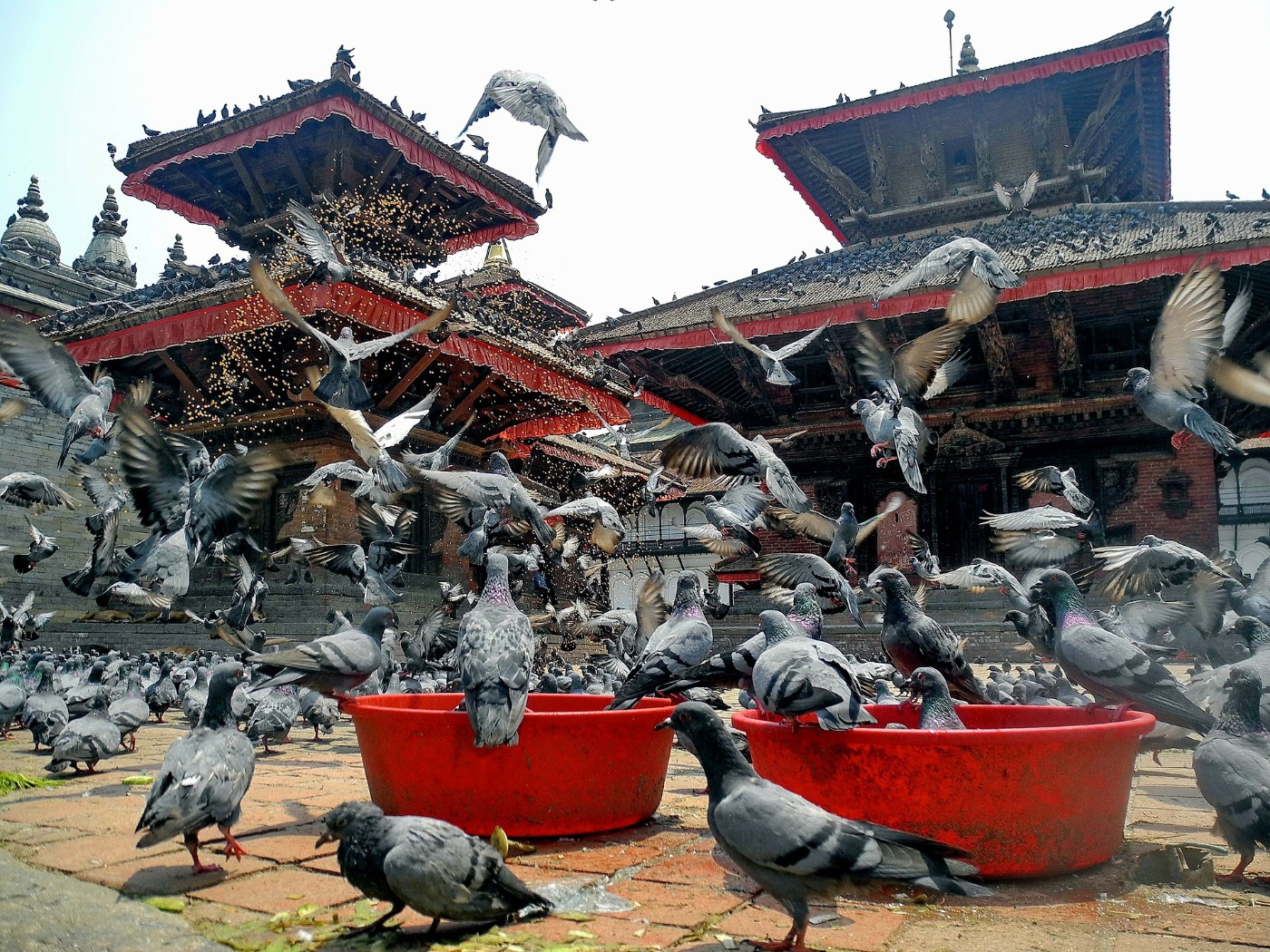
The ancient royal heart of the city — Kathmandu Durbar Square (Hanuman Dhoka), a UNESCO World Heritage Site, is a magnificent complex of palaces, temples, and courtyards built by the Malla kings between the 12th and 18th centuries and continued by the Shah dynasty that followed. The square's centrepiece is the Kumari Ghar — the elaborately carved wooden palace of the Kumari (the living goddess), a young pre-pubescent girl selected through an extraordinary ceremonial process to embody the goddess Taleju, who makes rare appearances at her palace window to the reverent faithful below. The towering pagoda temples, the beautifully carved wooden windows and struts, and the blend of Hindu and Buddhist iconography create an architectural ensemble of profound beauty and spiritual power.
UNESCO Heritage🕌 Boudhanath Stupa — UNESCO Heritage
One of the most sacred Buddhist sites in the world and the largest stupa in Nepal — Boudhanath is a vast, whitewashed dome surmounted by a gilded tower painted with the all-seeing eyes of the Buddha, rising from a mandala-shaped base in a neighbourhood that is the centre of Tibetan Buddhist culture outside Tibet. Walking the kora (circumambulation path) around the stupa's base — past hundreds of prayer wheels, monks in saffron robes, Tibetan pilgrims spinning prayer wheels and murmuring mantras, and the butter lamps of dozens of monasteries illuminating the surrounding lanes — is one of the most profoundly moving spiritual experiences available in Asia. At dawn, when the mists rise from the surrounding fields and the first monks begin their circuits, Boudhanath is transcendently beautiful.
UNESCO Heritage🛕 Pashupatinath Temple — UNESCO Heritage
The holiest Hindu temple in Nepal and one of the most sacred Shiva shrines in the world — Pashupatinath, on the banks of the sacred Bagmati River, is a living temple complex of extraordinary religious and cultural intensity. Non-Hindus may not enter the main temple but are welcome to observe from the opposite bank of the Bagmati — where the experience of watching Hindu cremation ceremonies on the stone ghats, Sadhu holy men covered in ash with trident staffs seated in meditation, and the daily rituals of one of Hinduism's most sacred sites creates an encounter with mortality and devotion of profound depth. The surrounding forest of subsidiary temples, Shiva lingams, and golden-roofed shrines is open to all visitors.
UNESCO Heritage🕊️ Swayambhunath — The Monkey Temple
One of the most atmospheric and symbolically rich sacred sites in Asia — Swayambhunath (the "Monkey Temple"), perched on a forested hilltop above the Kathmandu Valley, is an ancient stupa complex whose all-seeing Buddha eyes on its gilded tower gaze across the valley in all four directions. The climb up 365 stone steps — lined with carved Buddhas, prayer flags, and the resident monkey population that gives the site its popular name — arrives at a summit of extraordinary visual and spiritual power: prayer wheels, shrines, vajra (thunderbolt) symbols, Buddhist and Hindu iconography coexisting in the syncretic manner that is uniquely Nepali. The view over Kathmandu from the summit — the city spreading across the valley with the Himalayan panorama behind — is one of the finest in Nepal.
UNESCO Heritage🏰 Patan Durbar Square — UNESCO Heritage
The most refined and architecturally extraordinary of the three Kathmandu Valley Durbar Squares — Patan (also called Lalitpur, "City of Beauty"), just 5km from central Kathmandu, was the capital of a separate Malla kingdom and contains a concentration of medieval Newari architecture — carved wooden palace windows, bronze-doored temples, gilded rooftop struts, and stone sculpture of extraordinary quality — that many visitors consider even more beautiful than Kathmandu's own Durbar Square. The Patan Museum within the old palace complex is the finest museum of Himalayan art in Nepal: an outstanding collection of bronze deities, ritual objects, and religious art presented in beautifully restored palace rooms.
UNESCO Heritage🏙️ Bhaktapur — The Living Medieval City
The most perfectly preserved medieval city in the Kathmandu Valley — Bhaktapur ("City of Devotees"), 13km east of Kathmandu, is a UNESCO World Heritage Site that gives the most vivid and complete impression of what the entire valley looked like before modernisation: cobblestone lanes, traditional Newari brick houses with elaborately carved wooden windows, pottery workshops, and religious courtyards operating exactly as they have for centuries. The 55-Window Palace, the golden Nyatapola Temple (the tallest in Nepal), and the extraordinary Peacock Window — one of the most beautiful examples of wood carving in the world — make Bhaktapur a destination of the first rank for anyone interested in South Asian art and architecture.
Medieval Gem🗻 Himalayan Mountain Views — Nagarkot & Chandragiri
The Kathmandu Valley's surrounding ridges offer some of the most spectacular mountain panoramas accessible from any capital city in the world. Nagarkot (32km east, 2,175 metres elevation) is the classic sunrise viewpoint: on clear autumn and winter mornings, a panorama of over 20 Himalayan peaks is visible — including Everest, Lhotse, Cho Oyu, and the entire Langtang range — from a hilltop village of lodges and teahouses just 2 hours from Thamel by taxi. Chandragiri (cable car accessible from the city's western edge) offers similar panoramic views with the convenience of a 10-minute cable car ascent. A Nagarkot overnight followed by a dawn mountain view is one of the finest experiences accessible from Kathmandu.
Mountain Views🛍️ Thamel District & Asan Bazaar
Kathmandu's most characterful and visitor-friendly neighbourhoods — Thamel, the city's historic traveller district, is a dense labyrinth of narrow lanes lined with trekking gear shops, bookshops, handicraft stores, thangka (Buddhist scroll painting) galleries, restaurants, and rooftop cafés — the essential base for every visitor to Nepal and the best place in Asia to assemble a full trekking kit at remarkably low prices. The adjacent Asan Bazaar — an ancient trading crossroads where Kathmandu's traditional spice trade, grain market, and handicraft vendors operate in lanes unchanged since the medieval period — is the most authentic and immersive market experience in the valley, crowded with local life at every hour of the day.
Essential BaseLocal Food Recommendations
Nepali cuisine is a hearty, warming, mountain cooking tradition shaped by altitude, agricultural heritage, and the extraordinary diversity of Nepal's ethnic groups — from the Newari feast culture of the valley to the Tibetan-influenced cooking of the high mountain communities.
🍛 Must-Try Nepali Dishes
- Dal bhat — the national dish and the sustaining foundation of Nepali daily life: lentil soup (dal) poured over steamed rice (bhat), accompanied by vegetable curry (tarkari), spinach or seasonal greens (saag), fermented pickles (achar), and often a small amount of meat curry. Eaten twice a day by most Nepalis — and by trekkers who quickly discover why: the combination of slow-release carbohydrate from the rice, protein from the lentils, and micronutrients from the vegetables provides extraordinary sustained energy at altitude. The defining characteristic of a good dal bhat house: tauko bhayo bhaney — refills are free and expected. The dish that feeds the Himalayas.
- Momos — Nepal's most beloved and internationally recognised dish: steamed (or fried) dumplings filled with spiced minced buffalo, pork, chicken, or vegetables, served with a tomato and chilli dipping sauce of addictive intensity. The Tibetan and Newari origins of the momo have been thoroughly absorbed into Nepali national food culture — momo stalls operate on virtually every street in Kathmandu from morning to midnight, and the quality of the best Thamel and Asan momo houses rivals anything in the Tibetan world. The jhol momo variant — momos served in a spiced, aromatic soup broth — is a Kathmandu speciality of remarkable comfort.
- Newari feast dishes (Newari khaja set) — the indigenous Newar people of the Kathmandu Valley have one of the most sophisticated and distinctive culinary traditions in South Asia: a full Newari khaja (snack) set brings together beaten rice (chiura), buffalo meat (choila — grilled and spiced), black-eyed beans (bodi tarkari), spiced potato (aloo achaar), fermented bamboo shoots (tama), and home-brewed rice wine (aila) in a spread of extraordinary variety and flavour complexity. The Newari feast is a culinary exploration of a civilisation — best experienced at a traditional Newari restaurant in Patan or the old city lanes near Durbar Square.
- Thukpa — the definitive Tibetan-Nepali noodle soup: thick hand-rolled wheat noodles in a clear, deeply flavoured broth of yak bone (or beef), vegetables, and Himalayan spices — warming, nourishing, and perfectly calibrated to cold mountain evenings. The best thukpa in Kathmandu is found at the Tibetan restaurants around Boudhanath stupa, where it is prepared to the highest standard by Tibetan refugee cooks who have been making it their entire lives.
- Sel roti — Nepal's most beloved sweet street snack: a ring-shaped, deep-fried rice bread with a crispy exterior and a slightly sweet, chewy interior, prepared in large batches for festivals (particularly Dashain and Tihar) and sold at street stalls throughout Kathmandu year-round. Eaten hot from the oil with sweet tea or with achar, sel roti is the most distinctively Nepali street food — the smell of frying sel roti is one of the great sensory signatures of Kathmandu's streets.
- Yomari — the Newar community's most celebrated ceremonial sweet: a steamed rice-flour dumpling in the shape of a fish or a teardrop, filled with liquid jaggery and sesame seeds (or khuwa — condensed milk) — sticky, rich, and deeply satisfying. Made specifically for the Yomari Punhi festival in November–December and available at Newari sweets shops throughout the year, yomari is a unique culinary experience found only in the Kathmandu Valley.
☕ Drinks & Street Food
- Nepali chiya (spiced tea) — the defining drink of Nepal and one of the world's great tea traditions: strong black tea brewed with milk, sugar, cardamom, ginger, and sometimes cinnamon and cloves — thicker, sweeter, and more intensely spiced than Indian chai, and served in small glasses at tea stalls throughout Kathmandu from dawn to dusk. Nepali chiya culture — the pavement tea stall as social institution, the ritual of the morning glass before the day begins — is as fundamental to Kathmandu's urban life as café culture is to Paris. A glass costs 20–30 NPR ($0.15–0.25) and is one of the great value pleasures of travel in Nepal.
- Tongba and raksi — Nepal's most distinctive traditional alcoholic drinks. Tongba — a warm fermented millet drink consumed by inserting a bamboo straw into a container of fermented millet and sipping the warm liquid that filters through — is the traditional drink of the Himalayan hill communities (particularly the Rai and Limbu peoples) and is available at Thamel restaurants as a warming winter drink of great charm. Raksi — home-distilled grain spirit — is the Nepali equivalent of moonshine: fierce, clear, and consumed at every ceremony and celebration in village Nepal.
- Lassi and fresh juices — Kathmandu's Thamel district has an outstanding range of fresh juice bars: mango, papaya, apple (Himalayan hill apples are of extraordinary quality), pomegranate, and mixed tropical juices blended fresh for $1–2. The traditional Nepali lassi — yoghurt blended with water and salt (or sugar) — is one of the finest digestive drinks in South Asia: cooling, probiotic, and deeply refreshing after a morning of temple-climbing in the Kathmandu heat.
- Kathmandu street food circuit — the lanes of Asan Bazaar, Indra Chowk, and the old city offer the most concentrated street food experience in Nepal: sel roti from early morning, momo stalls operating all day, chatamari (Newari rice flour crepes with egg and meat topping) at traditional snack houses, roasted corn and sweet potatoes over charcoal in the colder months, and the extraordinary panipuri (crispy hollow spheres filled with spiced potato and tamarind water) at every bazaar corner. Kathmandu street food is remarkably affordable — a full street food tour costs $3–5.
- Coffee in Thamel — Nepal's coffee culture has developed significantly in recent years: excellent Nepali specialty coffee (grown in the Gulmi and Kaski districts of the mid-hills) is now available at a growing number of quality cafés in Thamel and the Lazimpat district. Nepali coffee — light-roasted, bright, and floral — is a revelation for visitors who expected only tea, and the rooftop café culture of Thamel (good coffee, mountain views, book exchange shelves) is one of the most pleasurable aspects of Kathmandu base-camp life.
🍽️ Where to Eat — Local Tips
- Newari restaurants in Patan old city — the most authentic and sophisticated Nepali dining in the valley: traditional Newari restaurants serving full khaja sets (chiura, choila, aloo achaar, tama, bodi, and aila) in old haveli buildings around Patan Durbar Square. The experience of eating a full Newari spread in a 200-year-old courtyard building while listening to traditional music is one of the finest cultural dining experiences in South Asia. Prices are very modest — $5–8 for a full khaja set with aila.
- Momo houses near Asan Bazaar — the best momos in Kathmandu are not in the tourist restaurants of Thamel but at the small, crowded local momo stalls in the lanes around Asan and Indra Chowk: freshly made, thin-skinned, generously filled, and served with a tomato-chilli sauce of genuine quality. A full plate (10 momos) costs 120–150 NPR ($0.90–1.15) — the finest value meal in Nepal.
- Thakali restaurants (Newa Lahana, Thakali Kitchen) — the Thakali community of the Mustang district produces some of Nepal's finest cooks, and Thakali dal bhat sets — served with multiple vegetable curries, excellent dal, homemade achar, and fresh rotis — are considered the gold standard of Nepali home cooking in Kathmandu. Available at dedicated Thakali restaurants throughout the city at $3–6 for a full unlimited set.
- Rooftop restaurants in Thamel — Thamel's rooftop dining scene is outstanding: restaurants with mountain views (on clear days), good Nepali and international food, cold Everest beer, and the extraordinary spectacle of Kathmandu's rooftop cityscape at sunset. OR2K, The Roadhouse Café, and Fire and Ice are long-established Thamel institutions beloved by trekkers and first-time visitors alike.
- Boudhanath monastery cafés — the lanes around Boudhanath stupa are lined with excellent Tibetan-run cafés and restaurants: butter tea, thukpa, momos, and tsampa (roasted barley flour — the Tibetan staple) in a setting of extraordinary peace and spiritual atmosphere. The best place in Kathmandu for an early morning breakfast while watching the first circumambulation of the stupa begin at dawn.
🌿 Nepali Craft & Spiritual Heritage
- Thangka painting — the Kathmandu Valley is the world centre of Tibetan Buddhist thangka scroll painting: fine silk or cotton paintings of Buddhist deities, mandalas, and sacred cosmological diagrams produced by skilled Newari and Tibetan artists in traditional techniques unchanged for centuries. The finest thangkas — painted with mineral pigments including genuine lapis lazuli and gold dust on hand-prepared cotton — are works of great spiritual and artistic power. The thangka workshops of Boudhanath and the galleries of Thamel range from mass-produced tourist pieces to genuine works of art requiring months of meticulous painting. A high-quality thangka from a reputable Kathmandu studio is among the finest and most meaningful souvenirs available in Asia.
- Singing bowls — Himalayan bronze singing bowls, produced by traditional metalworkers throughout Nepal and Tibet, are among the most distinctive and universally recognised Nepali craft objects: struck or rubbed with a wooden mallet to produce sustained, resonant tones used in meditation and healing practices. The best bowls are hand-hammered from a seven-metal alloy (including gold and silver) and produce complex, sustaining tones of great beauty. Available at every Thamel shop — quality varies enormously; ask for a demonstration before purchasing.
- Pashmina wool — Nepal is one of the world's finest sources of authentic pashmina: the extraordinarily fine, soft wool of the Himalayan mountain goat (Capra hircus), woven into shawls, scarves, and blankets of exceptional lightness and warmth. Genuine pashmina — requiring a certified laboratory test to distinguish from the acrylic imitations sold throughout Thamel — is available from reputable dealers in the Lazimpat and Durbar Marg areas. A genuine pashmina shawl is one of the finest and most practical souvenirs from Kathmandu.
- The extraordinary Newari woodcarving tradition — visible throughout the Durbar Squares, temple struts, and palace windows of the Kathmandu Valley — continues in active workshops in Bhaktapur and Patan, where carvers produce both traditional religious objects and contemporary decorative pieces. Hand-carved wooden windows, Ganesh figures, and decorative panels in the traditional Newari style are among the most distinctive large-format souvenirs available in Nepal.
Day Trip Itineraries from Kathmandu
Kathmandu's position at the heart of the valley and at the gateway to the Himalayas makes it one of the world's great bases for exploration — day trips of extraordinary variety are accessible within 1–3 hours:
🏙️ Day Trip: Bhaktapur — The Living Medieval City
Travel time: 30–45 minutes by taxi or bus | Cost: ~$2–5 by local bus; Bhaktapur entry fee ~$15 (included in heritage ticket)
The most perfectly preserved medieval city in South Asia — Bhaktapur, 13km east of Kathmandu, offers the most complete and authentic impression of traditional Newari civilisation. The three interconnected Durbar Squares contain the 55-Window Palace, the five-tiered Nyatapola Temple (Nepal's tallest), and the legendary Peacock Window — one of the most exquisitely carved wood panels in world art. The pottery quarter, the traditional craft workshops, and the taste of Bhaktapur's famous juju dhau (the "king of curd" — a thick, sweet buffalo curd sold in terracotta bowls that is the finest yoghurt in Nepal) complete a day of extraordinary cultural depth.
UNESCO Essential🌄 Day Trip: Nagarkot Sunrise & Himalayan Panorama
Travel time: 1.5–2 hours by taxi | Cost: ~$20–30 return by taxi
The most spectacular mountain view accessible from any capital city in the world — Nagarkot (2,175 metres, 32km east of Kathmandu) provides panoramic views of the Himalayan range from Dhaulagiri in the west to Kanchenjunga in the east: over 20 peaks including Everest visible on clear autumn and winter mornings. The standard approach is an overnight stay at one of Nagarkot's simple hilltop lodges, rising at 5am for dawn over the mountains — an experience of overwhelming natural grandeur. A day trip is possible in clear weather, but the sunrise is the defining moment and worth the overnight stay.
Unmissable🏔️ Multi-Day: Everest Base Camp Trek
Travel time: Flight to Lukla (35 min) + 12–14 days trekking | Cost: ~$50–80/day all-inclusive for guided trek
The world's most famous trek — the Everest Base Camp (EBC) trail from Lukla (accessible by a 35-minute mountain flight from Kathmandu) to Base Camp at 5,364 metres is one of the greatest trekking experiences on Earth: Sherpa villages, Buddhist monasteries, yak caravans, rhododendron forests, and the progressive revelation of the world's highest mountains culminating in the ice-fall and summit pyramid of Everest itself at Base Camp. The complete trek (Lukla to EBC return) takes 12–14 days. The Annapurna Circuit and the Langtang Valley trek (only 3 days from Kathmandu by bus) offer alternative world-class trekking experiences for all ability levels.
World-Class Trek🐘 Day Trip: Chitwan National Park
Travel time: 5–6 hours by tourist bus or 25 min by domestic flight | Cost: ~$10 by bus; park entry + activities $30–60/day
Nepal's finest wildlife destination and one of Asia's great national parks — Chitwan National Park (UNESCO World Heritage Site) in the Terai lowlands is home to the one-horned Indian rhinoceros (over 600 individuals — one of the world's most successful rhino conservation stories), Bengal tigers, wild elephants, gharial crocodiles, and over 500 bird species. Jeep safaris, elephant bathing experiences, dugout canoe river trips, and guided jungle walks with trained naturalists make Chitwan one of the finest wildlife experiences in Asia. A 2-night stay from Kathmandu (overnight bus or domestic flight) is the standard and most rewarding approach.
Wildlife UNESCOTourist Tips for Kathmandu
🚌 Getting Around
- Kathmandu's city centre — Thamel, the Durbar Square area, Asan Bazaar, and the surrounding heritage quarter — is best explored on foot. The narrow lanes, temple courtyards, and bazaar alleys that constitute the old city's greatest pleasures are inaccessible by vehicle. Wear comfortable shoes suitable for uneven cobblestones and temple steps.
- Taxis — widely available throughout Kathmandu and the primary transport for reaching sites outside the walkable centre (Boudhanath, Pashupatinath, Swayambhunath, Patan). Always negotiate a fare before departure — meters exist but are rarely used. Typical fares within the city: $2–5; to Boudhanath or Pashupatinath $3–6; to the airport $5–8. The Pathao and inDrive apps operate in Kathmandu for transparent, metered pricing.
- Rickshaws — cycle rickshaws operate in the old city lanes and are a charming and appropriate way to travel between heritage sites in the central area. Negotiate the fare before departure ($1–3 for short distances). Electric rickshaws are increasingly available and cover slightly longer routes.
- For day trips within the valley — Bhaktapur, Patan, Nagarkot — private taxis hired for the day ($20–40 depending on distance) provide the most comfortable and flexible option. Local buses to Bhaktapur depart from Ratna Park and are extremely cheap ($0.30–0.50) but crowded and slow.
- For trekking, a TIMS card (Trekkers' Information Management System) and any required national park permits must be obtained before departure — these are available at the Nepal Tourism Board office in Bhrikutimandap. Most trekking agencies in Thamel can arrange all permits and logistics for a modest fee.
💡 General Safety & Travel Tips
- Kathmandu is a generally safe city for tourists — Nepal has a strong culture of hospitality and visitors are warmly welcomed. Standard precautions apply in the bazaar and in Thamel (watch for pickpockets in crowded areas, particularly near Durbar Square and the main bus stations). For trekking, always use a registered trekking agency or guide — solo trekking in remote areas carries genuine risks that a local guide mitigates substantially.
- The Nepalese Rupee (NPR) is the local currency. USD, EUR, and GBP exchange well at banks and authorised money changers throughout Thamel — rates vary, so comparing 2–3 exchange offices is worthwhile. ATMs are widely available in Thamel and central Kathmandu. Indian Rupees (100, 500, 1000 denomination) are not accepted in Nepal — lower denomination Indian notes only.
- Nepal offers a convenient tourist visa on arrival at Tribhuvan International Airport and at major land border crossings: 15-day ($30), 30-day ($50), or 90-day ($125) visas are available on presentation of your passport, one passport photograph, and the fee in USD cash. An e-visa can also be obtained online before travel through the official Nepal immigration portal — strongly recommended to save time at the airport.
- Altitude: Kathmandu at 1,400 metres causes mild symptoms in some visitors. Allow one day of rest on arrival before undertaking strenuous activity. For any trek above 3,000 metres, follow standard acclimatisation protocols: ascend no more than 300–500 metres per day above 3,000 metres, include rest days, and descend immediately at the first signs of serious altitude sickness (severe headache, confusion, loss of coordination).
- Nepal uses 230V/50Hz electricity with a mixture of two and three-pin Indian/European sockets. Power cuts (load shedding) have been significantly reduced in recent years but can still occur — a power bank is a useful precaution. Most hotels have backup generators.
- Food and water safety: drink only bottled or purified water in Kathmandu — tap water is not safe. Food at reputable restaurants and the freshly cooked street food at busy, high-turnover stalls is generally safe. Avoid raw salads and unpeeled fruits at cheaper establishments.
Apply for Tourist Visa
Nepal offers a convenient tourist visa on arrival at Tribhuvan International Airport (KTM) for citizens of most nationalities: 15-day ($30 USD), 30-day ($50 USD), or 90-day ($125 USD) visas available on presentation of passport, one passport photo, and USD cash fee. An e-visa can be obtained online before travel through the official Nepal Immigration portal — strongly recommended to reduce airport waiting time. Citizens of India, China, and a small number of other countries have specific separate visa arrangements. SAARC member country citizens (except Afghanistan) receive free visas. Check current requirements at the official Nepal Immigration website. Apply for Nepal e-Visa
Important Emergency Numbers
🇳🇵 Kathmandu Emergency Contacts
- 🚑 Ambulance: 102
- 🔥 Fire Brigade: 101
- 👮 Police: 100
- 🏔️ Tourist Police: 1144
International Emergency Phone Numbers
Find Flights to Kathmandu
Kathmandu Airport Code: KTM — Tribhuvan International Airport, located approximately 6km east of Thamel (the tourist district)
Airport Transfer: Taxis from Tribhuvan Airport to Thamel take approximately 20–30 minutes (official pre-paid taxi fare ~$7 from the airport taxi desk — always use the official desk rather than touts outside). Tuk-tuks are not available from the airport. Direct international flights connect Kathmandu with Delhi, Mumbai, Doha, Dubai, Abu Dhabi, Singapore, Kuala Lumpur, Bangkok, Hong Kong, and several European destinations including London and Frankfurt. Qatar Airways, Emirates, IndiGo, and Air Arabia are among the primary carriers. Tribhuvan Airport is Nepal's only international airport — the long-delayed new Nijgadh International Airport in the Terai will eventually provide a second international gateway. Note: Tribhuvan Airport's approach and departure involve a sharp turn through mountain terrain — a dramatic and memorable flight experience regardless of direction.
International Airport FinderCurrency in Kathmandu
The currency of Nepal is the Nepalese Rupee (NPR). USD, EUR, and GBP exchange well at banks and authorised money changers throughout Thamel — compare rates at 2–3 offices for the best deal. ATMs are widely available in Thamel and central Kathmandu. Indian Rupees in denominations of 100 and below are accepted; 500 and 1000 denomination Indian notes are not. Card acceptance is improving but cash is essential for street food, rickshaws, smaller restaurants, and market shopping.