Manila Weather
MANILA WEATHERAbout Manila
Manila is the capital city of the Philippines — a Southeast Asian archipelago nation of 7,641 islands stretching 1,850km from the South China Sea to the Pacific, with a population of over 113 million people and one of the most complex, layered, and energetically chaotic cultures in Asia. Set on the eastern shore of Manila Bay on the island of Luzon, Metro Manila — the National Capital Region — is a conurbation of 16 cities including Quezon City, Makati, Taguig, and Pasig, housing approximately 14 million people in the most densely populated metropolitan area in the world. The city is simultaneously one of the most historically rich, culturally diverse, and viscerally overwhelming urban environments in Southeast Asia: a place where 16th-century Spanish colonial fortifications stand alongside glass skyscrapers, where Catholic basilicas built on pre-colonial Tagalog settlement sites serve congregations of tens of millions, and where the street food carts of Quiapo market and the world-class restaurants of BGC (Bonifacio Global City) exist within kilometres of each other.
Manila's history is one of the most dramatic in Asia. Founded in 1571 by the Spanish conquistador Miguel López de Legazpi on the site of a pre-existing Tagalog Muslim settlement, Manila served for 333 years as the western terminus of the Manila Galleon Trade — the most important trans-Pacific commercial route in history, connecting the silver mines of Mexico with the silk, porcelain, and spice markets of Asia and making Manila the wealthiest and most cosmopolitan city in Asia for two centuries. The city passed to American administration in 1898 following the Spanish-American War, was catastrophically destroyed during the Battle of Manila (1945) — one of the most devastating urban battles of World War II, in which approximately 100,000 Filipino civilians were killed — and has been rebuilt, expanded, and reinvented multiple times since independence in 1946. The result is a city whose physical fabric is largely modern but whose cultural character is the product of four centuries of extraordinary historical complexity: indigenous Filipino, Spanish Catholic, Chinese merchant, American colonial, and the irreducible energy of one of the most creative, resilient, and hospitable peoples in the world.
Best Time to Visit Manila & Weather Guide
Manila has a tropical monsoon climate — hot and humid year-round, with a pronounced dry season and a wet season of considerable intensity. The city sits squarely in the Pacific Typhoon Belt — the Philippines experiences an average of 20 typhoons per year, of which approximately 8–9 make landfall, making typhoon awareness an important part of travel planning at any time of year outside the core dry season months.
☀️ Cool Dry Season (November–February)
The finest and most strongly recommended time to visit Manila — temperatures of 24–30°C with lower humidity, minimal rainfall, and the lowest typhoon risk of the year. December through February are the finest months: the northeast monsoon (amihan) brings relatively cool, dry air from the North Pacific, creating the most comfortable conditions Manila experiences. The city's cultural and social life is at its most festive — the Filipino Christmas season begins in September and peaks in December with the most elaborate, longest-running, and most joyfully celebrated Christmas traditions in the world: Simbang Gabi (the nine-night pre-dawn Mass series), street decoration of extraordinary elaboration, and a social warmth that makes visiting Manila in December a uniquely memorable experience. The cool dry season also coincides with the best conditions for island-hopping in the Philippines — Palawan, Boracay, Siargao, and the Visayan islands are all at their finest from November to April.
Best Time to Visit🌧️ Hot Wet Season (June–October)
The southwest monsoon (habagat) brings the heaviest rains of the year — intense, flooding downpours, very high humidity, and the peak of the typhoon season (July–October). This period is not recommended for first-time visitors — Metro Manila floods severely during heavy rain events (the city's drainage infrastructure is chronically overwhelmed), typhoons can disrupt travel with little warning, and the heat-humidity combination (32–36°C with near-100% humidity) is genuinely debilitating. However, the wet season has its rewards for experienced travellers: the landscape of the Filipino countryside turns brilliant green, waterfalls throughout Luzon and the Visayas reach their spectacular peak, and accommodation prices drop significantly in tourist destinations throughout the archipelago. Visitors should monitor the Philippine Atmospheric, Geophysical and Astronomical Services Administration (PAGASA) typhoon bulletins daily during this period.
Typhoon Season🌤️ Hot Dry Season (March–May)
The hottest and driest period of the year — temperatures of 34–38°C with very low rainfall and intense sunshine. March and April are the most popular months for Filipino domestic beach tourism — Holy Week (Semana Santa) and summer school holidays send millions of Manila residents to the beaches of Boracay, Palawan, Batangas, and the Visayas. The heat in Manila itself is extreme during this period, making extended outdoor sightseeing uncomfortable for visitors not acclimatised to tropical conditions. However, the beaches and islands of the Philippines are at their most accessible and most beautiful — the dry season clarity of the water, the white sand beaches, and the reef diving conditions are outstanding. The Pahiyas Festival (Lucban, Quezon — May 15) and the spectacular Moriones Festival (Marinduque — Holy Week) are among the finest Filipino festivals accessible from Manila.
Hot & Sunny🎉 Festivals & Cultural Calendar
Sinulog Festival (Cebu, third Sunday of January) — the Philippines' most spectacular and most internationally celebrated festival: a massive street parade and dance competition honouring the Santo Niño (the Holy Child Jesus), with millions of participants in elaborate costumes performing the sinulog dance through the streets of Cebu City in a day-long celebration of extraordinary colour, energy, and devotion. Accessible from Manila by a 1-hour flight. Ati-Atihan Festival (Kalibo, Aklan — January) — the oldest and most authentic of the Philippines' Santo Niño festivals: three days of continuous street dancing with participants painted in black soot in a tradition of pre-colonial indigenous origin, one of the most genuinely wild and participatory festivals in Asia. Panagbenga Flower Festival (Baguio — February) — a month-long celebration of flowers in the cool mountain city 250km north of Manila, with grand street parades of flower-covered floats. Feast of the Black Nazarene (Manila, January 9) — the most important and most intensely attended religious event in Manila: the annual procession of the Black Nazarene image through the streets of Quiapo, attracting 6–9 million barefoot devotees in one of the largest religious gatherings in the world.
Festival CalendarCool Dry Season (Nov–Feb): Lightweight, breathable clothing for the warm days (24–30°C). A light cardigan or layer for heavily air-conditioned malls, restaurants, and jeepneys — Filipino air conditioning is set to Arctic levels as a matter of cultural preference, and the temperature contrast between outside (30°C) and inside (18°C) is dramatic. Sunscreen and sunglasses for the intense tropical UV. Comfortable walking shoes for Manila's mixed terrain — Intramuros cobblestones, BGC smooth pavements, and the occasional flooded street.
Wet Season (Jun–Oct): Quick-dry clothing that tolerates sudden saturation. A compact waterproof jacket or poncho for the monsoon downpours. Waterproof sandals for flooded streets — Manila flooding during heavy rain can be ankle-to-knee deep on major roads. Insect repellent with DEET for dengue prevention — dengue fever is endemic in the Philippines and cases spike in the wet season.
Year-round: Modest clothing for church visits — the Philippines' many historic Catholic churches require covered shoulders and knees. A small anti-theft day bag for market and Quiapo visits. A basic stock of Filipino phrases (salamat — thank you; magandang umaga — good morning) will produce warm responses from Filipinos, though English is universally spoken in Manila's tourist, commercial, and hospitality sectors.
Top Attractions in Manila
Manila's attractions span nearly 500 years of recorded history and range from the Spanish colonial fortifications of Intramuros to the world-class contemporary art institutions of BGC — with pre-colonial rice terraces, baroque churches, and the world's most spectacular island beaches within easy reach.
🏰 Intramuros — The Walled City
The most historically significant and most atmospherically complete district in Manila — Intramuros (literally "within the walls"), the fortified colonial city built by the Spanish from 1571 on the southern bank of the Pasig River, is the most intact Spanish colonial walled city in Asia: 4.5 kilometres of stone walls 6–8 metres high, punctuated by seven gates (puertas) and preserved bastion platforms overlooking Manila Bay, enclosing a grid of cobbled streets, baroque churches, colonial mansions, and museums that constitute the most concentrated historical district in the Philippines. The Fort Santiago — the citadel within Intramuros, used successively as a Spanish military fortress, an American garrison, and a Japanese military prison — houses the Rizal Shrine (dedicated to Dr José Rizal, the Philippines' national hero, who was imprisoned here before his execution in 1896) and the most important museum of Philippine nationalist history. The Manila Cathedral (officially the Minor Basilica of the Immaculate Conception, rebuilt eight times since 1571 — the current Romanesque building dating from 1958) is the seat of the Archdiocese of Manila and the most historically significant church in the Philippines.
Colonial Heart⛪ San Agustin Church — UNESCO World Heritage
The oldest stone church in the Philippines and one of the most historically remarkable buildings in Asia — the Basilica Minore de San Agustin, within Intramuros, was completed in 1607 and is the only building in Manila to have survived the catastrophic Battle of Manila in 1945 (when approximately 90% of the walled city was destroyed in the fighting) entirely intact. A UNESCO World Heritage Site (one of the four Baroque Churches of the Philippines), San Agustín is a masterpiece of Spanish colonial religious architecture: a massive Baroque facade of volcanic stone, an interior of extraordinary elaboration (trompe l'oeil ceiling paintings simulating a vaulted nave, carved wooden choir stalls, and 14 side chapels each with gilded altarpieces), and the Museo de San Agustín housing the finest collection of colonial-era religious art in the Philippines. The church has witnessed every major event in Filipino history since the 17th century — coronations, marriages of colonial governors, and the signing of the Treaty of Paris in 1898.
UNESCO Heritage🌅 Rizal Park (Luneta) — Manila's National Green Space
The most symbolically important public space in the Philippines and the emotional heart of Filipino national identity — Rizal Park (officially Luneta National Urban Park), a 58-hectare public park on Manila Bay immediately south of Intramuros, is the site of the execution of Dr José Rizal (December 30, 1896) — the event that galvanised the Philippine Revolution against Spanish colonial rule and made Rizal the supreme national martyr and hero. The park's Rizal Monument (a bronze statue above the marble mausoleum containing Rizal's remains, guarded by an Honour Guard of the Philippine Army) is the most visited national monument in the country and the focal point of every Philippine Independence Day celebration. The park extends to the Manila Bay waterfront, where the legendary Manila sunset — the sky turning orange and gold over the bay's broad horizon — is one of the finest urban sunset experiences in Asia and one of the most celebrated natural spectacles in the Philippines.
National Monument🎨 National Museum Complex — Ermita
The Philippines' most important cultural institution and the finest collection of Filipino art, history, and natural history under a single administration — the National Museum of the Philippines complex in Ermita comprises four interconnected institutions in beautifully restored neoclassical buildings around Agrifina Circle: the National Museum of Fine Arts (home to Juan Luna's monumental Spoliarium — 1884, winner of the gold medal at the Madrid Exposition and the most celebrated Filipino painting in history — and the largest collection of Philippine fine art); the National Museum of Anthropology (the Tabon Man skull fragments — 47,000 years old and among the oldest human remains in Southeast Asia — and the nation's pre-colonial archaeology and indigenous culture collections); the National Museum of Natural History (the skeleton of Lolong — at 6.17 metres the largest saltwater crocodile ever measured in captivity — and the Philippines' extraordinary biodiversity in comprehensive display); and the National Planetarium. Admission to all four museums is free.
National Museums🛍️ Quiapo — Manila's Living Market Heart
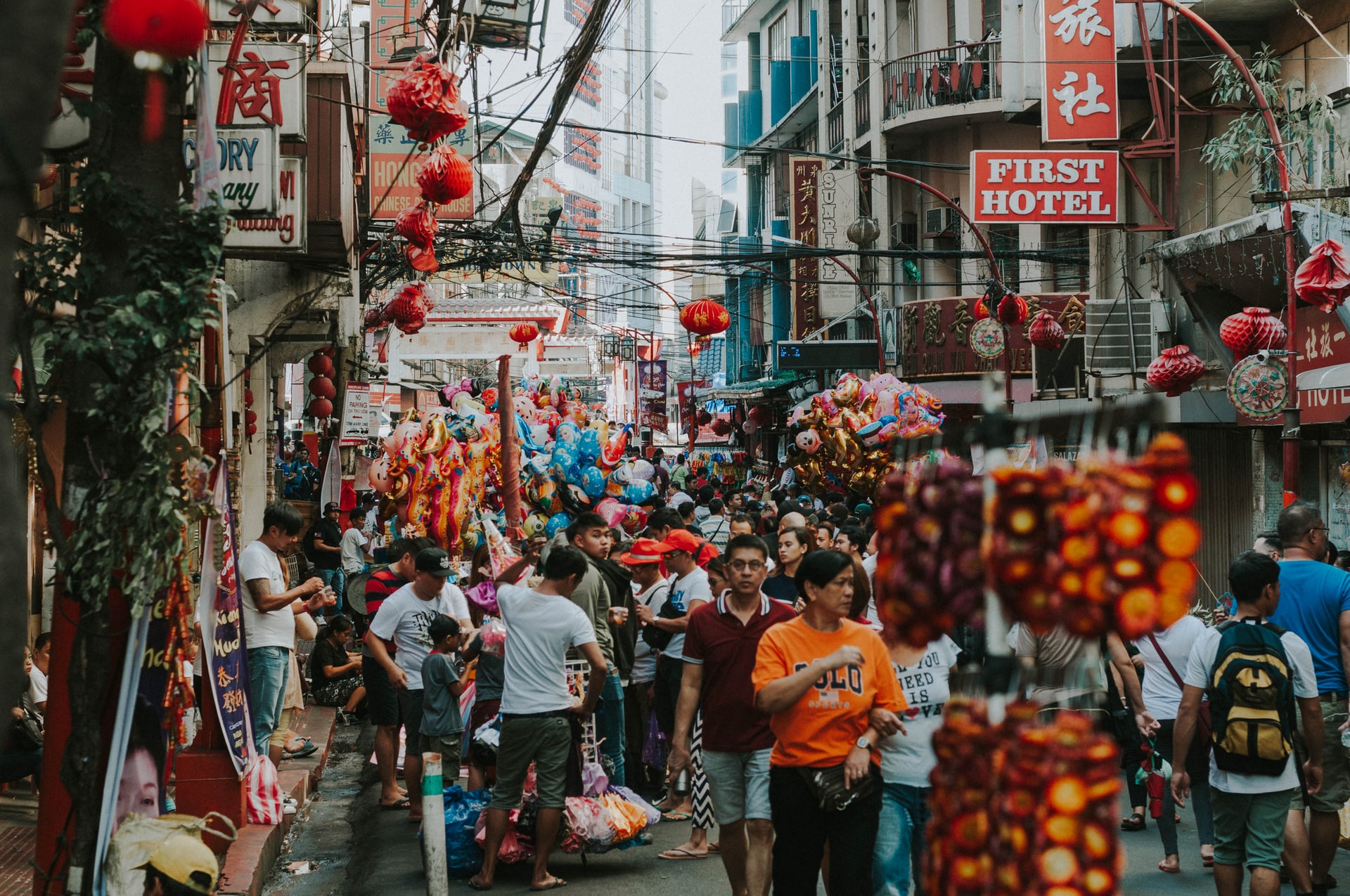
The most intense and most authentically Manileño urban experience available and the finest single destination for understanding the everyday culture of the capital — Quiapo, immediately north of Intramuros across the Jones Bridge, is a dense, chaotic, overwhelming neighbourhood of street markets, wholesale traders, herbal medicine vendors (herbolaryo), taho sellers, fortune tellers, and the constant human energy of a city of 14 million compressed into a few city blocks. At the heart of the district stands the Minor Basilica of the Black Nazarene (Quiapo Church) — home to the miraculous image of the Black Nazarene, a dark-skinned statue of Christ bearing the cross believed to have been brought from Mexico in 1606 and venerated as one of the most powerful miraculous images in Asia. The Friday pahalik (ritual touching and kissing of the image's robe) and the annual January 9 procession draw millions of devotees in scenes of extraordinary collective faith.
Market & Devotion🏙️ BGC (Bonifacio Global City) — Manila's Modern Face
Metro Manila's most dynamic, most internationally oriented, and most visitor-friendly district — Bonifacio Global City (BGC), in Taguig City on the former grounds of Fort Bonifacio (the American military installation that preceded it), is a planned urban district of wide boulevards, public art installations, luxury residential towers, and the highest concentration of world-class restaurants, bars, galleries, and cultural venues in the Philippines. The Bonifacio High Street (outdoor retail and restaurant strip), the Mind Museum (the Philippines' finest science museum), the Ayala Museum (outstanding dioramas of Philippine history and pre-colonial gold collection — one of the finest collections of Philippine tribal jewellery and ritual objects in the world) in nearby Makati, and the Philippine Art Fair (February) make BGC and Makati together the cultural heart of contemporary Manila. The BGC street art programme — with works by Filipino and international artists on building facades throughout the grid — is the most impressive outdoor public art collection in Southeast Asia.
Modern Manila🌊 Manila Bay Sunset & Baywalk
Manila's most iconic and most universally loved daily spectacle — the Manila Bay sunset, viewed from the Roxas Boulevard Baywalk (the seafront promenade stretching 7km from the US Embassy to the Cultural Center of the Philippines complex), is one of the great urban sunsets of Asia: the sky turning orange, red, and deep purple over the flat expanse of Manila Bay — framed by the silhouette of the Corregidor island fortress in the middle distance and the distant mountains of Bataan on the far shore — is a spectacle of considerable beauty that draws hundreds of thousands of Manileños to the waterfront every clear evening. The sunset ritual — vendors selling balut, taho, and cold San Miguel beer along the wall, families occupying every bench and sea wall, and the collective sigh of appreciation as the sun reaches the horizon — is the most characteristically Manileño shared experience available to visitors.
Iconic Sunset🎭 Cultural Center of the Philippines (CCP) Complex
The Philippines' most important performing arts institution and the finest venue for Filipino cultural expression — the Cultural Center of the Philippines, on the reclaimed land of the Manila Bay waterfront south of Roxas Boulevard (built during the Marcos administration in the 1960s–70s as a flagship of national cultural ambition), houses the main CCP Main Theater (the country's premier venue for ballet, opera, orchestral concerts, and theatrical productions), the Tanghalang Pilipino (the national theatre company), and the Metropolitan Museum of Manila (international art collections). The adjacent National Museum of Modern and Contemporary Art (in the former Museum of the Filipino People building) and the Coconut Palace (a 1978 state guesthouse built almost entirely from coconut materials — one of the most unusual state residences in the world) complete a cultural complex of considerable scope and ambition on the Manila Bay waterfront.
Arts & CultureLocal Food Recommendations
Filipino cuisine is the most underrated in Asia and one of the great culinary traditions of the world — a complex fusion of indigenous Austronesian, Malay, Chinese, Spanish, and American influences that has produced a cooking vocabulary of extraordinary depth, sweetness, sourness, and the characteristic Filipino love of contrasting flavours in a single dish. Manila is the finest place in the world to eat Filipino food.
🍽️ Must-Try Filipino Dishes
- Adobo — the Philippines' most iconic dish and the most representative expression of Filipino cooking philosophy: meat (pork, chicken, or both) slow-braised in vinegar, soy sauce, garlic, bay leaves, and black pepper until the liquid has reduced to a glossy, intensely savoury sauce and the meat is tender enough to fall apart. Every Filipino family has its own adobo recipe — dry or saucy, more soy or more vinegar, with coconut milk or without — and the dish's infinite regional variation is the subject of the most passionately held culinary opinions in the country. The vinegar-based preservation technique predates the Spanish arrival, making adobo one of the few truly indigenous Filipino cooking methods. Available everywhere in Manila from market turo-turo (point-point) canteens to fine dining restaurants — the most fundamental and most beloved Filipino comfort food.
- Sinigang — the great Filipino sour soup and arguably the dish most beloved by Filipinos as the taste of home: a clear, intensely sour tamarind-based broth with pork ribs (or shrimp, fish, or beef), tomatoes, onion, and a variety of vegetables including kangkong (water spinach), sitaw (string beans), labanos (radish), and eggplant. The sourness of the tamarind broth — which can be replaced by kamias (bilimbi), green mango, or calamansi in regional variations — is the defining flavour of Filipino cooking: refreshing, appetite-stimulating, and perfectly adapted to the hot tropical climate. Sinigang has been voted the world's best soup by TasteAtlas multiple times — the international recognition of a dish that Filipinos have always known is extraordinary.
- Lechón — the Philippines' most spectacular and most celebratory dish: a whole pig slow-roasted on a bamboo spit over live coals for 4–6 hours until the skin achieves a crackling of supernatural crispness and the meat beneath is impossibly tender and fragrant from the aromatics (lemongrass, garlic, onion, and bay leaves) stuffed inside. Lechón is the centrepiece of every major Filipino celebration — birthdays, weddings, fiestas, and Christmas — and the best lechón in the Philippines is an object of fierce regional pride: Cebu lechón (seasoned with lemongrass, garlic, and green onions, served without sauce) is considered the finest, but Manila's La Loma district (the "lechón capital of Manila") produces outstanding examples eaten with Mang Tomas liver sauce.
- Kare-kare — one of the most distinctively Filipino and most labour-intensive dishes in the national culinary canon: a rich, thick stew of oxtail (or tripe and beef shank), banana blossom, eggplant, and string beans in an elaborate sauce of ground toasted rice, toasted peanuts, and annatto (providing the sauce's characteristic deep orange-yellow colour). The kare-kare sauce — nutty, slightly sweet, intensely flavoured — is always served with bagoong alamang (fermented shrimp paste), whose pungent saltiness provides the essential counterpoint to the richness of the peanut sauce. Kare-kare is a Sunday dish — a project requiring hours of preparation — and is the dish most associated with traditional Filipino family dining culture. Available at traditional Filipino restaurants throughout Manila.
- Balut — the Philippines' most adventurous and most internationally notorious street food: a fertilised duck egg (with the partially developed duck embryo — 16–18 days incubated — inside) hard-boiled, cracked open at the wide end, seasoned with salt and vinegar, and eaten from the shell. Balut is simultaneously a beloved Manileño street snack, a rich source of protein, a test of culinary adventurousness for visitors, and one of the most culturally specific food experiences available in the Philippines. Sold by street vendors throughout Manila from early evening — the classic pairing is cold San Miguel beer and balut at the Manila Bay Baywalk. The sabaw (broth inside the shell) is drunk first, then the egg white eaten, then the embryo — Filipinos eat balut with a casual naturalness that contrasts dramatically with the reaction of first-time foreign tasters.
- Halo-halo — the Philippines' most beloved and most visually spectacular dessert: a tall glass of crushed ice, evaporated milk, and an elaborate assortment of sweet ingredients including ube (purple yam), sweetened beans, macapuno (coconut string), nata de coco (coconut gel), leche flan, jackfruit, sago pearls, and a scoop of ube ice cream on top — the name meaning "mix-mix" in Tagalog, describing the essential first action of stirring the entire construction together before eating. Halo-halo in the Manila summer heat (35–38°C) is one of the great refreshments of the tropics — sweet, cold, creamy, chewy, and extraordinarily complex in a single glass.
🍺 Drinks & Social Culture
- San Miguel Beer — the Philippines' national lager and one of the great Asian beers: brewed by San Miguel Brewery since 1890 (making it the oldest brewery in Southeast Asia), San Miguel Pale Pilsen is the definitive Filipino beer — clean, light, refreshing, and served ice-cold at every inihaw (grill), carinderia (small restaurant), and social gathering in the country. Cold San Miguel — the essential accompaniment to lechón, inihaw na liempo, and Manila Bay sunsets — is one of the simple pleasures of Filipino life. The companion brands Red Horse (a stronger malt lager of considerable potency, popular in provinces) and San Mig Light are equally ubiquitous.
- Taho — Manila's most beloved and most distinctively Manileño morning street drink: warm silken tofu (soft tofu) served in a plastic cup with arnibal (brown sugar syrup flavoured with vanilla) and sago (tapioca pearls) by the magtataho — the taho vendor who carries two large aluminium canisters on a bamboo shoulder yoke and calls "Tahooo!" through residential streets at dawn. Taho has been sold on Manila's streets for over 300 years (introduced by Chinese traders) and remains one of the most deeply embedded food traditions in the city — the call of the taho vendor is the sonic signature of a Manila morning.
- Calamansi juice — the essential Filipino citrus drink: freshly squeezed calamansi (the Philippine lime — smaller, more fragrant, and more intensely flavoured than regular lime) with water and sugar, served over crushed ice. Calamansi juice is the most refreshing drink in the Manila heat — the tiny, fragrant citrus permeates Filipino cooking as lime does in Southeast Asia, and the fresh juice, slightly tart and intensely aromatic, is the finest non-alcoholic drink in the country. Available at every market, restaurant, and roadside stall.
- Lambanog — the Philippines' traditional coconut spirit and one of the most potent and most culturally specific alcoholic drinks in Southeast Asia: a clear distilled spirit made from the tuba (fermented coconut sap), produced in the coconut-growing provinces of Quezon, Laguna, and Batangas south of Manila. Lambanog ranges from the rough, raw de baso (unaged, drunk by the shot in rural fiestas) to the more refined aged and flavoured expressions now available in Manila specialty bars. The most distinctive and most distinctive Philippine spirit, increasingly available in flavoured versions (coconut, mango, pandan) at Manila craft cocktail bars.
🍽️ Where to Eat — Local Tips
- Bonifacio High Street and BGC restaurant strip — the finest concentration of high-quality restaurants in Manila, with every cuisine represented alongside excellent Filipino fine dining. Metronome (tasting menu of contemporary Filipino cooking) and Gallery by Chele (Chef Chele González — ranked among Asia's 50 Best Restaurants) are the most acclaimed fine dining destinations. Budget $40–100 per person for fine dining; $15–25 for the excellent BGC mid-range restaurants.
- Aristocrat Restaurant (Roxas Boulevard, near Rizal Park) — Manila's most historically beloved and most institutionally significant traditional Filipino restaurant, open since 1936: the classic adobo, kare-kare, lechón kawali, and pancit in generous, home-style servings at prices unchanged since the mid-20th century in spirit if not in currency. A Manila institution of genuine historical significance — the Aristocrat has fed every Filipino president, every visiting foreign dignitary, and several generations of ordinary Manileños since before the Second World War. Budget P400–700 ($7–12) per person.
- Dampa Macapagal — Manila's most famous and most atmospheric seafood market-restaurant complex on Macapagal Boulevard, Pasay: a cluster of seafood stalls where diners select their fish, prawns, crabs, and shellfish by the kilo from the market, then hand it to an adjacent restaurant kitchen for preparation in any style desired. The combination of market-fresh seafood chosen directly by the diner and cooked to order — sinabawang tahong (mussel soup), grilled blue marlin, garlic butter prawns, chilli crab — at prices of P800–1,500 ($14–26) per person is the finest seafood dining experience in Manila.
- Turo-turo canteens near Quiapo and Divisoria — the most authentic and most affordable everyday eating in Manila: the turo-turo (point-point) system — glass display cases of pre-cooked dishes from which diners point at their choices to be served over rice — is the fundamental Filipino mass-market food delivery system. A complete meal of adobo, sinigang, or pinakbet (Ilocano vegetable stew) over steamed rice costs P80–150 ($1.40–2.60) and represents some of the finest value everyday eating in Southeast Asia.
- Bistro Filipino (various locations) and Sentro 1771 (Greenbelt, Makati) — the finest mid-range traditional Filipino restaurants accessible to visitors: both serve the full range of Filipino regional cooking in comfortable, modern settings with English menus, attentive service, and outstanding food. The sinigang na hipon (prawn sinigang) at Sentro 1771 is widely regarded as the finest version of the dish in Manila.
🎨 Filipino Crafts & Cultural Heritage
- The Philippines' most internationally celebrated craft tradition is the parol (Christmas lantern) — an elaborate star-shaped lantern made from bamboo, paper, capiz shell, and increasingly complex materials, produced in the town of San Fernando, Pampanga (the self-proclaimed Christmas Capital of the Philippines) in sizes ranging from table decorations to the building-sized installations that light up the Giant Lantern Festival (December). The parol — simultaneously a symbol of the Star of Bethlehem and a continuation of pre-colonial light festival traditions — is the most distinctively Filipino Christmas symbol and one of the most beautiful craft traditions in Asia.
- Capiz shell products — the translucent, oyster-like Placuna placenta shell harvested from the Capiz province of Panay island is the raw material of one of the Philippines' most distinctive craft traditions: lampshades, window panels, jewellery boxes, and decorative objects made from thin capiz shell sections that transmit a warm, golden, opalescent light. Available at craft shops throughout Manila, particularly at the Tesoro's and Kultura Filipino shops in SM malls.
- Barong Tagalog — the Philippines' most prestigious and most culturally significant garment: a formal shirt of extraordinary delicacy made from piña (pineapple leaf fibre) or jusi (silk-piña blend), hand-embroidered with intricate floral patterns by skilled bordadoras (embroiderers) in the cottage industries of Lumban (Laguna) and Caloocan. The barong Tagalog — worn as formal dress by Filipino men at weddings, state occasions, and official events — is one of the most distinctive and most technically accomplished formal garments in Southeast Asian textile culture. Available at specialist barong shops in Intramuros and at Robinson's Place and SM malls throughout Metro Manila.
- Weaving traditions — the Philippines' extraordinary diversity of indigenous weaving traditions (the T'nalak of the T'boli people of Mindanao, the Inabel of the Ilocos region, the Hablon of Iloilo) produces textiles of remarkable beauty and cultural specificity, available at the Museo ng Kalinangang Pilipino (Museum of Philippine Culture) shop and at specialist craft retailers in BGC and Makati.
Day Trip Itineraries from Manila
Manila's position at the heart of Luzon and its role as the Philippines' main aviation hub make it the gateway to some of the most spectacular destinations in Southeast Asia — many accessible as day trips or short overnight journeys:
🌋 Day Trip: Taal Volcano & Lake
Travel time: 2 hours by road | Cost: Bus from P150 ($2.60); organised tour $35–60 per person
Taal Volcano — 65km south of Manila in Batangas province — is one of the most dramatic and most photographically extraordinary volcanic landscapes in the world: an active volcano island rising from a volcanic lake (Taal Lake), which is itself contained within a much larger volcanic caldera — a volcano within a lake within a volcano, creating a layered geological spectacle of rare visual impact. The Taal Volcano Island (accessible by banca boat from Talisay and Laurel towns on the lake shore) can be hiked to the main crater's edge — a 45-minute climb on foot or horseback — for views into the still-active crater. The ridge town of Tagaytay, on the rim of the outer caldera at 700m elevation (significantly cooler than Manila), offers the classic vista across Taal Lake to the volcano island, alongside excellent restaurants serving Batangas cuisine and the finest bulalo (beef bone marrow soup) in the Philippines.
Volcanic Spectacle⛰️ Day Trip: Corregidor Island
Travel time: 1.5 hours by ferry from Manila | Cost: Ferry and tour P1,800–2,200 ($31–38) per person
Corregidor Island — the rocky fortress island at the entrance of Manila Bay — is the most historically significant and most atmospherically haunting battlefield site in Southeast Asia: the scene of one of the most heroic and most catastrophic military stands of World War II, where a combined Filipino-American garrison held out against overwhelming Japanese forces for six months (December 1941–May 1942) before final surrender. The island's extensive WWII fortifications — gun batteries, tunnels, barracks, and the ruins of the mile-long Malinta Tunnel complex used as MacArthur's headquarters — are preserved as a historical park of considerable emotional power. The nightly Sound and Light Show in the Malinta Tunnel is one of the finest historical presentations in Southeast Asia. The ferry journey across Manila Bay — with views of the Manila skyline receding behind and Bataan's mountains ahead — is itself a moving historical experience.
WWII History🌾 Day Trip: Pampanga — Culinary Capital of the Philippines
Travel time: 1.5 hours by road | Cost: Bus from P150 ($2.60); taxi/van P2,000–3,000 ($34–52) return
Pampanga — the province immediately north of Metro Manila — is the gastronomic capital of the Philippines and the source of some of the most celebrated dishes in the national culinary canon: sisig (the world-famous sizzling chopped pork face and ears dish, invented by Aling Lucing in Angeles City), kare-kare (the peanut-oxtail stew considered finest in its Pampango original form), and the extraordinary Christmas food tradition of the province (including morcon, relleno, and the finest lechón outside Cebu). Angeles City's Aling Lucing's Sisig — the original sisig restaurant, still operating in a humble carinderia — is the most historically significant restaurant in the Philippines, the birthplace of one of the great street foods of the world. Pampanga is also the home of the spectacular Giant Lantern Festival (December) in San Fernando.
Food Capital🏝️ Multi-Day: Palawan — World's Best Island
Travel time: 1 hour 20 minutes by air to Puerto Princesa | Cost: Flights from P1,800–4,500 ($31–78) return; El Nido tours $35–80 per day
Palawan — the long, narrow island province stretching southwest from Luzon toward Borneo — has been repeatedly voted the world's best island by international travel publications, and the claim is not unreasonable: a 450km-long wilderness of limestone karst mountains, ancient rainforest, and coral reef-fringed coastline containing the Puerto Princesa Subterranean River (UNESCO World Heritage Site — one of the world's longest navigable underground rivers), the extraordinary island-and-lagoon landscape of El Nido and the Bacuit Archipelago (among the most photographed seascapes in the world), and the diving and snorkelling sites of Tubbataha Reef (UNESCO — one of the top five dive sites in the world). A minimum 5-day visit is recommended to experience both Puerto Princesa and El Nido.
World's Best IslandTourist Tips for Manila
🚌 Getting Around
- Metro Manila's traffic congestion is among the worst in the world — the city consistently ranks in global studies as one of the most traffic-congested metropolitan areas on Earth. Journey times that appear short on a map can take 2–3 times longer in practice; plan generously and use off-peak hours (before 7am and after 9pm) for essential journeys if possible.
- Grab — Southeast Asia's dominant rideshare app and the most important transport tool for visitors to Manila: Grab operates throughout Metro Manila and provides safe, metered, cashless (or cash) transport with driver identification and GPS tracking. Always use Grab over street taxis for safety and price transparency. Typical fares: BGC to Intramuros P180–280 ($3.10–4.85); airport to Makati P350–550 ($6.05–9.50).
- Jeepney — the most iconic and most distinctively Filipino form of transport: elaborately decorated shared mini-buses running fixed routes for P13–20 ($0.22–0.35) per journey. The traditional jeepney — evolved from US military jeeps left after WWII, now produced in Philippine workshops and decorated with chrome horses, religious iconography, and neon — is one of the most recognisable cultural artefacts of the Philippines. The government's Public Utility Vehicle Modernization Program is replacing traditional jeepneys with modern electric units — ride a traditional jeepney while they remain.
- MRT-3 and LRT lines — Metro Manila's elevated rail system: three lines covering the main north-south and east-west axes of the metro area. Fast, cheap (P15–28 / $0.26–0.48), and air-conditioned — the best public transport option for the EDSA corridor (MRT-3) and the Pasay–Monumento axis (LRT-1). Subject to crowding at peak hours; platform queues can be significant.
- Ninoy Aquino International Airport (NAIA/MNL) — Manila's international airport, 7km south of Makati and 12km from BGC. Four terminals (T1: legacy international carriers; T2: Philippine Airlines; T3: Cebu Pacific, AirAsia; T4: charter). The inter-terminal distance requires 30–45 minutes by shuttle between terminals — allow significant connection time for inter-terminal connections. Use Grab for airport transfers.
💡 General Safety & Travel Tips
- Metro Manila requires a standard level of urban awareness — petty theft and pickpocketing occur in crowded areas including Quiapo, Divisoria, LRT/MRT stations, and the Baywalk. Use Grab rather than street taxis. The tourist districts of Intramuros, BGC, Makati, and the Ermita/Malate tourist belt are the safest and most visitor-friendly areas. Avoid displaying expensive electronics and jewellery in markets and on public transport.
- The Philippine Peso (PHP) is the official currency. ATMs are widely available throughout BGC, Makati, and SM/Ayala malls. Credit cards (Visa, Mastercard) are accepted at malls, hotels, and most restaurants in tourist areas but cash is needed for jeepneys, tricycles, market stalls, and carinderia eating. USD is accepted at some tourist hotels and money changers. Avoid street money changers — use bank ATMs or mall-based money changers (such as those in SM and Ayala malls) for the best rates.
- Health precautions: Dengue fever is endemic in the Philippines and mosquito protection (DEET repellent, long sleeves at dusk) is important particularly in the wet season. Drink bottled water only — tap water is not safe. The Philippines has a strong and accessible healthcare system in Manila's private hospitals (Makati Medical Center, St Luke's Medical Center) — medical travel insurance is strongly recommended.
- The Philippines uses 220V/60Hz electricity with both Type A (flat two-pin, US standard) and Type B (flat three-pin) sockets — the same as the USA. Most international appliances handle 110–240V dual voltage; check your equipment before travel.
- Filipino hospitality (mabuting pagtanggap) is genuine, warm, and one of the most celebrated aspects of the country's culture — Filipinos are consistently ranked among the world's most hospitable peoples and the warmth of the welcome extended to visitors throughout the country is one of the Philippines' greatest assets. Responding to Filipino warmth with equivalent openness and respect will transform any visit to Manila.
Apply for Tourist Visa
Citizens of most Western countries including the USA, Canada, EU member states, the UK, Australia, and New Zealand can enter the Philippines visa-free for tourist stays of up to 30 days (extendable to 59 days and then to longer periods at Bureau of Immigration offices). Citizens of some countries must obtain a tourist visa in advance through the nearest Philippine embassy or consulate. Verify current entry requirements through your country's foreign affairs ministry or the Bureau of Immigration of the Philippines before travel. Philippines Visa Information
Important Emergency Numbers
🇵🇭 Manila Emergency Contacts
- 🚑 Ambulance: 117
- 🔥 Fire Brigade: 117
- 👮 Police: 117
International Emergency Phone Numbers
Find Flights to Manila
Manila Airport Code: MNL — Ninoy Aquino International Airport (NAIA), 7km south of Makati CBD (30–60 minutes by road depending on traffic)
Airport Transfer: Use Grab for all airport transfers — agree the fare in the app before departure. NAIA is one of Southeast Asia's busiest international hubs, with direct flights to London (British Airways, Philippine Airlines), Amsterdam (KLM), Frankfurt (Lufthansa), Dubai (Emirates, Etihad), Singapore (Singapore Airlines, Cebu Pacific), Hong Kong (Cathay Pacific), Tokyo (ANA, JAL), Seoul (Korean Air, Asiana), and all major Asian and Middle Eastern destinations. Most European visitors route via Dubai, Singapore, Hong Kong, or Doha.
Cities Around the World with IATA Airport CodesCurrency in Manila
The official currency of the Philippines is the Philippine Peso (PHP). ATMs are widely available throughout Metro Manila's malls, banks, and commercial districts. Credit cards (Visa, Mastercard) are accepted at malls, hotels, and tourist-area restaurants, but cash is essential for jeepneys, tricycles, markets, street food, and carinderia eating. The Philippines offers outstanding value for visitors — particularly for food, accommodation, and island activities — making it one of the most affordable destinations in Southeast Asia for international visitors.