New Delhi Weather
NEW DELHI WEATHERAbout New Delhi
New Delhi is the extraordinary capital of India — the world's most populous nation and one of its oldest continuous civilisations — a vast, layered, overwhelming metropolis of 31 million people where the ancient and the ultramodern collide at every turn and every street corner offers a new sensory encounter. Delhi is not one city but many cities stacked on top of each other across millennia — seven successive cities have been built, destroyed, and buried on this site since the 3rd century BCE, and the ruins and monuments of each era are scattered across the landscape of the modern capital. Mughal emperors built mosques of incomparable grandeur; British architects planned wide ceremonial avenues and imposing colonial buildings; medieval sultans constructed towering minarets of red sandstone; and modern India has added a sprawling, traffic-choked, energy-filled metropolitan landscape of remarkable vitality and ambition. For visitors willing to embrace its chaos, complexity, and sensory intensity, Delhi offers one of the most profound and unforgettable urban experiences on Earth — a city that forces an encounter with the full weight of human history, spiritual diversity, and civilisational continuity in a way no other capital quite matches.
Best Time to Visit New Delhi & Weather Guide
Delhi's climate is extreme by any standard — scorching summers, monsoon rains, and cool winters create four very distinct seasons, each with its own character and visitor implications.
🌸 Cool Season (October–March)
The best and most popular time to visit Delhi — pleasantly warm days (18–28°C) and cool, sometimes cold evenings (dropping to 5–8°C in December–January). The sky is clear (before winter fog sets in), the parks and gardens are lush, and outdoor sightseeing is genuinely enjoyable. October and November are particularly beautiful — the post-monsoon freshness still in the air, the light golden and clear. December and January bring the famous Delhi winter fog — mornings of dense, cold fog that delays flights and shrouds the monuments in an atmospheric haze, but afternoons that warm up pleasantly. February and March see the arrival of spring blossoms — an excellent time to visit.
Best Time to Visit🌧️ Monsoon Season (July–September)
The southwest monsoon reaches Delhi in late June or early July, bringing heavy rain that dramatically reduces temperatures and fills the city's parks and gardens with green. Temperatures are 28–38°C but feel more bearable than the pre-monsoon heat. The rain is typically heavy but concentrated — long breaks of sunshine between downpours. Flooding can affect low-lying areas. The monsoon is actually a wonderful time to see Delhi's Mughal monuments in their greenest and most atmospheric state — the crowds are thinner and the light after rain is extraordinary.
Atmospheric☀️ Summer Season (April–June)
Delhi's summers are genuinely brutal — temperatures regularly exceed 42–45°C in May and June, with the notorious loo (a hot, dry desert wind) making outdoor activity genuinely dangerous in the middle hours of the day. Humidity is low (unlike Mumbai's wet heat), making the heat dry and intense. Not recommended for first-time visitors. Sightseeing must be limited to early morning and evening. Dust storms (andhi) can occur with dramatic suddenness in May and June. Air conditioning is essential throughout this period.
Very Hot🌡️ Air Quality Warning
Delhi has a serious air quality problem — particularly from October through January when a combination of agricultural stubble burning in neighbouring states, vehicle emissions, construction dust, and cold air trapping pollution creates some of the world's worst urban air quality. AQI (Air Quality Index) readings frequently exceed 300–500 during peak pollution episodes (November–December) — hazardous levels requiring N95 masks for all outdoor activity. Monitor AQI forecasts before and during any visit to Delhi in winter months. Despite this, the cool season remains the best time to visit — the air is typically cleaner in October, February, and March.
Health NoteCool season (Oct–Mar): Light layers for warm days, a medium-weight jacket or fleece for cool evenings and December–January nights. Comfortable walking shoes for extensive monument and market exploration — Delhi's sights are spread across a huge area and involve significant walking. An N95 or FFP2 mask for air quality protection in winter months. Modest clothing (shoulders and knees covered) for visiting mosques, temples, and Sikh Gurdwaras — a scarf or dupatta is useful for covering hair in Sikh temples.
Summer (Apr–Jun): Light, breathable cotton only; early morning and evening activity only; SPF50+ sun protection; high-quality sunglasses; carry water at all times.
Monsoon (Jul–Sep): Quick-dry clothing, waterproof sandals or shoes, a compact umbrella or light waterproof jacket.
Top Attractions in New Delhi
Delhi's monuments span 3,000 years of history — from the Iron Pillar of the 4th century to Lutyens' magnificent British Imperial buildings — spread across a city so vast it requires careful planning to explore effectively.
🕌 Jama Masjid & Old Delhi (Shahjahanabad)
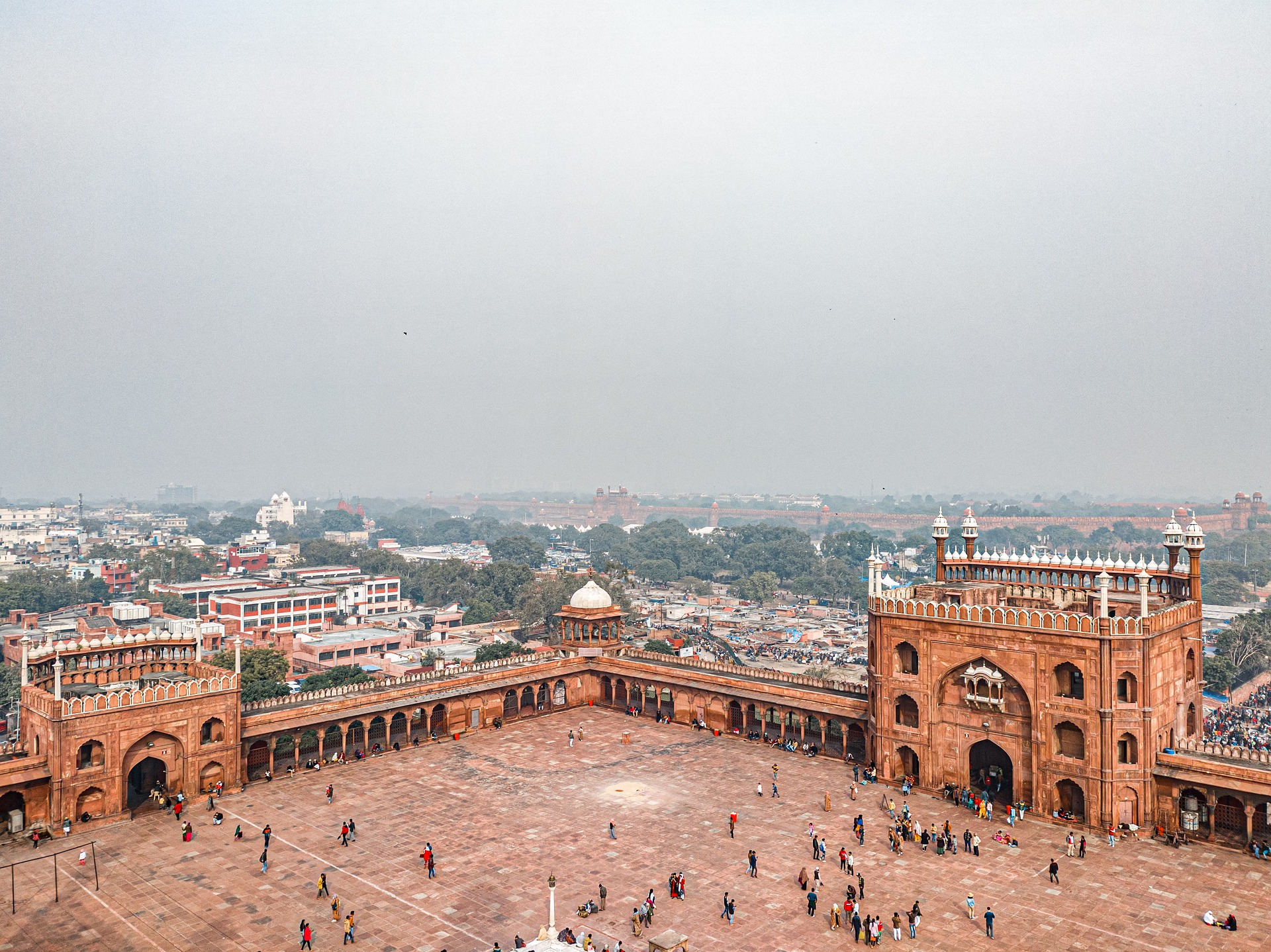
The beating historic heart of Delhi — the magnificent Jama Masjid, India's largest mosque, built by the Mughal Emperor Shah Jahan (also builder of the Taj Mahal) in 1656, dominates Old Delhi from its elevated platform of red sandstone and white marble. The mosque's three great white marble domes and two 40-metre minarets, crowded with the rooftops and minarets of the densest and most chaotic urban landscape in India, create one of the great architectural spectacles of the subcontinent. The surrounding lanes of Chandni Chowk — silver merchants, spice markets, street food stalls, wedding shops, and centuries of accumulated commercial energy — offer the most overwhelming and authentic encounter with Old Delhi's Mughal heritage.
Must See🏰 Red Fort (Lal Qila) — UNESCO Heritage
The supreme symbol of Mughal power in India — the Red Fort, built by Shah Jahan between 1638 and 1648 as the centrepiece of his new capital Shahjahanabad (now Old Delhi), is a UNESCO World Heritage Site of extraordinary architectural grandeur. The fort's massive red sandstone walls extend 2.5km around a complex of palaces, audience halls, baths, and gardens that once housed the Mughal court in its full pomp. The Diwan-i-Khas (Hall of Private Audience), where the legendary Peacock Throne once stood, is particularly magnificent. The fort is the site of India's Independence Day celebrations each August 15.
UNESCO Heritage🏛️ Qutb Minar — UNESCO Heritage
The tallest minaret in India and one of the finest examples of early Indo-Islamic architecture in the world — the Qutb Minar, built in 1193 by Qutb-ud-Din Aibak after the Islamic conquest of Delhi, stands 72.5 metres high in bands of red sandstone and buff marble covered in intricate calligraphy and geometric carving. The surrounding Qutb Complex is a UNESCO World Heritage Site containing some of the earliest mosques in India, the mysterious Iron Pillar of the 4th–5th century CE (which has stood without significant rust for 1,600 years — a metallurgical mystery yet to be fully explained), and the ruins of the Quwwat-ul-Islam mosque — India's oldest surviving mosque.
UNESCO Heritage⚱️ Humayun's Tomb — UNESCO Heritage
The architectural precursor to the Taj Mahal — Humayun's Tomb, built in 1570 for the second Mughal Emperor Humayun by his widow Haji Begum, is a UNESCO World Heritage Site widely considered the first great Mughal garden-tomb and the direct inspiration for the Taj Mahal's design eighty years later. Set in a magnificent formal Persian garden (charbagh) of water channels, cypress trees, and geometric paths, the tomb's great white marble dome rising above red sandstone arches creates one of the most serene and perfectly proportioned architectural compositions in Asia. Quieter than the Taj and arguably as beautiful in its own refined, mathematical way.
World Class🛕 Lotus Temple (Bahá'í House of Worship)
One of the most architecturally extraordinary buildings in modern India — the Lotus Temple, completed in 1986, is a Bahá'í House of Worship in the form of a half-opened lotus flower in white Greek marble. Its 27 free-standing marble petals rise to 34 metres in a structure that has won numerous architectural awards and been called one of the most beautiful buildings of the 20th century. Open to visitors of all religions and none, the interior is a vast, silent, flower-shaped meditation hall of extraordinary calm and beauty. One of the most visited religious buildings in the world — receiving 4–8 million visitors annually.
Iconic🌿 Lodhi Garden
Delhi's most beautiful public park — a 90-acre garden of extraordinary tranquillity containing the 15th-century tombs of the Sayyid and Lodi dynasty rulers, set in magnificently landscaped grounds of lawns, flowering trees, and winding paths. The Mohammed Shah's Tomb and the Bara Gumbad (Great Dome) are particularly fine — medieval Islamic architecture in perfect harmony with a cultivated English-style landscape created by the British in 1936. Lodhi Garden is where Delhi comes to breathe — runners, yogis, couples, and office workers seeking escape from the city's chaos. Particularly beautiful at dawn.
Peaceful🏛️ India Gate & Rajpath (Kartavya Path)
The ceremonial heart of Lutyens' Delhi — the India Gate, a 42-metre memorial arch inscribed with the names of 70,000 Indian soldiers who died in the First World War, stands at the eastern end of the great ceremonial boulevard (Kartavya Path, formerly Rajpath) that stretches from India Gate to the Rashtrapati Bhavan (Presidential Palace) — one of the finest examples of Imperial civic planning anywhere in the world. The approach to the Presidential Palace, flanked by the Secretariat buildings designed by Herbert Baker, is a composition of magnificent scale and confidence. India Gate is the most popular gathering place in Delhi on cool evenings.
Iconic🧡 Akshardham Temple
One of the most spectacular Hindu temples ever built — the Swaminarayan Akshardham, completed in 2005, is a colossal complex of pink sandstone and white marble covering 30 acres on the banks of the Yamuna. The central monument — 43 metres high, 96 metres wide, adorned with 234 ornately carved pillars, 20,000 figures of deities, sadhus, and devotees, and entirely hand-carved by traditional craftsmen — is a staggering achievement of contemporary sacred architecture. The campus includes IMAX-style presentations, boat rides, gardens, and evening fountain shows. Entry is free (cameras prohibited inside the main monument).
SpectacularLocal Food Recommendations
Delhi's food scene is one of the greatest in Asia — a city of extraordinary culinary depth drawing on Mughal, Punjabi, Rajasthani, street food, and modern Indian traditions in a landscape of overwhelming choice.
🍛 Must-Try Delhi Dishes
- Butter chicken (Murgh Makhani) — arguably the most famous dish ever to emerge from Delhi: chicken marinated in yoghurt and spices, roasted in a tandoor, then finished in a velvety tomato-butter-cream sauce. Invented at Moti Mahal restaurant in Daryaganj in the 1950s by Kundan Lal Gujral and his head chef — now one of the most replicated dishes in world cuisine. Eating butter chicken at its birthplace in Delhi is a culinary pilgrimage.
- Dal makhani — whole black lentils (urad dal) and kidney beans slow-cooked overnight on a very low flame with butter, cream, tomatoes, and aromatic spices — a dish of extraordinary depth and richness. Another creation credited to Delhi's Punjabi cuisine, perfected in the dhabas and restaurants of the capital over decades.
- Nihari — the definitive Old Delhi breakfast: a rich, slow-cooked bone-in mutton or beef braise cooked overnight with aromatic spices and eaten at dawn with sheermal (sweet flatbread) or khamiri roti. Served in the old nihari shops near the Jama Masjid since the Mughal era. One of the most deeply flavoured meat dishes in South Asian cuisine.
- Chole bhature — the quintessential Delhi Sunday breakfast: spiced chickpea curry (chole) served with enormous deep-fried leavened bread (bhature) that puffs up like a balloon. Eaten with pickle and raw onion at every dhaba and street restaurant in the city. A meal in itself — rich, satisfying, and deeply Delhiite.
- Paranthe Wali Gali — a lane in Chandni Chowk that has been serving stuffed flatbreads (paranthas) since the 19th century. Stuffed with everything from potatoes and paneer to dried fruits and mixed vegetables, then fried in ghee and served with chutneys — a living piece of Old Delhi culinary history.
- Delhi street chaat — the city's extraordinary repertoire of street snacks: golgappe (crispy hollow spheres filled with spiced water), aloo tikki (spiced potato patties), papdi chaat, dahi bhalla — a whole universe of sweet, sour, spicy, tangy street food that is one of the great pleasures of Delhi life.
🍺 Drinks & Street Food
- Lassi — chilled, thick yoghurt drink in sweet (with rose water and cardamom) or salted varieties. The most refreshing and practical drink in Delhi's heat. Old Delhi's famous Lala Duli Chand Naresh Gupta lassi shop near Chandni Chowk has been serving extraordinary thick lassi in earthenware cups since 1875.
- Masala chai — spiced milk tea brewed with cardamom, ginger, cloves, and black pepper — served in small glasses or disposable clay cups at tea stalls throughout the city. The starting point of every interaction and the universal social lubricant of Delhi life.
- Fresh lime soda (nimbu pani) — fresh lime juice with soda water, salt or sugar — the most refreshing drink in summer. Available at virtually every juice stall and restaurant. Essential for maintaining hydration in Delhi's heat.
- Sharbat and rose milk — traditional Indian cold drinks made from rose water, basil seeds (sabja), and cooling herbs — particularly popular in summer and available at Old Delhi's traditional sweet shops.
- Kingfisher and Bira 91 — India's most popular beer brands, widely available at restaurants and hotels licensed to serve alcohol. Note that alcohol is not available at all establishments — particularly in Muslim Old Delhi areas. Delhi's craft beer scene has grown significantly in the last decade, particularly in the Hauz Khas and Connaught Place areas.
🍽️ Where to Eat — Local Tips
- Karim's (Old Delhi) — the most famous restaurant in Mughal Delhi, serving the royal Mughal cuisine since 1913. Located in a narrow lane behind the Jama Masjid, Karim's serves the definitive Old Delhi mutton dishes — nihari, mutton korma, seekh kebabs, and the extraordinary mutton brain masala. A pilgrimage for any serious lover of North Indian food.
- Paranthe Wali Gali (Chandni Chowk) — the famous stuffed parantha lane, where family shops have been frying paranthas in ghee since 1875. Unique Delhi flavours impossible to replicate elsewhere.
- Connaught Place food scene — the elegant circular colonial commercial district at the heart of New Delhi contains some of the city's finest restaurants alongside beloved old institutions like Wenger's (Delhi's oldest bakery, since 1926) and the legendary United Coffee House.
- Hauz Khas Village — a medieval reservoir complex converted into Delhi's most fashionable dining and nightlife neighbourhood — rooftop restaurants overlooking a Lodi-era lake and deer park, eclectic cafés, and the full range of Delhi's modern restaurant scene.
- INA Market (INA Colony) — Delhi's finest food market for imported and specialist ingredients alongside excellent fresh produce — a great place to buy authentic spices, pickles, and Indian pantry staples to take home.
🌶️ The Mughal Kitchen Legacy
- Delhi's cuisine is inseparable from its Mughal history — the imperial kitchens of the Mughal emperors, who ruled from Delhi between 1526 and 1857, created the template for North Indian cooking that is now recognised globally. The techniques of tandoor cooking, slow-braising in sealed pots (dum pukht), the use of rich yoghurt marinades, and the layering of aromatic spices that defines North Indian cuisine were all developed and perfected in Delhi's royal kitchens.
- The partition of India in 1947 brought hundreds of thousands of Punjabi refugees to Delhi — and with them, the Punjabi culinary traditions (butter chicken, dal makhani, tandoori cooking) that now define "Indian restaurant cuisine" worldwide. The remarkable thing about Delhi's food history is that its two greatest culinary gifts to the world — Mughal court cuisine and Punjabi dhaba cooking — were both created or transformed here within a generation of each other.
- Delhi's sweet shops (mithai) are world-class — Ghantewala Halwai (serving since 1790, though now closed), Nathu's, and dozens of family-run shops in Chandni Chowk and Karol Bagh produce extraordinary Bengali sweets, Punjabi milk sweets, and the finest Indian mithai outside Kolkata.
- A Delhi food walk through Old Delhi — guided by a knowledgeable local food guide — is one of the finest and most rewarding culinary experiences available anywhere in Asia.
Day Trip Itineraries from New Delhi
Delhi is one of the world's great bases for day trips — some of the most magnificent monuments in India are within 2–4 hours by road or rail:
🕌 Day Trip: Agra & the Taj Mahal
Travel time: 2 hours by Gatimaan or Shatabdi Express train | Cost: ~₹700–1,500 by train; Taj entry ₹1,100 for foreigners
The most popular and essential day trip from Delhi — the Taj Mahal (arguably the world's most beautiful building, a UNESCO World Heritage Site built 1632–1653 by Shah Jahan as a mausoleum for his wife Mumtaz Mahal) is easily combined with the Agra Fort (another UNESCO site, the Mughal citadel overlooking the Yamuna with a view of the Taj) in a full but manageable day trip. Take the Gatimaan Express (India's fastest train, 2 hours) for the smoothest experience. Arrive at dawn for the Taj — the early morning light on the white marble is unsurpassed in any hour.
Bucket List🏰 Day Trip: Jaipur — The Pink City
Travel time: 4.5 hours by Shatabdi Express train | Cost: ~₹600–1,000 by train return
The magnificent pink-walled capital of Rajasthan — Jaipur, the City of Victory — is the most rewarding overnight or long day trip from Delhi on the Golden Triangle tourist circuit. The Amber Fort (a jaw-dropping hilltop palace overlooking a desert lake), the Hawa Mahal (Palace of Winds), the City Palace, and the pink-walled bazaars of the old city make Jaipur one of the finest destinations in India. More rewarding as a 2–3 day trip than a day trip, but perfectly possible as an ambitious single day by Shatabdi.
Golden Triangle🌿 Day Trip: Vrindavan & Mathura
Travel time: 2.5–3 hours by road or train | Cost: ~₹300–500 by train
A deeply spiritual day trip to the birthplace of Lord Krishna — Mathura (Krishna's birthplace, marked by the Krishna Janmabhoomi temple complex) and the adjacent town of Vrindavan (where Krishna spent his childhood, and one of the most sacred places in Hinduism) offer an extraordinary encounter with living Hindu devotion. Over 5,000 temples crowd the sacred landscape of Vrindavan — the most atmospheric being the Banke Bihari Temple and the ancient Govind Dev Temple. Particularly moving during Holi (March) and Janmashtami (August), when celebrations of extraordinary colour and energy draw hundreds of thousands of pilgrims.
Spiritual🐯 Day Trip: Sariska Tiger Reserve
Travel time: 3 hours by road | Cost: ~₹2,000–4,000 for a jeep safari
The closest tiger reserve to Delhi — Sariska National Park in Rajasthan, a 3-hour drive from central Delhi, offers the chance to see Bengal tigers in the wild without the longer journey to Ranthambore or Bandhavgarh. The forest is also home to leopards, striped hyenas, jungle cats, nilgai antelope, sambar deer, and an excellent variety of birds. Jeep safaris depart at dawn and dusk — the dawn safari offers the best chance of tiger sightings. Can be combined with a visit to the remarkable Neelkanth temples (9th–12th century) within the reserve.
WildlifeTourist Tips for New Delhi
🚇 Getting Around
- Delhi has one of Asia's finest metro systems — the Delhi Metro, with 12 lines and over 250 stations, connects virtually all major tourist attractions, shopping areas, and neighbourhoods efficiently and at very low cost (₹10–60 per journey). The metro is air-conditioned, safe, and the single most practical way to navigate the city's otherwise impenetrable traffic. Get a stored-value Metro Card at any station for convenience.
- Auto-rickshaws are the most atmospheric and practical short-distance transport — ubiquitous, cheap, and ideal for navigating the narrow lanes of Old Delhi where taxis cannot go. Use Ola Auto or Rapido apps to book at metered prices and avoid haggling.
- Ola and Uber operate extensively throughout Delhi and offer the most comfortable, transparent, and hassle-free taxi option. Always use app-based cabs in Delhi — street hailing can lead to significant overcharging of tourists.
- Delhi is a vast city — sights in Old Delhi, New Delhi, South Delhi, and the outer areas are spread across huge distances. Plan itineraries by geographical cluster rather than trying to cover the whole city in random order. The metro makes cross-city movement fast and affordable.
- In Old Delhi's narrowest lanes (particularly Chandni Chowk's subsidiary markets), the most practical transport is a cycle rickshaw — a slow, atmospheric, and genuinely useful way to navigate the medieval street network.
💡 General Safety & Travel Tips
- Delhi is a safe city for tourists by South Asian standards, but standard urban precautions are necessary — be aware of your belongings in crowded markets, on the metro, and around major monuments. Petty theft and opportunistic scams targeting tourists (particularly around New Delhi Railway Station and Connaught Place) are the most common concerns.
- Water: Never drink tap water in Delhi. Sealed bottled water (₹20–40/litre) is available everywhere — always check the seal is unbroken before drinking. Be cautious with ice in budget establishments. Carry a water bottle and refill it with sealed bottles throughout the day — dehydration is a real risk in Delhi's heat.
- Food safety: Delhi Belly (traveller's diarrhoea) is a common experience for first-time visitors — caused by bacteria in food and water that residents have adapted to. Eat at busy, high-turnover restaurants (high turnover = fresh ingredients), avoid raw salads and cut fruit from street stalls, and carry oral rehydration salts. The famous street food of Old Delhi is generally safe to eat from well-established, busy vendors.
- The Indian Rupee (INR) is the sole legal tender. ATMs are abundant throughout the city. Credit cards are accepted at most hotels, major restaurants, and tourist-facing shops. Cash is essential for markets, auto-rickshaws, and small establishments. UPI (Unified Payments Interface) digital payment is now nearly universal for Indian residents but requires an Indian bank account.
- Dress code: Modest clothing (shoulders and knees covered) is required at all mosques, Sikh Gurdwaras, and most Hindu temples. Many provide free sarongs or head coverings at the entrance. Removing shoes before entering religious sites is universal — wear shoes that are easy to slip off and bring a small bag for socks.
- Delhi has excellent, affordable private hospitals — Max, Fortis, and Apollo are the best — with internationally trained doctors. Medical treatment in Delhi is of high quality and very affordable by Western standards. Travel insurance with medical coverage is strongly recommended.
Apply for Tourist Visa
India offers an e-Tourist Visa (eTV) for citizens of over 160 countries — a convenient online application that can be completed in minutes and is typically approved within 72 hours. The e-Tourist Visa allows a stay of up to 30 days (double entry) or 1 year (multiple entry) depending on the visa category chosen. Apply through the official Indian government portal — no visit to an embassy or consulate is required for eligible nationalities. Apply India e-Visa Online
Important Emergency Numbers
🇮🇳 New Delhi Emergency Contacts
- 🚑 Ambulance: 102
- 🔥 Fire Brigade: 101
- 👮 Police: 100
International Emergency Phone Numbers
Find Flights to New Delhi
Delhi Airport Code: DEL — Indira Gandhi International Airport — one of Asia's busiest airports, located 16km southwest of New Delhi city centre
Airport Transfer: The Delhi Airport Metro Express connects Terminals 1–3 to New Delhi Railway Station and Shivaji Stadium metro station in 19 minutes (₹60) — the fastest, most reliable, and most affordable option. Pre-paid taxi booths at all terminals offer fixed-rate licensed transfers (approximately ₹500–700 to central Delhi). Ola and Uber also operate from the airport. Delhi has direct connections to virtually every major international hub — London, Dubai, Singapore, New York, Hong Kong, Frankfurt, and all major Asian and Gulf cities.
International Airport FinderCurrency in New Delhi
The currency of India is the Indian Rupee (INR). ATMs are widespread throughout Delhi. Credit cards are accepted at hotels, major restaurants, and tourist shops. Cash remains essential for markets, auto-rickshaws, and smaller establishments. India has one of the world's most advanced digital payment systems (UPI/Google Pay/PhonePe) — widely used by residents, though visitors require an Indian bank account to use it. Exchange currency at authorised forex counters in hotels, banks, or the airport — avoid street moneychangers.