Pretoria Weather
PRETORIA WEATHERAbout Pretoria
Pretoria is the executive capital of South Africa — one of the country's three capitals (alongside the legislative capital Cape Town and the judicial capital Bloemfontein) — and one of the most historically significant, botanically extraordinary, and frequently overlooked cities on the African continent. Situated in the Apies River valley in the northeastern corner of the Highveld plateau at an elevation of approximately 1,340 metres, Pretoria enjoys one of the finest climates of any major Southern African city: warm, sunny summers tempered by dramatic afternoon thunderstorms, and mild, dry, brilliantly clear winters of great beauty. Known internationally as the Jacaranda City — a name earned by the estimated 70,000 jacaranda trees lining its avenues and parks, which transform the entire city into a canopy of violet-blue blossom for three breathtaking weeks in October and November — Pretoria is simultaneously a city of profound historical resonance, great natural beauty, and a contemporary vibrancy that is often overshadowed by its larger neighbour Johannesburg, 56km to the south. Founded in 1855 by the Voortrekker leader Marthinus Wessel Pretorius and named after his father Andries Pretorius (hero of the Battle of Blood River), the city served as the capital of the independent Zuid-Afrikaansche Republiek (South African Republic, or Transvaal) from 1860 until the Anglo-Boer War, when the fall of Pretoria to British forces in June 1900 effectively decided the outcome of the conflict. Today, Pretoria — officially known as City of Tshwane within the metropolitan municipality — is a city of government buildings, embassies, and diplomatic missions alongside a thriving university district, a rapidly growing technology sector, and a cultural scene that engages seriously with the full complexity of South African history, from the Voortrekker Monument to the Freedom Park and the Union Buildings.
Best Time to Visit Pretoria & Weather Guide
Pretoria has a subtropical highland climate — warm to hot summers with afternoon thunderstorms and mild, dry, sunny winters — shaped by its position on the Highveld plateau at 1,340 metres elevation, which moderates what would otherwise be extreme subtropical heat and produces the clear, luminous quality of light that is one of the most characteristic features of the South African interior.
☀️ Dry Season (April–September)
The finest time to visit Pretoria for most purposes — temperatures of 18–26°C, virtually no rainfall, clear blue skies of extraordinary clarity, and the mild, golden-light days and cool evenings that make the South African Highveld winter one of the most pleasant climates in the world. June and July are the coolest months — overnight temperatures can drop to 4–8°C in the city and below freezing on open highveld, but daytime temperatures are reliably warm and sunny (18–22°C). The dry season is the best time for day trips to the Pilanesberg Game Reserve and Madikwe Game Reserve, when the absence of vegetation makes game viewing dramatically easier and malaria risk is at its lowest in these areas. The dry season is also the season of the Pretoria Show (August) and numerous outdoor events in the city's parks and university districts.
Best Time to Visit🌺 Jacaranda Season (October–November)
The most spectacular and uniquely Pretoria experience available anywhere — the jacaranda season, when 70,000 trees across the city simultaneously burst into violet-blue blossom, typically peaks between mid-October and mid-November and transforms the entire city into one of the most extraordinarily beautiful urban landscapes in the world. The avenues of Church Street, Arcadia, and the Union Buildings gardens under full jacaranda canopy are among the most photogenic urban scenes in Africa. October and November are also the transition from dry season to summer — temperatures rising to 28–33°C, the first rains beginning to fall in dramatic afternoon thunderstorms that provide a stunning contrast to the violet-blue canopy. The Jacaranda Festival and the University of Pretoria exams (the legend holds that if a jacaranda flower falls on your head you will pass) give this season a particular cultural resonance.
Most Spectacular Season🌩️ Summer (December–February)
Pretoria's warmest and wettest months — temperatures of 25–33°C, high humidity before the afternoon storms, and the spectacular late-afternoon thunderstorms of the Highveld that can be among the most dramatic weather events in Southern Africa: rapid cloud build-up, powerful lightning, and intense downpours of 30–60 minutes followed by clearing skies and the extraordinary freshness of the washed highveld air. Summer is the lush green season: the Rietvlei Nature Reserve and the surrounding bushveld are at their most verdant, and the game reserves are experiencing their calving and birthing seasons. December and the school holiday period (mid-December to mid-January) bring higher hotel rates and busy leisure venues. The summer rains occasionally cause flash flooding in low-lying areas — be aware of weather forecasts.
Green Summer Season🌿 Autumn (March)
March is a transition month of considerable charm in Pretoria — temperatures easing from the summer highs towards the perfect dry-season range of 22–28°C, the last rains of the summer season bringing freshness without the humidity of January–February, and the city's parks and gardens showing the full green richness of the rainy season before the drying begins. The Pretoria Botanical Garden is at its most lush in March; the Rietvlei Nature Reserve birdwatching is at its most productive during the late-summer migration period. March is an underrated shoulder season offering excellent weather, lower prices than the December–January peak, and the full programme of Pretoria's cultural institutions operating at spring intensity. The Arts and Culture programme of the Tshwane Events Centre and the university theatre venues is at full activity through the autumn academic calendar.
Pleasant ShoulderDry Season (Apr–Sep): Warm layers for the cool evenings and cold nights — a fleece or light jacket is essential for June–August evenings when temperatures can drop sharply after dark. Sunscreen and sunglasses for the brilliant dry-season days. Comfortable walking shoes for Pretoria's parks and heritage sites.
Jacaranda Season (Oct–Nov): Light summer clothing for the warm days, with a light rain jacket for the first afternoon thunderstorms of the season. High-factor sunscreen for the strong spring sunshine. A camera — the jacaranda canopy is one of the most photographed natural spectacles in Africa.
Summer (Dec–Feb): The lightest possible breathable clothing; high-factor sunscreen; a compact umbrella or rain jacket for the afternoon thunderstorms. Insect repellent for outdoor evenings — mosquitoes are active after summer rain. Malaria prophylaxis is not required in Pretoria itself but is essential for travel to game reserves in Limpopo and Mpumalanga.
Year-round: South Africa drives on the left. The electrical system uses the distinctive South African Type M three-round-pin plug (230V/50Hz) — all visitors need an adaptor. English is widely spoken throughout Pretoria. A portable car charger or power bank is useful for longer game reserve drives. Water from the tap is safe in Pretoria but many visitors prefer bottled water. Tap water in game reserve lodges should be verified before drinking.
Top Attractions in Pretoria
Pretoria rewards visitors with a remarkable range of attractions spanning South African political and cultural history, extraordinary natural beauty, world-class museums, and some of the finest wildlife reserves accessible from any African capital city.
🏛️ Union Buildings
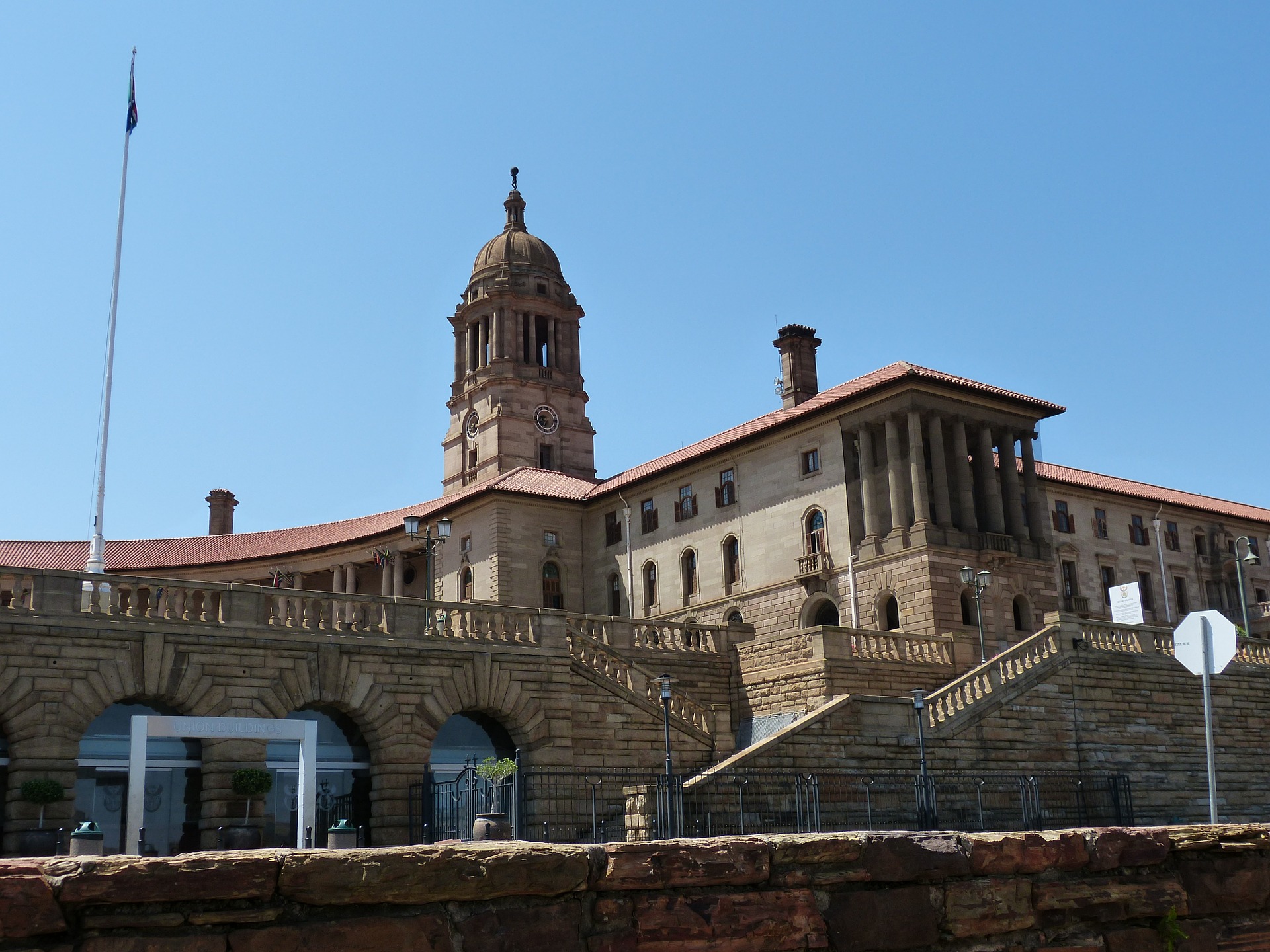
The most important building in South Africa and one of the most architecturally distinguished government complexes in the world — the Union Buildings, designed by Herbert Baker and completed in 1913 on Meintjieskop Hill overlooking the city, serve as the official seat of the South African government and the office of the President of South Africa. Built from warm Transvaal sandstone in a synthesis of classical and Cape Dutch influences, the semicircular complex with its twin towers, colonnaded wings, and magnificent terraced Italian gardens represents the finest example of Baker's South African work and one of the great government buildings of the 20th century. The amphitheatre gardens are open to the public and provide the finest panoramic view of Pretoria — including the extraordinary October–November jacaranda canopy stretching across the city below. The Nelson Mandela bronze statue (9 metres tall, unveiled 2013) in the upper garden marks the site of his 1994 presidential inauguration.
South Africa's Seat of Power🕊️ Freedom Park
South Africa's most important post-apartheid memorial and one of the most emotionally powerful heritage sites in Africa — Freedom Park, perched on Salvokop Hill opposite the Voortrekker Monument with deliberate symbolic intent, is a memorial to all those who died in conflicts that shaped South Africa: the San wars, the Khoikhoi resistance, the Great Trek, the Anglo-Boer Wars, World War I and II, and the liberation struggle against apartheid. The memorial's central elements — the Wall of Names (!hapo) listing the names of those who fell in each conflict, the eternal flame, and the Isivivane (a symbolic resting place of the nation's heroes) — are conceived in a landscape design of contemplative beauty by the architects Mashabane Rose and MMA Architects. The juxtaposition of Freedom Park and the Voortrekker Monument — facing each other across the valley, representing opposing histories that have been brought into dialogue — is one of the most profound statements of post-apartheid reconciliation available anywhere in South Africa.
Post-Apartheid Memorial🗿 Voortrekker Monument
One of the most significant and most contested heritage sites in South Africa — the Voortrekker Monument, a massive granite structure completed in 1949 on a hill south of the city centre, was built to commemorate the Afrikaner Voortrekkers who made the Great Trek from the British Cape Colony into the interior between 1835 and 1854. The monument's interior contains the Cenotaph Hall — where a shaft of sunlight falls precisely on the inscription "Ons vir jou, Suid-Afrika" (We for thee, South Africa) on 16 December at noon each year — and a 27-metre-long marble frieze depicting the history of the Great Trek in extraordinary detail. The surrounding Heritage Site includes the Museum of the Great Trek and the Nienaber Cultural History Museum. A UNESCO tentative list site and a National Heritage Site of South Africa; essential for understanding Afrikaner culture and South African history.
National Heritage Site🏛️ Pretoria Art Museum & Church Square
Two of the finest cultural spaces in South Africa within walking distance of each other — the Pretoria Art Museum (Pretoria Kunste Museum) in Arcadia Park houses the most important collection of South African art outside Johannesburg, with particular strength in the Pierneef landscapes (J.H. Pierneef's sweeping depictions of the Transvaal bushveld are among the most beloved images in South African art) and a comprehensive collection of Dutch Old Masters. Church Square (Kerkplein) — the historic heart of Pretoria where Paul Kruger's statue stands at the centre of a square enclosed by magnificent late Victorian and Edwardian buildings including the Palace of Justice, the Old Raadsaal (Parliament of the Transvaal Republic), and the Nedbank Building — is the finest ensemble of late-19th-century South African civic architecture in existence and the most historically resonant public space in Pretoria.
Art & Historic Heart🦁 Rietvlei Nature Reserve
The finest wildlife experience accessible from any African capital city — Rietvlei Nature Reserve, a 3,800-hectare protected area of highveld grassland, wetlands, and bushveld within the Tshwane metropolitan boundary, harbours an extraordinary diversity of wildlife: white rhino, buffalo, zebra, wildebeest, red hartebeest, eland, impala, cheetah, brown hyena, and over 265 bird species — all within 20 minutes of the city centre. The reserve is open daily for self-drive game viewing (no guide required) in personal vehicles, making it one of the most accessible and affordable wildlife encounters in South Africa. The Rietvlei Dam at the reserve's heart attracts enormous concentrations of waterbirds — flamingo, pelican, heron, and duck — and is one of the finest birdwatching venues in Gauteng. A morning drive in Rietvlei, followed by breakfast at the reserve's restaurant, is the finest and most distinctive start to a day in the South African capital.
Wildlife in the City🌿 Pretoria National Botanical Garden
South Africa's most important botanical garden and one of the finest in the Southern Hemisphere — the Pretoria National Botanical Garden (South African National Biodiversity Institute), covering 76 hectares of the eastern suburbs, presents the most comprehensive collection of Southern African flora available anywhere: the Highveld Grassland section with its extraordinary diversity of bulbs and seasonal wildflowers, the Bushveld Section recreating the savannah of the Lowveld, the Cycad Amphitheatre housing the finest collection of cycads (living fossils of the dinosaur era) in the world, and the magnificent Succulent Garden. The garden's network of walking trails, picnic lawns, and the celebrated Summer Sunset Concert series (December–January, with South Africa's finest musical performers on the open-air lawn stage) make it one of the most beloved and best-used public green spaces in the South African capital.
Botanical Wonder🏺 Mapungubwe & African Collections
South Africa's most important repository of African cultural heritage and one of the most significant museum collections in the continent — the Ditsong National Museum of Natural History (formerly the Transvaal Museum) in Paul Kruger Street houses the world-renowned Mrs. Ples Australopithecus africanus skull (one of the most complete early hominid specimens ever discovered), the extraordinary Austin Roberts Bird Hall (the finest Southern African bird collection in existence), and the comprehensive natural history of Southern Africa from the Precambrian to the present. The adjacent Ditsong National Museum of Cultural History holds the finest collection of African material culture in South Africa, including the celebrated Mapungubwe gold artefacts — the golden rhinoceros, the golden bowl, and the golden sceptre from the 13th-century Mapungubwe civilisation — among the most significant archaeological objects in sub-Saharan Africa.
Africa's Heritage🎨 Hatfield & Brooklyn — University & Lifestyle Districts
Pretoria's most vibrant and youthful urban districts and the best places to experience the contemporary social and cultural life of the city — Hatfield, the student district surrounding the University of Pretoria (one of the largest universities in South Africa with 50,000 students), is dense with independent restaurants, craft beer bars, live music venues, and the weekend Hatfield Square outdoor market that is one of the finest and most energetic public spaces in Gauteng. Brooklyn, the upmarket residential and commercial district south of Hatfield, contains Pretoria's finest restaurant strip, independent boutiques, the excellent Brooklyn Mall, and the gallery and design scene that reflects the city's creative class. The Hazel and Dely Road corridors between Hatfield and Brooklyn constitute the finest concentration of quality independent dining and drinking in the South African capital.
Food & Culture HubLocal Food Recommendations
Pretoria's food scene reflects its identity as South Africa's administrative capital — a city where traditional South African cooking of great diversity and depth coexists with a sophisticated restaurant scene serving the diplomatic and government community, a vibrant braai (barbecue) culture that is the foundation of South African social life, and a rapidly growing craft food and beverage scene of genuine ambition.
🍽️ Must-Try Pretoria Dishes
- Braai (South African barbecue) — the most fundamental expression of South African culture and the social ritual that unites a nation of extraordinary diversity: the braai (from Afrikaans braaivleis — grilled meat) is not merely a cooking method but a way of life, a social institution, and a national identity marker of such significance that 24 September — Heritage Day — has been unofficially renamed National Braai Day. The essential braai repertoire includes: boerewors (farmer's sausage — a coiled, spiced beef and pork sausage of great distinction, its recipe protected by South African government standards), sosaties (marinated lamb and apricot skewers — a Cape Malay contribution of extraordinary flavour), braaibroodjies (grilled cheese, tomato, and onion sandwiches on the coals), and mieliepap (maize porridge, either stiff or soft, served alongside). Finding a braai in Pretoria is as simple as smelling the air on a weekend afternoon in any residential neighbourhood.
- Boerewors roll — South Africa's most beloved street food and the quintessential outdoor event food: a coiled boerewors sausage grilled over charcoal and served in a fresh white bread roll with tomato-onion chakalaka relish, mustard, and tomato sauce. The boerewors roll is found at every sporting event, outdoor market, school fundraiser, and street corner grill in Pretoria, and eating one — the sausage still sizzling from the grid, the bread soft and fresh — is as characteristically South African an experience as watching the Springboks. The Pretoria Boerewors Roll, made from premium Highveld beef with the correct spice balance of coriander, clove, and nutmeg, is considered by many South Africans to be the finest in the country.
- Pap en vleis (Pap and meat) — the most widely eaten meal in South Africa and the staple of township cooking, township social life, and any outdoor gathering with roots in Zulu, Sotho, or Tswana culinary tradition: a generous serving of stiff maize porridge (pap) — either smooth (stywe pap) or crumbly (krummelpap) — alongside a rich, slow-simmered beef or lamb stew (vleis), tomato-onion chakalaka relish, and a salad. The combination is deeply satisfying, extraordinarily affordable, and one of the most genuinely South African food experiences available — particularly at the traditional township restaurants (shebeens converted to formal dining) of Mamelodi and Atteridgeville on the outskirts of Pretoria.
- Biltong and droëwors — South Africa's greatest culinary export and the snack food most closely associated with South African identity worldwide: biltong — air-dried, spiced beef or game meat (venison, ostrich, kudu) cured in vinegar, coriander, salt, and pepper and dried to a firm, intensely flavoured chew of extraordinary depth — and droëwors (dried boerewors, the sausage equivalent of biltong) are produced by specialist biltong shops throughout Pretoria and available at every supermarket, petrol station, and sporting venue in the city. The finest Pretoria biltong — from grass-fed Highveld cattle or free-range kudu — is among the best in South Africa and makes an outstanding and very portable souvenir.
- Potjiekos — South Africa's most social and most slowly cooked traditional dish: a layered stew of meat (lamb, chicken, or venison), root vegetables, and seasonal produce cooked over a small charcoal fire in a cast-iron three-legged pot (potjie) for 3–6 hours without stirring — the slow, gentle heat of the charcoal building a depth of flavour and a melting tenderness of meat that no faster cooking method can replicate. Potjiekos is the food of long, relaxed outdoor gatherings — camping trips, family reunions, and the Highveld winter weekends when South Africans congregate around fires with cold beer and unhurried conversation. Found at traditional restaurants in Pretoria and at the regular potjie competitions that are a fixture of the South African social calendar.
- Melktert and koeksisters — the great baked goods of the Cape Dutch and Afrikaner culinary tradition: melktert (milk tart — a custard tart of exceptional delicacy, with a thin pastry shell filled with a lightly set, cinnamon-dusted milk custard of silky texture that is among the finest desserts in South African cooking) and koeksisters (Cape Malay-style — a syrup-soaked, spiced, plaited pastry doughnut coated in desiccated coconut; or Afrikaner-style — a twisted, golden, honey-dripping fried dough plait) are available at every South African bakery, supermarket deli, and coffee shop in Pretoria. The finest versions come from the artisan Afrikaner bakeries of the eastern suburbs.
🍺 Drinks & Bar Culture
- South African craft beer — Pretoria is one of the most important cities in South Africa's exploding craft beer scene: the Pretoria Brew Collective and the breweries of the Hatfield and Brooklyn districts — particularly CBC (Cape Brewing Co.), Triggerfish Brewing, and the local Gauteng craft producers — produce ales, lagers, IPAs, and innovative South African styles using local ingredients including African grains and indigenous botanicals. The craft beer bars of Hatfield Square and the Brooklyn restaurant strip serve the finest selection of South African and international craft beer in the capital. The dominant mainstream beer culture is anchored by the SAB (South African Breweries) stable — Castle Lager, Hansa Pilsner, and Windhoek Lager — which provides the cold, well-made backdrop to South African social life at extraordinary value.
- South African wine in Pretoria — despite being far from the Cape wine regions, Pretoria has a sophisticated wine culture supported by excellent specialist wine bars and restaurants stocking the full range of South African viticulture: the great Cabernet Sauvignons of Stellenbosch, the elegant Pinot Noirs of Hemel-en-Aarde, the Chenin Blancs of Swartland, and the dessert wines of Constantia are all well represented in the better wine lists of the Brooklyn and Hatfield restaurant districts. South African wine is extraordinary value even in the finest Pretoria restaurants: a premium Stellenbosch Cabernet costs R150–300 (USD 8–16) per bottle in a restaurant — a fraction of comparable wines in Europe.
- Rooibos and South African coffee culture — Rooibos (red bush) tea — brewed from the needle-like leaves of the Aspalathus linearis plant endemic to the Cederberg mountains — is South Africa's most distinctive non-alcoholic beverage: naturally caffeine-free, rich in antioxidants, and with a warm, slightly sweet, faintly woody flavour entirely unlike any other tea on earth. Available at every South African café and restaurant; the finest versions are the full-leaf Cederberg estate rooibos available at specialist tea shops. Pretoria's specialty coffee scene — concentrated in the independent coffee bars of Hazel Street, Brooklyn, and the University of Pretoria precinct — produces excellent single-origin South African and East African coffees in a culture of genuine third-wave ambition.
- Amarula and South African spirits — Amarula (a cream liqueur made from the fruit of the marula tree — the same fruit famously eaten by elephants when overripe and fermented) is South Africa's most internationally recognised spirit and a product of genuine quality: rich, creamy, with a tropical fruit caramel character that makes it an outstanding dessert drink or mixed with coffee. Produced in the Limpopo bushveld north of Pretoria. The growing South African craft gin scene — using indigenous botanicals including buchu (a fynbos shrub with an extraordinarily complex aromatic profile), rooibos, and honeybush — has produced gins of world-class distinction available at the specialist liquor stores and cocktail bars of the Brooklyn district.
🍽️ Where to Eat — Local Tips
- Hazel Food Market (Brooklyn) — Pretoria's finest artisan food market and the best single introduction to the city's contemporary food culture: operating on selected weekends at the Hazel Street precinct in Brooklyn, with artisan cheese producers, craft biltong makers, sourdough bakers, specialty coffee roasters, and some of the finest independent food stalls in Gauteng. Budget R200–400 (USD 11–22) for a comprehensive market breakfast and lunch — outstanding quality and value in an excellent social atmosphere.
- Ribs & Bibs / Cattle Baron (Hatfield) — the most reliably excellent steakhouses in the Pretoria Hatfield district, serving premium South African beef — sourced from Highveld grass-fed cattle and dry-aged on the premises — in the generous, unfussy South African style that has made the country's beef culture one of the finest in the world. A 400-gram rump or fillet steak with béarnaise sauce, hand-cut chips, and a half-litre of Castle costs R180–280 (USD 10–15) — extraordinary value for beef of this quality.
- Cynthia's Restaurant (Mamelodi) — the finest traditional South African township dining experience accessible from central Pretoria: a family-run restaurant in the Mamelodi township east of the city, serving pap en vleis, umngqusho (samp and beans — Nelson Mandela's favourite dish), morogo (wild spinach stew), and braai meat in generous, home-cooked portions at prices of extraordinary value (R60–120 / USD 3–6.50 for a complete meal). A guided township visit to Mamelodi combined with lunch at Cynthia's is the most authentic and culturally rich food experience available from the South African capital.
- Col'Cacchio / Tashas (Brooklyn Mall) — for lighter, international-standard café dining in the most pleasant setting in central Pretoria: the restaurant strip of the Brooklyn Mall precinct offers excellent wood-fired pizza, fresh salads, and all-day brunch menus at mid-range South African prices (R120–220 / USD 6.50–12 for a main course). The Brooklyn outdoor café terraces are the finest people-watching venues in Pretoria on a weekday lunchtime.
- Irene Farm (Centurion) — the most charming and uniquely South African weekend food destination within easy reach of central Pretoria: the historic Smuts House farm in Irene (20 minutes south) operates a weekend farm market, dairy shop (selling the finest fresh milk, cream, butter, and artisan cheeses in Gauteng), and café serving home-baked goods, farm-fresh breakfasts, and picnic hampers in a setting of considerable pastoral beauty. The Irene Farm Market on weekend mornings is one of the most popular and beloved family destinations in Pretoria — authentic, affordable, and deeply South African in character.
🎨 Art, Culture & Creative Scene
- Pretoria's arts and cultural scene reflects its dual identity as a government capital and a university city — the State Theatre on Church Street, the largest performing arts complex in South Africa, stages opera, ballet, drama, and musical theatre of high quality throughout the year, with ticket prices that are among the most accessible of any comparable institution in Southern Africa. The University of Pretoria Aula Theatre and the ABSA Galerie provide further performance and exhibition venues of excellent quality.
- The Pretoria Art Museum (Arcadia Park) runs a programme of temporary exhibitions alongside its permanent collection that regularly features the most significant South African contemporary artists working in painting, sculpture, printmaking, and photography. The museum's annual Pretoria Art Fair is one of the most important commercial art events on the South African calendar, drawing collectors, gallerists, and artists from across the country. The independent gallery scene of the Hatfield and Brooklyn districts — particularly the Everard Read Gallery's Johannesburg shows accessible via Gautrain — represents the most dynamic contemporary South African art market.
- The Tshwane University of Technology design and architecture programme has produced a generation of South African designers, architects, and visual artists of international significance; the university's annual graduate exhibition is the finest showcase of emerging South African design talent available in the capital. The creative industries district emerging around the Maboneng-equivalent precinct of the Salvokop neighbourhood near Freedom Park represents the most interesting urban renewal story currently developing in Pretoria.
- South Africa's extraordinary musical diversity is well represented in Pretoria's live music scene: the SAMRO Endowment for the National Arts (headquartered in Pretoria) supports classical, jazz, and indigenous music programmes throughout the city; the Hatfield Square outdoor concert programme brings South African pop, jazz, and Afrikaans music to a young, mixed audience in the finest outdoor performance setting in the capital. The annual Arts Alive Festival (September) — one of South Africa's oldest performing arts festivals — brings international and South African performers to venues across Johannesburg and Tshwane in a programme of jazz, dance, theatre, and visual arts of genuine ambition.
Day Trip Itineraries from Pretoria
Pretoria's position in the heart of Gauteng — within easy reach of the bushveld game reserves of the North West Province, the historical battlefields of the Anglo-Boer War, the Cradle of Humankind, and the cosmopolitan attractions of Johannesburg — provides access to some of the finest day-trip destinations in Southern Africa:
🦏 Day Trip: Pilanesberg Game Reserve
Travel time: 2 hours northwest by car | Cost: Entry R200 (USD 11); self-drive or organised safari from R800
Pilanesberg Game Reserve — a 55,000-hectare malaria-free reserve in the crater of an ancient alkaline volcano, 2 hours northwest of Pretoria — is the finest accessible Big Five game reserve in Gauteng and the most popular wildlife destination for Pretoria residents: elephant, white and black rhino, lion, leopard, and buffalo, alongside cheetah, wild dog, hyena, and an extraordinary diversity of antelope and birdlife, all in a spectacular volcanic landscape of concentric ridges and hidden valleys. Pilanesberg is one of the largest malaria-free Big Five reserves in South Africa — making it particularly attractive for families with young children and visitors who prefer not to take malaria prophylaxis. Self-drive in a personal vehicle or organised day safari from Pretoria; combine with the adjacent Sun City resort if an overnight stay is desired.
Big Five Safari🦴 Day Trip: Cradle of Humankind
Travel time: 1 hour west by car | Cost: Maropeng entry R220 (USD 12); Sterkfontein Caves R200
The most significant palaeontological site in the world and a UNESCO World Heritage Site of extraordinary importance — the Cradle of Humankind, a 47,000-hectare area of dolomite caves and fossil sites in the Magaliesberg foothills west of Pretoria, has yielded more early hominid fossils than any other site on earth: Australopithecus africanus, Paranthropus robustus, Homo habilis, and the celebrated 2.3-million-year-old Little Foot (the most complete Australopithecus skeleton ever discovered) have all emerged from these caves. The Maropeng Visitor Centre provides a world-class interpretive experience of human evolution; the Sterkfontein Caves guided tour descends into the actual fossil-bearing chambers. Combine with lunch at one of the excellent Magaliesberg restaurants for an outstanding and intellectually extraordinary day trip.
UNESCO World Heritage🏙️ Day Trip: Johannesburg
Travel time: 50 minutes by Gautrain or 1 hour by car | Cost: Gautrain from R70 (USD 4)
Johannesburg — South Africa's commercial capital, Africa's wealthiest city, and one of the most dynamic and culturally complex urban environments on the continent — is the most extraordinary and most accessible day trip from Pretoria, connected by the Gautrain high-speed rail (50 minutes, R70, one of the finest urban rail connections in Africa). The essential Johannesburg itinerary from Pretoria covers: the Apartheid Museum (the finest museum in South Africa and one of the most important in the world); the Constitutional Hill complex (the former prison where both Nelson Mandela and Mahatma Gandhi were incarcerated, now housing the Constitutional Court); and the Maboneng Precinct (Johannesburg's most vibrant arts and design district). Allow a full day and return by Gautrain in the evening.
City of Gold🌄 Day Trip: Magaliesberg Mountains
Travel time: 1.5 hours northwest by car | Cost: Car hire recommended; activities from R200
The most beautiful natural landscape within easy reach of Pretoria and one of the finest weekend escapes available from any South African city — the Magaliesberg mountain range, an ancient quartzite ridge rising from the Highveld plateau between Pretoria and Rustenburg, offers dramatic gorge walks, raptor watching (the cliffs are home to one of the finest Cape vulture colonies in South Africa), hot-air ballooning over the valley at dawn, adventure activities including abseiling and zip-lining, and a concentration of excellent country restaurants and boutique lodges. The Magalies River valley — sheltered, green, and entirely unlike the surrounding Highveld — provides an escape from the city that feels far more distant than the 1.5-hour drive suggests. The Mount Amanzi and De Hoek Country House lodges offer excellent overnight options.
Mountain EscapeTourist Tips for Pretoria
🚌 Getting Around
- Pretoria is a car-oriented city — private vehicle transport or app-based rideshare is the most practical and safest way to navigate between the city's dispersed attractions, hotels, and restaurant districts. Uber operates reliably throughout Pretoria and is the strongly recommended option for all visitor transport: safe, metered, and English-language. A typical Uber journey within the city (city centre to Hatfield/Brooklyn) costs R60–120 (USD 3–6.50).
- Gautrain — South Africa's world-class high-speed rail network — connects Pretoria to Johannesburg (50 minutes, from R70) and to O.R. Tambo International Airport (from R200, 40 minutes from Pretoria Hatfield station, changing at Marlboro). The Gautrain is the safest, most comfortable, and most reliable public transport option for the Pretoria–Johannesburg corridor and for airport transfers from OR Tambo.
- Tshwane Bus Rapid Transit (A Re Yeng) operates on several main corridors including the Church Street and Pretorius Street routes through the city centre — affordable (R11–17 per journey) and safe for daytime use on the main corridors. Less practical for most visitor itineraries than Uber but useful for budget travellers on the main routes.
- Car hire is strongly recommended for day trips to Pilanesberg, the Magaliesberg, the Cradle of Humankind, and any self-drive game reserve visit. All major South African and international rental companies (Avis, Budget, Hertz, Europcar) operate from O.R. Tambo Airport and Pretoria city locations. South Africa drives on the left; road signs are in English; the N1 and N4 highways connecting Pretoria to game reserve regions are in good condition.
- O.R. Tambo International Airport (JNB) — Johannesburg's international airport, 40km from central Pretoria — is the primary gateway for international visitors to Pretoria, connected by Gautrain (40 minutes from Hatfield, change at Marlboro, from R200) or Uber (45–60 minutes, R350–500). Wonderboom Airport (PRY), 10km north of the city, handles domestic routes only. Most international visitors arrive via OR Tambo on South African Airways, British Airways, Emirates, Lufthansa, or Kenya Airways.
💡 General Safety & Travel Tips
- South Africa uses the South African Rand (ZAR). ATMs are widely available at all major shopping centres, bank branches, and the airport — use ATMs inside shopping centres (Menlyn Mall, Brooklyn Mall) rather than street-facing machines for greater security. Major credit cards are accepted at all hotels, restaurants, and shops in the tourist areas. Avoid carrying large amounts of cash; use cards and Uber where possible. Currency exchange is available at the airport, major hotels, and Rennies Travel bureaux.
- South Africa uses the distinctive Type M three-round-pin plug (230V/50Hz) — found almost nowhere else in the world. All international visitors require a South African plug adaptor, available at OR Tambo Airport, shopping centres, and hardware stores throughout Pretoria. Type C (European two-pin) adaptors are also widely available for European devices.
- The Tshwane Tourism office at the corner of Prinsloo and Vermeulen Streets, Church Square, provides city maps, event listings, and tourism information; the offices of South African Tourism and the embassies' consular sections can provide further visitor support. The major international hotel chains (Sheraton, Protea Hotels, City Lodge) maintain excellent concierge services for visitor orientation and security guidance.
- Pretoria is at 1,340 metres elevation — the thin Highveld air means that the sun is significantly stronger than at sea level, and UV exposure is higher than visitors from lower elevations might expect. High-factor sunscreen (SPF 50+) is essential year-round. The thin air also means that alcohol has a stronger effect than at sea level — pace accordingly.
- The jacaranda season (October–November) is the single most popular period for visiting Pretoria — book accommodation at least 2–3 months in advance if planning to visit during the peak blossom period (mid-October to mid-November). The Freedom Park and Union Buildings gardens under full jacaranda canopy are the finest photographic subjects in the South African capital during this period.
Apply for Tourist Visa
South Africa offers visa-free entry to citizens of many countries including the United States, United Kingdom, European Union member states, Canada, Australia, and most Commonwealth nations — for stays of up to 30 or 90 days depending on nationality. Citizens of countries not on the visa-free list must apply for a South African tourist visa through their nearest South African embassy or consulate before travel; South Africa does not currently offer a general visa-on-arrival programme. All visitors require a passport valid for at least 30 days beyond their intended departure date and with at least two blank pages. Verify your country's current entry requirements with the South African Department of Home Affairs website before travel. South Africa Visa Information
Important Emergency Numbers
🇿🇦 Pretoria Emergency Contacts
- 🚑 Ambulance: 10111
- 🔥 Fire Brigade: 10177
- 👮 Police: 10177
- 🆘 General Emergency (mobile): 112
International Emergency Phone Numbers
Find Flights to Pretoria
Airport Codes: PRY — Wonderboom Airport (domestic only, 10km north) | JNB — O.R. Tambo International Airport (40km south — all international flights)
Airport Transfer: From O.R. Tambo International (JNB): Gautrain to Pretoria Hatfield station (40 minutes, from R200, changing at Marlboro) — the safest and most reliable option; Uber approximately R350–500, 45–60 minutes depending on traffic. International airlines serving Johannesburg include South African Airways, British Airways, Emirates, Ethiopian Airlines, Kenya Airways, Lufthansa, Air France, Qatar Airways, and Turkish Airlines, with direct connections to Europe, the Middle East, Asia, and North America. Domestic connections to Cape Town, Durban, and other South African cities via South African Airways, Kulula, and FlySafair from both OR Tambo and Wonderboom.
International Airport FinderCurrency in Pretoria
The currency of South Africa is the South African Rand (ZAR). ATMs are widely available at all major shopping centres and bank branches throughout Pretoria — use ATMs inside shopping malls (Brooklyn Mall, Menlyn Mall) for greater security. Major credit cards (Visa, Mastercard, Amex) are accepted at all hotels, restaurants, and shops in the tourist areas. Contactless payment is widely available. Rennies Travel and Standard Bank offer competitive currency exchange rates at the airport and city centre branches.