Rabat Weather
RABAT WEATHERAbout Rabat
Rabat is the elegant royal capital of Morocco — a city of extraordinary historical depth, architectural beauty, and Atlantic coastal charm that is often overlooked by visitors rushing to Marrakech or Fez, yet rewards those who linger with some of the finest and most accessible Moroccan experiences available anywhere in the kingdom. Rabat is one of Morocco's four imperial cities — alongside Fez, Marrakech, and Meknès — and its historic core, comprising the ancient medina, the magnificent Almohad-era Kasbah of the Udayas, the Hassan Tower, and the UNESCO World Heritage archaeological site of Chellah, contains some of the most beautiful medieval Islamic architecture in North Africa. Unlike the frenetic energy of Marrakech, Rabat has a relaxed, sophisticated, and distinctly Francophone character — wide tree-lined boulevards, elegant colonial-era buildings, a thriving café culture, and a well-preserved medina that can be explored without the relentless hustle that characterises some Moroccan tourist cities. On the Atlantic coast at the mouth of the Bou Regreg River, Rabat enjoys a mild, breezy Mediterranean-influenced climate — one of the finest in Morocco — and a setting of great natural beauty.
Best Time to Visit Rabat & Weather Guide
Rabat's Atlantic coastal location gives it one of the most pleasant and moderate climates in Morocco — cooler summers and milder winters than the inland imperial cities, making it comfortable to visit for much of the year.
🌸 Spring (March–May)
One of the two finest seasons — warm, sunny days (18–24°C), wildflowers on the Atlantic cliffs and in the Chellah gardens, and the city at its most pleasant and colourful. The medina is manageable, the light is beautiful for photography, and the Atlantic is beginning to warm. April and May are particularly lovely — spring blossom in the parks and gardens, comfortable temperatures for walking the medina lanes and historic sites, and a freshness and vitality in the city after the winter rains that makes Rabat feel particularly welcoming.
Best Time to Visit☀️ Summer (June–August)
Rabat's Atlantic position makes summer far more pleasant than inland Moroccan cities — Atlantic breezes keep temperatures at a comfortable 22–28°C (compared to 40°C+ in Marrakech at the same time). The beaches of Rabat-Salé and the nearby Plage de Temara are excellent. The city is busier with Moroccan domestic tourism. July and August see the occasional hot spell when the chergui (hot desert wind from the Sahara) blows — brief periods of intense heat that pass within a day or two. Overall, Rabat is one of the best Moroccan cities to visit in high summer.
Good Summer Option🍂 Autumn (September–November)
The second finest season — the summer crowds have gone, temperatures are warm and perfect for sightseeing (20–26°C in September–October), and the light turns golden and rich over the Atlantic and the medina rooftops. October is particularly excellent — warm, clear, uncrowded, and with the full cultural season (concerts, exhibitions, the Mawazine music festival in some years) in full swing. November brings the first Atlantic storms and autumn rains — still pleasant but with increasingly changeable weather.
Excellent🌧️ Winter (December–February)
Rabat's winters are mild by European standards but can be wet and grey — temperatures average 12–18°C with regular Atlantic rain and overcast skies. The medina and historic sites are at their quietest and most atmospheric. Winter is the green season — the surrounding countryside turns intensely green after the autumn rains, and the Chellah gardens are beautiful. Accommodation prices are at their lowest. A good season for visitors who prefer atmosphere, solitude, and low prices over guaranteed sunshine.
Low SeasonSpring/Autumn: Light to medium layers — warm days but cool Atlantic evenings require a medium-weight jacket or cardigan. Comfortable walking shoes for the medina's uneven lanes and the historic sites. A light scarf for mosque visits (women) and as a general layer for Atlantic breezes.
Summer: Lightweight clothing, a light layer for evenings. Sun protection (SPF 50+) and sunglasses are essential — the Atlantic light can be very intense. A light jacket for air-conditioned interiors.
Winter: A medium-weight coat or jacket (12–18°C with rain), waterproof footwear, and layers. Rain is frequent but typically not prolonged — a compact umbrella is useful throughout the city.
Year-round: Modest clothing (shoulders and knees covered) for medina, mosque, and Chellah visits — Morocco is a Muslim-majority country and conservative dress is respectful and appreciated in the old city. A small day bag for market purchases.
Top Attractions in Rabat
Rabat's compact historic core contains some of the finest Islamic architecture in North Africa — all within comfortable walking distance and without the overwhelming tourist pressure of Marrakech or Fez.
🏰 Kasbah of the Udayas — UNESCO Heritage
Rabat's most beautiful and atmospheric historic quarter — the Kasbah of the Udayas, a fortified Almohad citadel at the mouth of the Bou Regreg River, is one of the finest examples of medieval Islamic urban architecture in the Maghreb. The Kasbah's interior is a picturesque maze of blue-and-white painted lanes, flowering bougainvillea, traditional Andalusian houses, and a magnificent 12th-century mosque. The Andalusian Garden within the kasbah — a serene formal garden of geometric pools, orange trees, and roses — is one of the most peaceful spaces in Morocco. The platform walls offer unforgettable views over the Atlantic and the mouth of the Bou Regreg.
UNESCO Heritage🕌 Hassan Tower & Mausoleum of Mohammed V
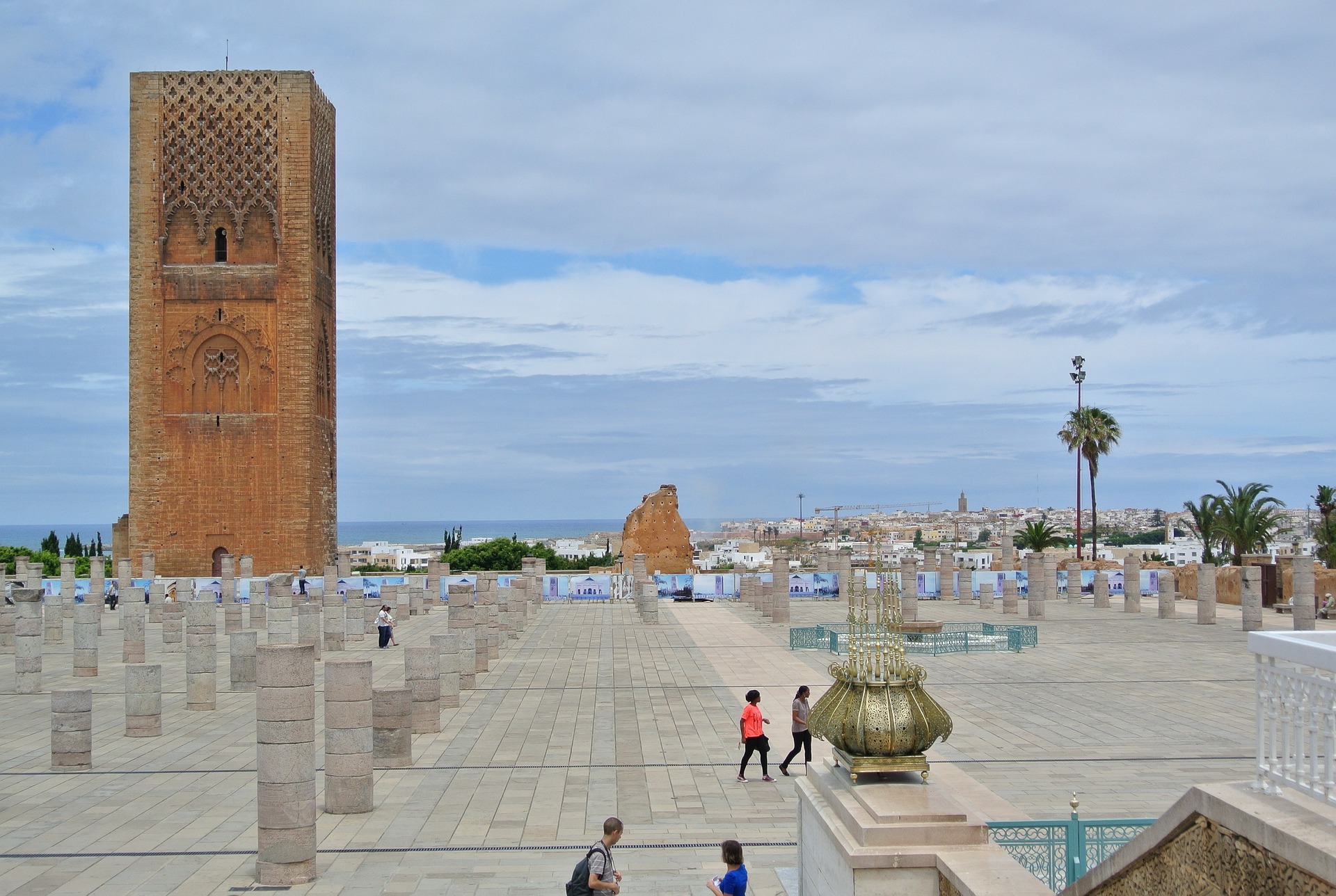
The most iconic landmark in Rabat — the Hassan Tower, a red sandstone minaret begun in 1195 and never completed, stands 44 metres high surrounded by the ruined columns of what would have been the largest mosque in the world. Adjacent is the magnificent Mausoleum of Mohammed V — the elaborate marble tomb of Morocco's independence king, his son Hassan II, and grandson Prince Abdallah, housed in one of the finest examples of modern Moroccan craftsmanship: carved cedar ceilings, mosaic zellige tilework, and carved plaster of extraordinary quality. The mausoleum is open to non-Muslim visitors — a rare privilege in Morocco — and is one of the most beautiful and moving spaces in the country.
Must See🏛️ Chellah Necropolis — UNESCO Heritage
One of the most hauntingly beautiful archaeological sites in North Africa — the Chellah, a walled funerary garden on the outskirts of Rabat's old city, contains the remains of a Roman city (Sala Colonia), a medieval Marinid royal necropolis, and a mosque whose ruined minaret is now colonised by nesting storks. Walking through Chellah — past Roman columns, Marinid tombs, and stork nests in a garden of wild flowers, banana palms, and ancient fig trees — is one of the most atmospherically extraordinary experiences in Morocco. Most beautiful in spring when the gardens are in flower and the storks are nesting.
UNESCO Heritage🛒 Rabat Medina & Rue des Consuls
Rabat's medina is one of the most pleasant and accessible in Morocco — smaller and less frenetic than Fez or Marrakech, with good craft shops, excellent food stalls, and a genuine local atmosphere. The Rue des Consuls — the historic street where foreign consulates were once located — is the finest shopping street in the medina: lined with carpet sellers, leather artisans, antique dealers, and traditional craft workshops selling the finest Rabati specialities including embroidered silks, zellige tilework, and the city's famous hand-woven Rabati carpets in characteristic geometric patterns. The medina is far less pressured than other Moroccan souks — a genuine pleasure to explore.
Shopping & Culture🏖️ Rabat Atlantic Beaches
Rabat's Atlantic coastline offers excellent beach options within easy reach of the city centre — the Plage de Rabat (Oudayas Beach) at the river mouth is the most central and atmospheric, while the Plage de Temara and Plage de Skhirat (30–40 minutes south by taxi) offer wider, less crowded stretches of Atlantic sand. The Atlantic surf along this coast is excellent for surfing — consistent swells make the beaches between Rabat and Casablanca among the finest surfing spots in Morocco. The ocean temperature is refreshingly cool compared to Mediterranean beaches — perfect for summer visits when the inland Moroccan heat is intense.
Beach🎨 Mohammed VI Museum of Modern Art
One of Africa's finest contemporary art museums — the Musée Mohammed VI d'Art Moderne et Contemporain, opened in 2014, houses an outstanding collection of Moroccan and international modern and contemporary art in a beautifully designed building in the heart of the new city. The museum's permanent collection traces the development of Moroccan visual art from the late 19th century to the present — from the École de Tétouan's orientalist paintings to the bold abstract works of the Casablanca School and contemporary installation art. Temporary exhibitions bring international artists to Rabat in a programme of remarkable ambition and quality.
World Class🌿 Jardins Exotiques de Bouknadel
One of Morocco's finest and most unusual gardens — the Jardins Exotiques, 12km north of Rabat near the town of Bouknadel, were created between 1951 and 1959 by the French horticulturist Marcel François from seeds and plants collected from tropical and subtropical regions worldwide. The gardens contain labyrinthine paths through dense plantings of tropical trees, bamboo groves, water gardens, Chinese pavilions, and Amazonian vegetation — an astonishing and surreal landscape utterly unlike anything else in Morocco. Beautiful and peaceful at any time of year, particularly spectacular in spring when the tropical flowering trees are at their most extravagant.
Hidden Gem🏛️ Archaeological Museum of Rabat
Morocco's most important archaeological museum — the Musée Archéologique de Rabat, though modest in scale, holds the finest collection of pre-Islamic Moroccan antiquities in the country: extraordinary Roman bronzes from the nearby UNESCO site of Volubilis (arguably the finest collection of Roman bronze sculpture in North Africa), prehistoric artefacts from Morocco's earliest human settlements, and Phoenician, Carthaginian, and early Islamic objects that trace the full depth of human presence in Morocco. The famous Dog of Volubilis and the Ephèbe bronze statue are particular highlights — world-class Roman sculpture in an easily overlooked museum.
UnderratedLocal Food Recommendations
Rabat's cuisine reflects Morocco's extraordinary culinary heritage — one of the world's great cooking traditions, combining Berber, Arab, Andalusian, and French influences in dishes of remarkable complexity, refinement, and flavour.
🍲 Must-Try Moroccan Dishes
- Pastilla (bastilla) — Morocco's most celebrated and extraordinary savoury pastry: layers of paper-thin warqa dough filled with slow-cooked pigeon or chicken, eggs, almonds, cinnamon, and saffron — dusted with icing sugar and cinnamon on top. The combination of sweet, savoury, crispy, and yielding in a single dish is one of the great achievements of world cuisine. Rabat and Fez are considered to produce the finest pastilla in Morocco.
- Tagine — the defining cooking vessel and technique of Moroccan cuisine: slow-cooked meat, poultry, or fish with vegetables and a complex spice mixture in a conical earthenware pot. The most beloved versions include chicken with preserved lemon and olives (a Rabati speciality), lamb with prunes and almonds, and kefta (spiced minced lamb) with eggs. The slow braising in the sealed cone creates dishes of extraordinary tenderness and depth.
- Couscous — Morocco's national dish and one of the great culinary gifts of North African civilisation to the world: hand-rolled semolina steamed to lightness above a broth of seven vegetables and lamb or chicken. Friday couscous is a Moroccan ritual — families gather for the shared communal meal after Friday prayers. The finest couscous is hand-rolled over days — a labour of love that produces a texture impossible to replicate with commercial couscous.
- Harira soup — Morocco's most comforting and nourishing soup: a rich tomato, lentil, chickpea, and lamb broth flavoured with cumin, coriander, ginger, and saffron, thickened with a flour paste — traditionally eaten to break the Ramadan fast and now available year-round. Served with chebbakia (honey-sesame pastries) or sfenj (Moroccan doughnuts), harira is one of the most satisfying single dishes in North African cuisine.
- Mechoui (whole-roasted lamb) — a lamb slow-roasted in a clay pit over charcoal until perfectly tender, traditionally prepared for celebrations and special occasions. In Rabat's medina, mechoui is available at specialist restaurants where whole sides of lamb are carved directly from the pit. Eaten with cumin, salt, and bread — nothing more needed.
- Rfissa — one of Rabat's most celebrated local specialities: a rich, aromatic chicken or pigeon stew cooked with fenugreek, smen (aged butter), saffron, and msemen (layered flatbread) — traditionally served to mothers after childbirth as a restorative dish but now eaten at celebrations throughout the year. Deep, complex, and uniquely Rabati.
🍵 Drinks & Street Food
- Moroccan mint tea (atay) — the defining social ritual of Morocco: strong green tea brewed with a generous handful of fresh mint leaves and an apparently impossible quantity of sugar, poured repeatedly between pot and glass from a great height to aerate and cool it. The ceremony is at least as important as the drink — no negotiation, no conversation, no hospitality is complete without three glasses of mint tea. Rabat's medina cafés serve it throughout the day in small glasses on ornate silver trays.
- Fresh orange juice — Morocco is one of the world's finest orange producers, and fresh-squeezed orange juice (jus d'orange pressé) sold at stalls throughout Rabat is among the finest and most refreshing in the world. A glass of cold Moroccan orange juice at the Djemaa el-Fna (or Rabat's equivalent medina square) is one of the definitive Moroccan pleasures.
- Msemen and harcha — Morocco's finest breakfast breads. Msemen (layered, griddle-fried flatbread folded into squares) and harcha (a crumbly semolina flatbread) are sold warm at bakeries and market stalls from dawn — eaten with butter and honey, or with amlou (an argan oil, almond, and honey spread unique to Morocco) for one of the world's finest breakfasts.
- Moroccan street snacks — the medina's food stalls offer merguez (spiced lamb sausage) sandwiches, kefta brochettes, potato chips with harissa, and the extraordinary maakouda (spiced potato fritters in bread) that is the definitive Moroccan street food. The food stalls near the Bab el-Had gate and at the central market are consistently reliable.
- Café culture — Rabat's café scene, particularly in the new city (Agdal and Hassan districts) and along the Bou Regreg waterfront, is excellent — a legacy of the French Protectorate era that created a genuine café culture of newspapers, mint tea, coffee, and patisseries that is now thoroughly Moroccan in character.
🍽️ Where to Eat — Local Tips
- Medina food stalls (Place du Grand Socco) — the most authentic and affordable eating in Rabat is found at the food stalls in and around the medina's central square. Harira soup (10–15 MAD), kefta brochettes, msemen with honey, and fresh orange juice — a full breakfast or lunch for under $3. Arrive hungry in the morning or evening when the stalls are at their most active.
- Restaurant Dinarjat (Medina) — one of Rabat's most celebrated traditional restaurants, housed in a beautifully restored 17th-century medina palace with carved plaster, painted cedar ceilings, and zellige tilework. The finest Moroccan cuisine in a setting of extraordinary authenticity — pastilla, rfissa, and classic tagines prepared to the highest standard.
- Borj Eddar (Kasbah des Oudayas area) — a well-regarded restaurant serving excellent traditional Moroccan food with views over the Bou Regreg and the sea. The setting alone — terrace overlooking the kasbah walls and the Atlantic — is worth the visit.
- Agdal neighbourhood cafés and restaurants — Rabat's upscale residential and commercial district contains the city's finest contemporary restaurants, international cuisine, and Francophone cafés and patisseries. The most pleasant area for a leisurely lunch or dinner away from the tourist medina circuit.
- Wistaria — a beloved Rabat institution serving excellent traditional and modern Moroccan cuisine in a garden setting. Particularly good for couscous Friday lunch (the definitive Moroccan weekly ritual) and pastilla.
🌿 Moroccan Spice & Argan Culture
- Moroccan cuisine's extraordinary complexity derives from one of the world's most sophisticated spice traditions — the ras el hanout spice blend (literally "head of the shop"), containing up to 35 individual spices including rose petals, cardamom, cubeb pepper, mace, and galangal alongside the more familiar cinnamon, cumin, and coriander, is the master flavouring of Moroccan cooking. Every spice merchant in the medina has their own secret recipe.
- Argan oil — produced exclusively in southwestern Morocco from the nuts of the argan tree, and now recognised as one of the world's finest culinary and cosmetic oils. Culinary argan oil (toasted) has a distinctive nutty, roasted flavour quite unlike olive oil — used in the extraordinary amlou spread and drizzled over couscous and salads. A bottle of pure culinary argan oil is one of the finest and most authentic Moroccan food souvenirs.
- Rabat's position as Morocco's administrative capital means it has attracted talented chefs from across the country — the city's restaurant scene combines the refined cooking traditions of Fez (considered Morocco's culinary capital) with Rabati specialities like rfissa and the fresh Atlantic seafood of the coast.
- The Bou Regreg waterfront development has created a new string of restaurants and cafés on both the Rabat and Salé banks — pleasant outdoor dining with river views in an increasingly sophisticated setting.
Day Trip Itineraries from Rabat
Rabat's central location on Morocco's Atlantic coast makes it an excellent base — major Imperial cities and Roman ruins are within easy striking distance:
🏛️ Day Trip: Volubilis Roman Ruins & Meknès
Travel time: 2 hours by road/train | Cost: ~$10–15 by train to Meknès; Volubilis entry ~$5
The finest day trip from Rabat — the magnificent Volubilis (UNESCO World Heritage Site), the best-preserved Roman city in Morocco, with extraordinary mosaics in situ, triumphal arches, and a spectacular hilltop setting in the Middle Atlas foothills. Combine with the baroque imperial city of Meknès — the monumental Bab Mansour gate, the medina, and the vast royal stables of Sultan Moulay Ismail. A full day combining the finest Roman archaeology in the Maghreb with one of Morocco's most dramatic imperial cities.
UNESCO Combo🕌 Day Trip: Fez — The Living Medieval City
Travel time: 3 hours by train | Cost: ~$15–20 by train return
Morocco's most extraordinary city — the UNESCO-listed medina of Fez el-Bali is the largest car-free urban area in the world and the most complete medieval Islamic city on Earth: 9,000 lanes, 300 mosques, the ancient Al-Qarawiyyin university, and the famous tanneries where leather has been processed in the same way for 1,000 years. A day trip from Rabat by train is very manageable — arrive early to maximise time in the medina before the afternoon heat. An overnight stay in a Fez riad is strongly recommended for a deeper experience.
UNESCO🌊 Day Trip: Casablanca & the Hassan II Mosque
Travel time: 1 hour by train | Cost: ~$5–8 by train; mosque tours ~$15
Morocco's economic capital and largest city — just 90 minutes by train from Rabat. The centrepiece is the awe-inspiring Hassan II Mosque (completed 1993), the world's third-largest mosque and the only one in Morocco open to non-Muslim visitors: 60,000 worshippers inside, a 210-metre minaret (the world's tallest), and an extraordinary setting with the mosque's prayer hall built directly over the Atlantic Ocean with a glass floor. The Corniche waterfront, the Art Deco city centre, and the Rick's Café (a recreation of the Casablanca film café) round out a satisfying day.
Easy Excursion🏖️ Day Trip: Asilah — Atlantic Art Town
Travel time: 2.5 hours by train | Cost: ~$10–15 by train return
One of Morocco's most beautiful and least-touristed coastal towns — Asilah, a Portuguese-walled Atlantic town 45km south of Tangier, is famous for its whitewashed medina walls covered in extraordinary murals painted during the annual International Cultural Moussem festival (held in August). The town's compact whitewashed medina, excellent Atlantic beaches, fresh seafood restaurants, and art galleries make it one of the finest day trips from Rabat for visitors who want to experience a quieter, more intimate side of Moroccan coastal life.
Hidden GemTourist Tips for Rabat
🚌 Getting Around
- Rabat's historic sites — the Kasbah, Hassan Tower, Chellah, and medina — are all within comfortable walking distance of each other in the old city. The new city (centre-ville, Agdal) is a pleasant 20–30 minute walk or a short taxi ride from the medina.
- Tram (tramway) — Rabat has a modern, efficient two-line tram network connecting the old city, the new city, and the outlying districts including Salé across the river. Clean, reliable, and very affordable (6–8 MAD per journey). The tram is the best way to reach Salé and the northern parts of the city.
- Taxis (petit taxi) — Rabat's small blue taxis are metered, affordable, and abundant throughout the city. Always insist on the meter being used. Supplement with the Careem or inDrive app for transparent pricing. For excursions out of the city, grand taxis (larger shared taxis) depart from specific stands for fixed fares.
- The Bou Regreg tramway bridge and the pedestrian footbridge connect Rabat and Salé — the twin city across the river — making a visit to Salé's medina and the historic Merinid architecture easy to combine with a Rabat day.
- Train (ONCF) — Rabat's Mohammed V train station is well-connected to Casablanca (1 hour), Fez (3 hours), and Tangier (3 hours). Morocco's train network is one of Africa's finest — comfortable, punctual, and excellent value for day trips and intercity travel.
💡 General Safety & Travel Tips
- Rabat is one of the safest capitals in Africa and a very safe city by any international standard. The main concerns are standard urban petty theft in crowded tourist areas and occasional overly persistent guides near the historic sites. A firm but polite "la shukran" (no thank you) is the most effective response.
- The Moroccan Dirham (MAD) is the local currency — not freely convertible outside Morocco. Euros and US dollars exchange well at banks and certified exchange bureaux (Bureau de Change) throughout the city. ATMs are abundant. Credit cards are accepted at hotels, larger restaurants, and tourist-facing shops. Cash is essential for medina markets, taxis, and street food.
- Morocco is a Muslim-majority country — respectful behaviour is appreciated and expected. Dress modestly when visiting the medina, mosques, and the Chellah. During Ramadan, eating and drinking in public during daylight hours is culturally inappropriate (though not illegal for non-Muslims). The holy month is actually a fascinating and unique time to experience Moroccan culture — but requires planning around the changed rhythms of daily life.
- Haggling is expected in medina markets — opening prices in tourist-facing shops are typically 3–5x the fair price. Start at 30–40% of the asking price and settle around 50–60%. Fixed-price shops (marked with prix fixé signs) are an alternative for visitors who find haggling stressful.
- Morocco's tap water is generally safe in Rabat (the city has good water treatment) but most visitors prefer bottled water. Fresh orange juice, mint tea, and avocado smoothies from the medina stalls are all safe and delicious alternatives.
- Photography of people in the medina and markets requires sensitivity and usually a small tip. Never photograph anyone without permission. Military installations, royal palaces, and security personnel must never be photographed.
Apply for Tourist Visa
Morocco offers visa-free entry for 90 days to citizens of over 65 countries including the EU, UK, USA, Canada, Australia, and Japan — no advance visa application required. Citizens of other nationalities should check requirements with their nearest Moroccan embassy. Morocco does not currently have a standard e-visa system for most nationalities — visa-free visitors simply present their passport at the border. Entry is straightforward and Morocco is one of Africa's most visitor-friendly destinations. Morocco Visa Information
Important Emergency Numbers
🇲🇦 Rabat Emergency Contacts
- 🚑 Ambulance: 190
- 🔥 Fire Brigade: 190
- 👮 Police: 190
International Emergency Phone Numbers
Find Flights to Rabat
Rabat Airport Code: RBA — Rabat-Salé Airport, located approximately 10km northeast of the city centre
Airport Transfer: Taxis from the airport to central Rabat take approximately 20–30 minutes (fare ~80–120 MAD — agree before departure). A shuttle bus also connects the airport to the city centre. Note that Mohammed V International Airport in Casablanca (CMN) — just 90 minutes by train — has significantly more international connections than Rabat-Salé and is often the most practical arrival airport for Rabat visitors, with direct trains from the airport terminal to Casablanca central station and onward to Rabat. Direct flights to RBA connect to Paris, Madrid, Brussels, Amsterdam, and several other European cities.
International Airport FinderCurrency in Rabat
The currency of Morocco is the Moroccan Dirham (MAD). The dirham is not freely convertible — it cannot be imported or exported in significant quantities. Exchange euros, dollars, or sterling at banks or certified Bureau de Change offices on arrival (not before). ATMs are abundant throughout Rabat. Credit cards are accepted at hotels, larger restaurants, and upmarket shops. Cash is essential for the medina, markets, taxis, and street food stalls.