

Country's codes
International phone code for Kuwait: +965
Standard EAN-13 (country barcode): 627
 Olympic country code: KUW
Travel Tips for Tourists
- Getting There: Kuwait is served by Kuwait International Airport, with direct flights from major cities in Europe, Asia, and the Middle East. Ride-hailing apps like Careem and taxis are widely available for local transport. Renting a car is convenient but relatively expensive, and public transport is limited.
- Best Time to Visit: The best time to visit Kuwait is between November and March, when temperatures are cooler and more comfortable for sightseeing. Summers (June to September) can be extremely hot, with temperatures exceeding 45°C (113°F), making outdoor activities difficult.
- Top Attractions:
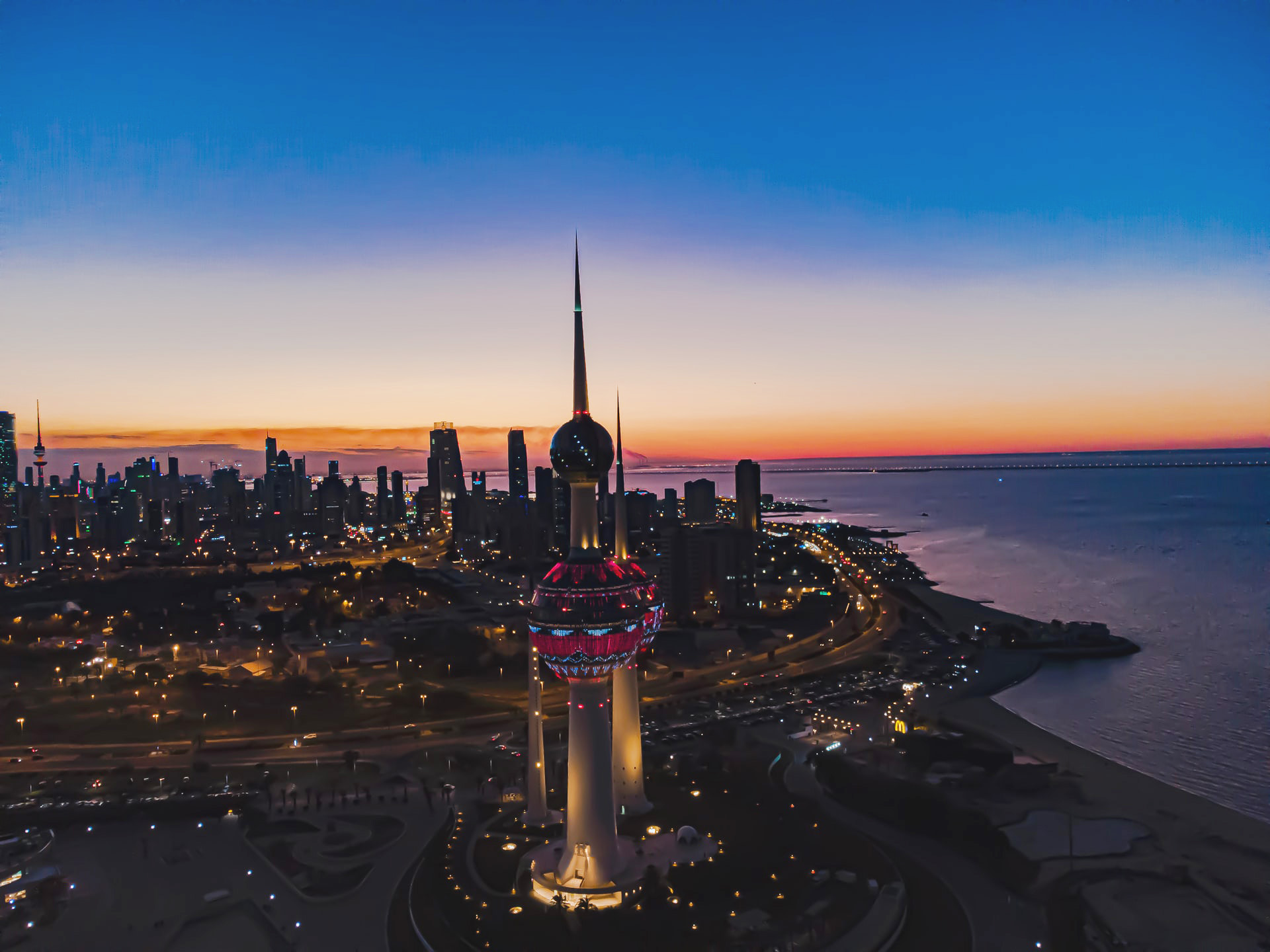
- Kuwait Towers: Iconic landmarks offering panoramic views of Kuwait City and the Arabian Gulf.
- The Grand Mosque: The largest mosque in Kuwait, known for its stunning Islamic architecture and free guided tours.
- Souk Al-Mubarakiya: A traditional market where visitors can explore local crafts, spices, and street food.
- Tareq Rajab Museum: A hidden gem showcasing Islamic art, calligraphy, and historical artifacts.
- Failaka Island: A historic island with archaeological sites and beach resorts, accessible by ferry.
- Healthy Travel Advice:
- Ensure routine vaccinations are up to date, including MMR, tetanus, and polio. Hepatitis A and B vaccines are recommended.
- Rabies vaccination is advised for long-term travelers or those likely to interact with animals.
- Drink bottled water, especially in rural areas, and practice good food hygiene to avoid traveler’s diarrhea.
- Protect yourself from the sun with SPF, hats, and hydration, especially in desert areas.
- Travel insurance is essential, covering medical care and emergency evacuation.
A Glimpse into Kuwait’s History
Kuwait’s history stretches back to ancient times, with early settlements on Failaka Island dating to the Mesopotamian era. In the 18th century, the Utub tribe founded Kuwait City, and the Al-Sabah family was chosen to lead the emerging sheikhdom. By the 19th century, Kuwait had become a thriving maritime hub, trading with India, Africa, and the Arabian Peninsula.
To protect its autonomy, Kuwait signed a treaty with Britain in 1899, becoming a British protectorate. The discovery of oil in the 1930s transformed Kuwait into one of the world’s wealthiest nations. Independence was declared on June 19, 1961, and the country adopted a constitution in 1962, establishing a parliamentary system. Kuwait’s modern history was marked by the 1990 Iraqi invasion, which led to the Gulf War and liberation in 1991. Since then, Kuwait has rebuilt and developed into a regional financial and humanitarian center.
Current Political Landscape
As of 2025, Kuwait is experiencing significant political upheaval. In May 2024, Emir Sheikh Mishal Al-Ahmad Al-Jaber Al-Sabah dissolved the elected parliament and suspended key articles of the constitution, citing political gridlock and the need for reform. This move has effectively halted Kuwait’s semi-democratic system, leaving the emir with full legislative control.
In addition, a controversial campaign has stripped over 42,000 people of their Kuwaiti citizenship, including naturalized citizens and foreign spouses. Critics argue this undermines civil rights and has led to a rise in stateless individuals. The emir’s actions have drawn international concern and domestic unrest, with many questioning the future of Kuwait’s parliamentary democracy.
Despite these challenges, Kuwait remains a stable country for travelers, with low crime rates and strong infrastructure. However, visitors should stay informed about local laws and political developments, especially regarding freedom of expression and dual nationality.
Useful country information
Total area: 6,880 sq mi (17,819 sq km)
Population (2012 est.): 4.329 million
Capital (2009 est.): Kuwait, 3,177,000
Kuwait: Capital City Profile
Monetary unit: Kuwaiti dinar (KD)
Languages: Arabic (official), English
Ethnicity/race: Kuwaiti 45%, other Arab 35%, South Asian 9%, Iranian 4%, other 7%
Religions: Islam 85% (Sunni 70%, Shiite 30%); Christian, Hindu, Parsi, and other 15%
National Holiday: National Day, February 25

Background
🇰🇼 State of Kuwait | Dawlat al KuwaytKuwait is a small but remarkably wealthy constitutional emirate nestled at the northwestern tip of the Arabian Gulf, bordering Iraq to the north and west and Saudi Arabia to the south, with maritime boundaries shared with Iran. Despite its compact size, Kuwait commands a fascinating history, a skyline of futuristic towers, and a hospitality tradition that makes it a rewarding destination for visitors exploring the Gulf region.
Several islands belong to Kuwait — the largest are Bubiyan, Warbah, and Failaka. Failaka Island is of particular interest to travellers, as it holds Greek-era ruins from the time of Alexander the Great and Bronze Age archaeological sites that predate most known Gulf settlements.
🏺 Ancient Roots & Ottoman Era
The region has been inhabited since antiquity, with Failaka Island serving as a trading and religious outpost for Dilmun civilisation and later for ancient Greek settlers. From the 16th century, the territory fell nominally under the Ottoman Empire, governed from Constantinople (today's Istanbul). By the late 17th century, the Bani Utub tribes — ancestors of today's Kuwaiti population — settled the area and established Kuwait Town as a thriving pearl-diving and maritime trading hub on the Gulf coast.
🇬🇧 British Protectorate & the Path to Independence
On 23 November 1899, Sheikh Mubarak Al-Sabah — known as "Mubarak the Great" — signed the Anglo-Kuwaiti Treaty with Great Britain, establishing Kuwait as an autonomous British protectorate. The agreement shielded Kuwait from Ottoman and later regional pressures while allowing the Al-Sabah dynasty to consolidate its leadership. This political stability laid the foundation for Kuwait's remarkable 20th-century transformation.
In the mid-1930s, Kuwait began developing its petroleum industry following the discovery of vast oil reserves — reserves that would make it one of the wealthiest nations on Earth per capita. On 19 June 1961, Kuwait gained full independence from Britain, becoming the first Gulf state to do so. It joined the United Nations in 1963 and rapidly invested its oil revenues into world-class infrastructure, free healthcare, free education, and one of the Arab world's most generous social welfare systems.
⚔️ Iraqi Invasion & Liberation (1990–1991)
Kuwait's sovereignty was violently threatened when Iraq invaded and occupied the country on 2 August 1990 under Saddam Hussein — an act condemned internationally as a flagrant violation of international law. The UN Security Council demanded immediate Iraqi withdrawal. An international coalition of 35 nations, led by the United States, launched Operation Desert Storm on 17 January 1991. A ground assault beginning on 23 February 1991 completely liberated Kuwait in just four days. The liberation marked a defining moment in modern Gulf history and strengthened Kuwait's ties with Western and Arab allies alike.
🌆 Modern Kuwait — Rebuilding & Prosperity
In the decades since liberation, Kuwait has rebuilt and modernised with extraordinary pace. Kuwait City today is a gleaming metropolis of glass towers, luxury malls, and waterfront corniche promenades. The Kuwait Towers — three elegant water towers on the Gulf coast — remain the most iconic symbol of the nation's post-liberation confidence and are a must-visit for any traveller. The Grand Mosque, one of the largest in the Gulf, and the Seif Palace along the seafront showcase the country's blend of Islamic architecture and modern ambition.
Kuwait is a constitutional emirate governed by the Al-Sabah dynasty, with an elected National Assembly — one of the Arab world's oldest and most active parliaments. The country consistently ranks among the top nations globally for quality of life, safety, and human development, making it a comfortable and welcoming destination for international visitors.



Source of Information:


